SEOUL — The landscape of digital currency in Asia is undergoing a structural transformation. As central banks and private institutions worldwide race to tokenize traditional fiat currencies, South Korea is making a calculated push to extend the Korean won (KRW) directly into blockchain infrastructure. At the vanguard of this movement is KRW1, a pioneering South Korean won-backed stablecoin designed to bridge legacy banking security with the borderless utility of decentralized finance (DeFi).
However, despite commanding institutional backing and cutting-edge integrations, KRW1 finds itself at a critical crossroads. While recent partnerships with payments titan Visa and high-performance blockchain network Avalanche have supercharged its infrastructural potential, the asset grapples with nascent adoption rates and thin liquidity pools.
This deep-dive analysis examines the mechanics of KRW1, its technological architecture, its strategic expansion into global payments, and the severe liquidity hurdles it must overcome to evolve from a regional experiment into a globally viable settlement rail.
1. Main Facts: The Architecture of KRW1
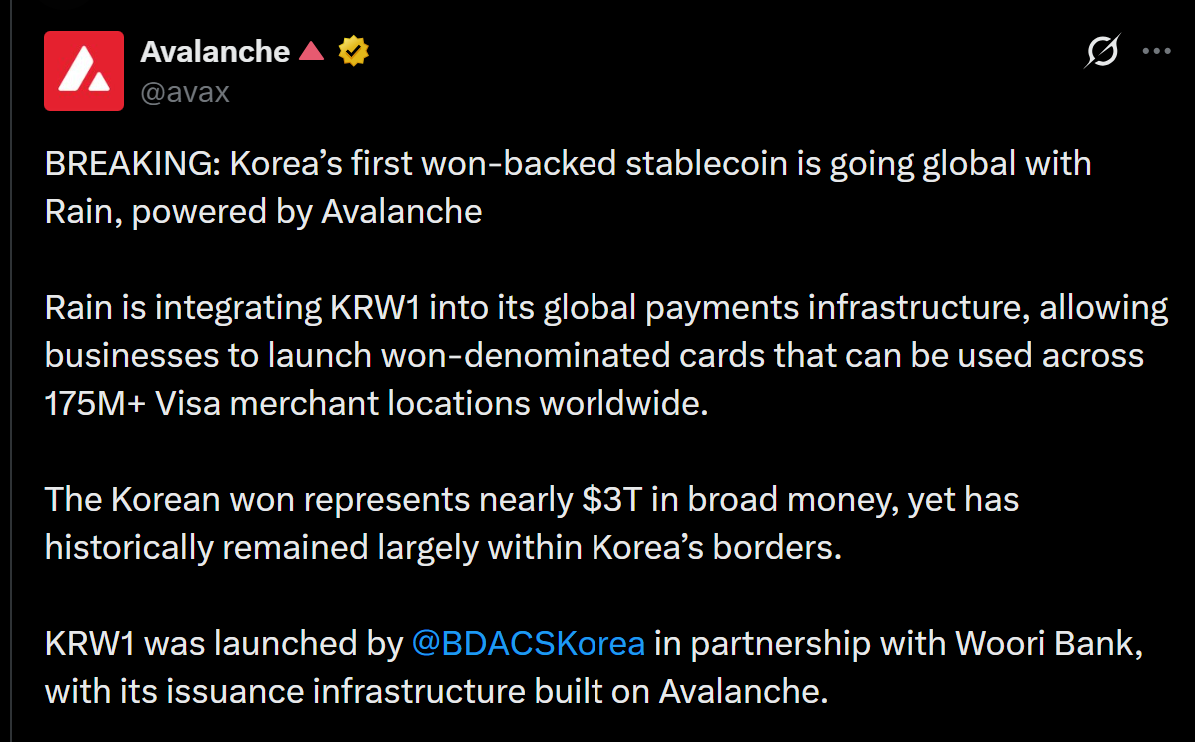
At its core, KRW1 is engineered to maintain a strict 1:1 peg with the South Korean won, utilizing a fully reserved, bankruptcy-remote model. Unlike algorithmic stablecoins that rely on complex crypto-economic incentives to maintain their value, KRW1 operates on a straightforward principle: for every single KRW1 token minted and brought into circulation, Woori Bank—one of South Korea’s premier financial institutions—holds an equivalent 1 KRW in cash reserves.
This traditional banking backing is compartmentalized through a multi-institutional partnership framework designed to separate regulated monetary custody from high-speed on-chain execution:
Woori Bank: Serves as the bedrock of trust, holding the fiat reserves to ensure absolute redeemability and regulatory compliance.
BDACS: Manages the operational intricacies of token issuance, burning, and institutional-grade digital asset custody.
Avalanche (AVAX): Acts as the high-throughput settlement layer, utilizing its custom subnet architecture to facilitate swift, low-cost token transfers outside of legacy banking hours.
By dividing responsibilities among a major commercial bank, a specialized digital asset custodian, and a scalable layer-one blockchain, the KRW1 model attempts to satisfy stringent regulatory compliance frameworks while unlocking the 24/7 programmable capabilities of Web3 rails.
2. Chronology: From Concept to Global Payment Rail
The development of KRW1 and its subsequent push toward global applicability marks a methodical progression in South Korea’s fintech and blockchain sectors.
Phase 1: Institutional Foundation and Architectural Design (Late 2023 – 2024)
Recognizing the growing global dominance of U.S. dollar-denominated stablecoins (such as USDT and USDC), South Korean stakeholders began laying the groundwork for a compliant, won-pegged digital asset. Collaborations between banking institutions like Woori Bank and Web3 infrastructure providers like BDACS were forged to design a risk-averse, reserve-backed token model that could satisfy South Korea’s notoriously strict financial watchdogs.
Phase 2: On-Chain Deployment via Avalanche (2025)
With the architectural framework finalized, KRW1 made its public debut on the Avalanche blockchain. This deployment provided the stablecoin with an efficient settlement environment capable of handling high transaction volumes with sub-second finality. During this initial rollout, focus remained heavily internal—testing issuance mechanisms, verifying reserve audits, and establishing baseline on-chain activity.
Phase 3: The Rain Integration and Visa Expansion (2026 – Present)
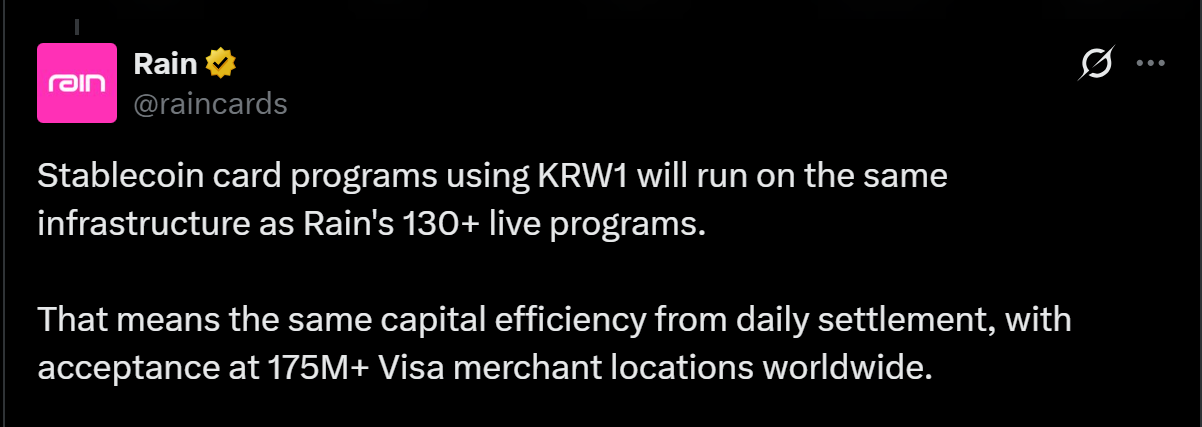
To solve the classic "chicken-and-egg" problem of stablecoin adoption—where users will not hold a token unless it is widely accepted, and merchants will not accept it without existing user demand—KRW1 developers turned to real-world spending rails. Through a strategic integration with Rain, which draws on over 130 pre-existing card-issuance programs, KRW1 gained access to the Visa merchant network. This move theoretically allows digital won holders to spend their balances across more than 175 million merchant locations in over 200 countries.
3. Supporting Data: Metrics, Adoption, and Liquidity Realities
Despite high-profile technological integrations and massive global reach courtesy of the Visa network, on-chain data paints a sobering picture of KRW1’s current market footprint.
According to Real-World Asset (RWA) tracking data, KRW1’s circulating supply sits at approximately 142 million tokens. Measured against global fiat exchange rates, this total circulating supply translates to a modest market capitalization of roughly $105,195 USD.
The Liquidity Disconnect
When benchmarked against multi-billion-dollar dollar-backed stablecoin behemoths, KRW1’s liquidity can be described as exceptionally thin. A market capitalization hovering around $105,000 creates a profound structural limitation:
Transaction Size Constraints: The lack of deep liquidity pools means that executing large corporate transfers, institutional settlements, or significant cross-border trade transactions via KRW1 is currently impossible without causing severe slippage or exhausting available liquidity.
Low Transaction Velocity: On-chain metrics reveal that daily transaction volumes and active wallet counts remain stubbornly low. Rather than indicating organic, broad-based consumer adoption, the data characterizes a network in its absolute infancy, dominated primarily by controlled issuance and testing phases rather than free-market utility.
Industry analysts note that a true inflection point for KRW1 will only occur when circulating supply, on-chain transfers, and active wallet addresses begin compounding upward simultaneously—signifying that users are holding and moving the asset out of genuine economic demand rather than speculative curiosity.
4. Official Responses and Industry Perspectives
The emergence of bank-backed local currency stablecoins has elicited cautious optimism from traditional financial regulators and fintech executives alike, alongside sharp warnings from macroeconomic analysts.
Speaking on the integration of institutional custody models into public blockchains, representatives from participating entities have emphasized risk mitigation. “The goal of KRW1 is not to bypass the regulatory apparatus, but to extend the trusted framework of South Korean banking directly into the next evolution of commerce,” noted a fintech strategist close to the project. By anchoring every token in segregated Woori Bank reserves, the initiative seeks to insulate itself from the catastrophic collapses that plagued unbacked or algorithmic stablecoins in prior market cycles.
Conversely, digital asset economists have been quick to point out the glaring chasm between infrastructure announcements and practical adoption. During a recent fintech panel discussion in Seoul, a senior blockchain researcher remarked:
"Getting integrated into Visa’s 175-million-merchant network is a masterclass in distribution engineering. However, distribution is meaningless if the asset backing it has the liquidity depth of a puddle. Until Korean won stablecoins achieve multi-million-dollar liquidity pools and deep secondary market integration across decentralized exchanges, they will remain fascinating prototypes rather than functional macroeconomic tools."
5. Implications: Can a Regional Token Go Global?
The trajectory of KRW1 carries profound implications not just for South Korea’s digital economy, but for non-USD stablecoins globally. For decades, the global digital asset ecosystem has suffered from extreme "dollarization," where nearly all on-chain commerce, liquidity pairs, and synthetic assets are denominated in USD.
If successful, KRW1 offers a blueprint for non-U.S. jurisdictions to project their sovereign currencies into the borderless digital economy.
The Path Forward: Overcoming Three Major Hurdles
For KRW1 to transition from a regional novelty with global ambitions into a heavily utilized global payment rail, it must successfully navigate three distinct hurdles:
Deepening Liquidity Pools: Market makers and institutional participants must be incentivized to commit substantial capital to KRW1 liquidity pools, enabling seamless multi-thousand-dollar transactions without market disruption.
Expanding Real-World Utility: While the Rain-Visa partnership provides the ability to spend KRW1 globally, users must find distinct economic advantages—such as lower cross-border remittance fees or preferential merchant discounts—over simply holding USD stablecoins or traditional credit cards.
Evolving Regulatory Clarity: As South Korea continues to refine its Virtual Asset User Protection Act and draft comprehensive secondary stablecoin legislation, the legal status of cross-border stablecoin spending via virtual cards must remain favorable and transparent.
Conclusion
KRW1 represents a sophisticated amalgamation of legacy banking trust and high-speed Web3 infrastructure. Through Woori Bank’s reserve backing, BDACS’s custody, Avalanche’s settlement speed, and Rain’s Visa integration, the token possesses all the mechanical components required for modern digital commerce. Yet, until its underlying liquidity expands by orders of magnitude and transactional velocity mirrors its infrastructural ambition, KRW1 remains a high-potential pilot project—waiting for the rest of the market to catch up to its global vision.