

BRUSSELS — The regulatory landscape for digital assets in Europe is undergoing a seismic shift. The European Securities and Markets Authority (ESMA), the bloc’s financial markets watchdog, has issued rigorous new guidelines establishing a definitive January 8, 2027, deadline for the complete wind-down of non-compliant, unauthorized stablecoins across member states.
The move marks the latest and most aggressive phase of the European Union’s landmark Markets in Crypto-Assets (MiCA) regulatory framework. By severely restricting the operational runway for unapproved asset-referenced tokens (ARTs) and e-money tokens (EMTs), EU regulators are signaling that the era of the unregulated wild west for stablecoins in Europe is officially over.
Main Facts: The Scope of ESMA’s Directive
According to formal guidance issued to national competent authorities across the EU, the regulatory tolerance for unauthorized digital currencies is evaporating. Under the new directive, any ongoing services related to non-MiCA-compliant stablecoins must be immediately curtailed.
ESMA stated that the continuation of services should be "strictly limited to sell-only, conversion, transfer, or withdrawal functionalities necessary to avoid client detriment." Furthermore, these residual allowances must be strictly time-limited, risk-based, and closely supervised by national regulators.
Key directives of the ruling include:
- The Final Wind-Down: All unauthorized stablecoin balances held by EU-based clients on licensed platforms must be completely wound down or converted by January 8, 2027—giving users a three-month window from the initial October 2026 enforcement push to clear out their holdings.
- Immediate Cease-and-Desist: New purchases, top-ups, swaps into unauthorized stablecoins, and associated marketing activities have been instantly frozen across all licensed Crypto-Asset Service Providers (CASPs).
- Allowed Actions: Users holding banned tokens are permitted to execute swaps strictly into MiCA-compliant alternatives, such as Circle’s USDC, or transfer and withdraw their funds to self-custody wallets outside the EU’s immediate regulatory perimeter.
The enforcement underscores the EU’s determination to scrub its financial ecosystem of systemic risks associated with opaque backing, insufficient reserves, or non-transparent governance models common among legacy offshore stablecoins.
Chronology: The Road to MiCA and the 2027 Cliff
To understand the gravity of ESMA’s latest timeline, one must trace the deliberate, step-by-step rollout of the EU’s regulatory framework for digital assets.

- June 30, 2024: The foundational rules of the MiCA regime officially came into effect for stablecoins. This initial milestone mandated that any stablecoin issued within or marketed to the European Union must secure formal authorization from a recognized EU regulatory authority, functioning effectively as an e-Money Token (EMT).
- December 30, 2024: Regulatory obligations expanded to encompass Crypto-Asset Service Providers (CASPs), requiring exchanges, custodian wallets, and brokerages operating in the EU to overhaul their compliance protocols, obtain proper licensing, and align their asset listings with MiCA specifications.
- July 1, 2026: Following a series of extended transitional windows granted to help legacy firms adapt, this date served as the hard enforcement cutoff. Unlicensed stablecoins—most notably Tether’s USDT—were effectively forced out, triggering widespread delistings across authorized European platforms.
- October 8, 2026: ESMA issued its clarifying operational guidelines to national regulators, closing loopholes regarding residual client balances and establishing the final three-month countdown.
- January 8, 2027: The absolute deadline. By this date, all exposure, remaining balances, and transitional services regarding unauthorized tokens within regulated EU entities must be fully liquidated or migrated.
Supporting Data: The Current State of the European Stablecoin Market
While the regulatory clampdown has effectively shut out major unverified players, it has concurrently opened the door for compliant alternatives, fundamentally altering the market share dynamics within the European Economic Area (EEA).
The Rise of Compliant Issuers
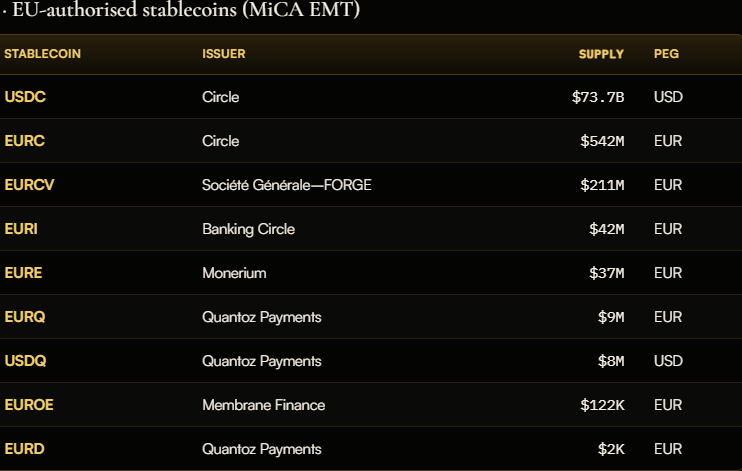
As of late 2026, the European Union has greenlit 25 e-Money Token (EMT) issuers. Prominent entities dominating this approved list include Circle and Société Générale–FORGE. Circle’s offerings—specifically the US dollar-pegged USDC and its Euro-pegged counterpart, EURC—have emerged as the undisputed heavyweights of the region’s regulated stablecoin market supply.
Euro vs. Dollar Supremacy
Despite regulatory hurdles keeping offshore giants like Tether (USDT) out of the compliant European zone, Euro-denominated stablecoins are experiencing a quiet renaissance.
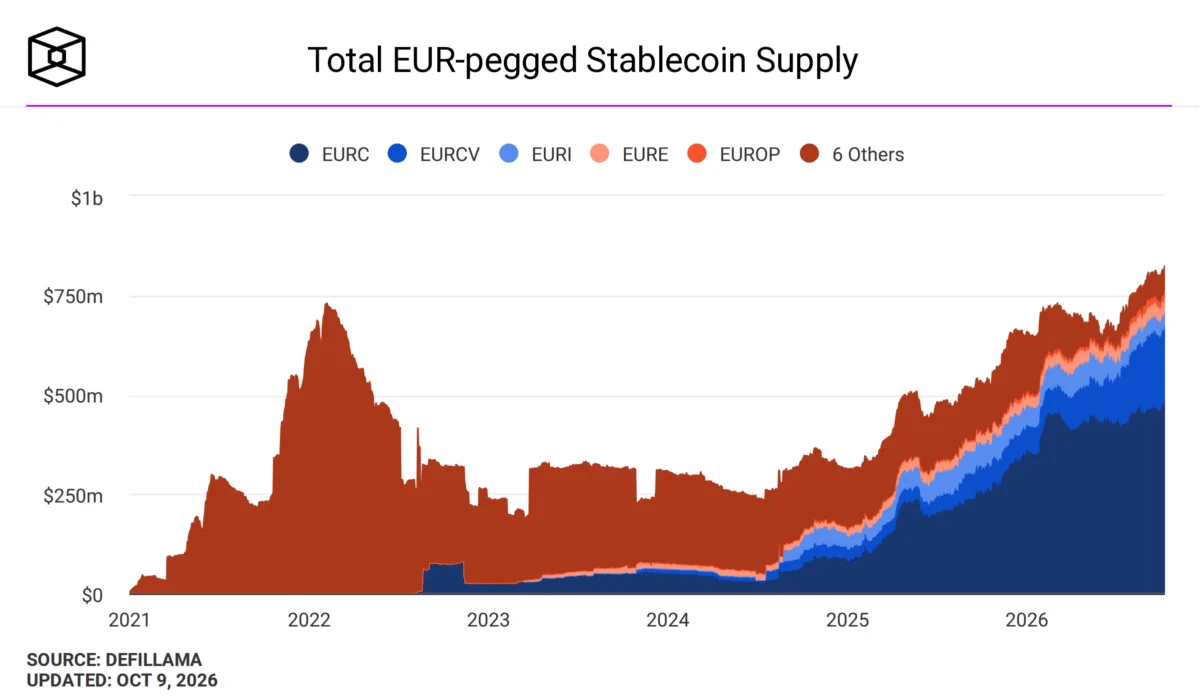
- Euro-Pegged Growth: The aggregate supply of Euro-based stablecoins stands at approximately $822 million. While modest on a global scale, this figure represents an impressive fourfold expansion compared to 2023 figures, highlighting a burgeoning demand for native-currency digital settlement rails.
- The Dollar Dominance: In stark contrast, USD-pegged stablecoin offerings globally boast a staggering market capitalization of roughly $315 billion. Even within Europe, USD-denominated stablecoins compliant with MiCA (such as USDC) continue to capture the lion’s share of professional trading volume.
Official Responses and Macroeconomic Implications
The ripple effects of Europe’s stablecoin regulations extend far beyond crypto-native circles, drawing the intense scrutiny of central bankers, monetary authorities, and sovereign debt managers.
The European Central Bank (ECB) and Sovereign Debt
The European Central Bank has been tracking the meteoric growth of euro-denominated stablecoins with intense interest. Economists and policymakers are increasingly analyzing how digital tokens interact with traditional finance, particularly regarding sovereign bond demand.
For U.S.-based stablecoin giants, vast reserve portfolios are traditionally parked in ultra-safe cash equivalents, predominantly short-term U.S. Treasury bills (T-bills). Globally, stablecoin issuers now collectively hold upwards of $200 billion in T-bills, acting as a crucial sponge absorbing weak sovereign debt demand from international buyers, including foreign central banks.
In Europe, the ECB recognizes a parallel opportunity. To bolster local capital markets and encourage greater institutional demand for European sovereign debt, the central bank has expressed a desire to revise restrictive bank deposit requirements for stablecoin issuers, rendering the European segment more competitive globally.
The Digital Euro Dilemma
However, Brussels faces a delicate, multi-layered balancing act. Alongside fostering a private-sector, MiCA-compliant stablecoin market, the European Union and the ECB remain deeply committed to launching their own central bank digital currency (CBDC)—the Digital Euro.
The aggressive push for a Digital Euro has occasionally created friction with private crypto firms seeking regulatory clarity. Critics and market participants have questioned whether the state-sponsored digital currency might receive preferential regulatory treatment or crowd out commercial innovation.
Financial analysts note that the success of Europe’s digital asset ecosystem will depend heavily on how the ECB manages this coexistence. If bureaucratic hurdles stifle private compliance—such as prolonged application processes for major market players—Europe risks lagging behind other jurisdictions in fintech innovation. Conversely, a clear, well-policed MiCA framework could establish Europe as the premier destination for institutional-grade digital finance.
Outlook: Navigating the Post-2027 Reality
As the January 2027 deadline approaches, institutional and retail crypto participants in Europe must finalize their operational adjustments. The message from ESMA and national regulators is unambiguous: compliance is non-negotiable, and transitional leniency has officially expired.
For investors, traders, and enterprises operating within the EU, the future is anchored to fully authorized, transparent instruments like USDC and regulated Euro tokens. Whether this hyper-regulated environment will foster healthy, secure financial innovation or drive trading volume to decentralized alternatives outside Europe’s borders remains the defining question for the region’s digital asset economy in the years ahead.
