


Ethena Labs, the architect behind the yield-bearing synthetic dollar USDe, has officially announced a significant expansion of its collateral backing. In a move designed to insulate the protocol from the inherent volatility and cyclical nature of the cryptocurrency markets, Ethena is set to integrate "Real-World Asset (RWA) perpetuals"—also known as equity perpetuals—into its reserve architecture.
This expansion marks a pivotal moment in the evolution of decentralized finance (DeFi). By moving beyond crypto-native assets, Ethena aims to tap into a multi-trillion-dollar traditional finance market, offering USDe holders a scalable, consistent yield that is decoupled from the boom-and-bust cycles of digital assets.
The Core Strategy: Moving Beyond Crypto-Native Volatility
At the heart of Ethena’s value proposition is the "basis trade"—a strategy that involves capturing the spread between an asset’s spot price and its corresponding futures or perpetual contract. While highly effective during bull markets, this strategy has historically been tethered to the health of the crypto ecosystem. When the market turns bearish, the spread narrows or flips, often leading to yield compression.
The integration of RWA perpetuals represents a calculated effort to institutionalize the protocol’s collateral base. By backing USDe with equity-based perps, Ethena is betting on the massive, liquid, and fundamentally different underlying dynamics of traditional financial markets.
Understanding the RWA Perp Explosion
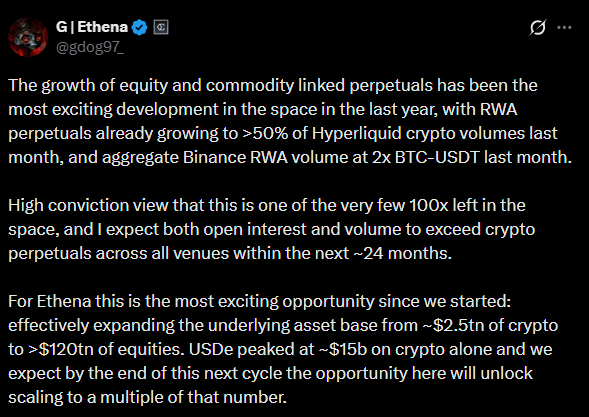
The market for RWA-tokenized perpetuals has seen an explosive growth trajectory, expanding 10x to reach $6 billion in Open Interest (OI) since March. Ethena’s leadership views this as only the beginning. With the underlying asset base of traditional equity markets exceeding $150 trillion—dwarfing the roughly $2.5 trillion crypto market—the scalability potential for RWA-backed yields is unprecedented.

Ethena projects that RWA perpetuals could scale 100x from their current state, eventually becoming the dominant component of the USDe backing, potentially eclipsing crypto-native allocations within the next 12 to 24 months.
A Chronological Perspective: From Launch to Diversification
To understand the necessity of this shift, one must examine the journey of USDe through the turbulent 2024–2025 market cycle.
The Rise and Contraction (2024–2025)
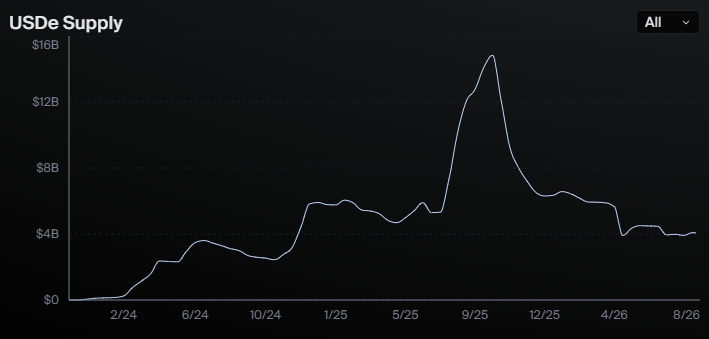
During the peak of the 2024–2025 bull run, USDe became a darling of the DeFi space. The protocol saw its market supply balloon to nearly $15 billion, with users enjoying yields exceeding 80% as the basis trade flourished in an environment of extreme market optimism. However, the subsequent "crypto winter" served as a sobering reminder of the strategy’s limitations. As market sentiment soured, USDe supply contracted to $4 billion, and yields dipped below 0%, highlighting the protocol’s vulnerability to market cyclicality.
The Pivot to Sustainability
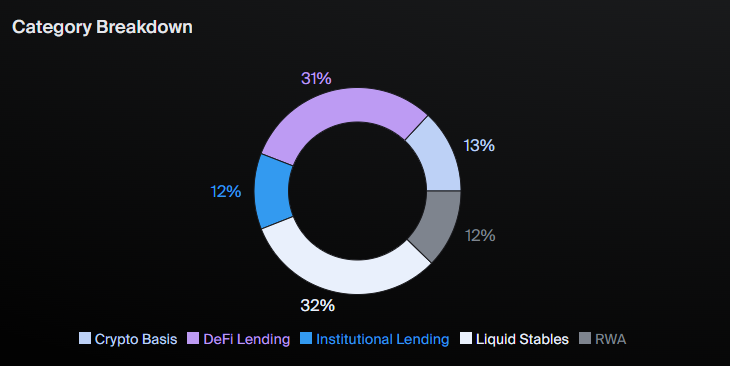
Recognizing these limitations, Ethena began a deliberate process of diversification. The first phase involved moving into traditional credit, notably through a partnership with financial giant Janus Henderson. This integration of AAA-rated collateralized loan obligation (CLO) funds now accounts for approximately 12% of USDe’s backing, providing a buffer of stability that pure crypto assets cannot offer.
The Upcoming Deployment
The transition to RWA perpetuals, scheduled to go live in the coming weeks, represents the second—and perhaps most ambitious—wave of this diversification strategy. Ethena has signaled that this is not a reactive measure, but a well-researched, long-term play.
Supporting Data and Market Dynamics
Currently, Ethena’s collateral architecture is a composite of diverse risk assets. Liquid stablecoins like USDT and USDC represent the largest share at 32%, reflecting a commitment to liquidity. DeFi lending, primarily across protocols like Aave and Morpho, accounts for another 31% of the reserves.
Comparative Yield Analysis
A key metric for any yield-bearing asset is its spread against the "risk-free" rate—typically represented by U.S. Treasury bills. Recently, USDe has maintained a 1.6% spread over short-term U.S. Treasuries. While this yield is attractive, Ethena is acutely aware that investors must weigh this against the inherent risks of DeFi smart contracts. The addition of RWA perps is intended to maintain or exceed these yield levels while diversifying the risk profile of the backing assets.
The Scalability Argument
The following table illustrates the potential transition of the reserve mix over the next two years:
| Asset Category | Current Share | Projected Share (24 Months) |
|---|---|---|
| Stablecoins | 32% | Moderate Decline |
| DeFi Lending | 31% | Stable |
| Crypto-Basis | 25% | Significant Decline |
| RWA Perpetuals | <5% | Dominant (>40%) |
Source: Internal data synthesis based on Ethena’s strategic growth projections.
Official Perspectives: The Rationale Behind the Move
Guy Young, the founder of Ethena, has been transparent about the cautious nature of the protocol’s development. Responding to inquiries regarding the timing of the RWA integration, Young emphasized that the delay was a strategic choice to ensure the safety and reliability of the protocol.
"We took a cautious approach to what was a nascent market," Young stated. "We waited until we saw deep, liquid markets with a data history we could study before moving into the opportunity at scale."
Young remains bullish on the potential of this sector, describing it as "one of the very few 100x opportunities left" in the current financial landscape. By treating the RWA sector with the same technical rigor applied to crypto-native perps, Ethena aims to set a new standard for how decentralized protocols leverage traditional financial instruments.
Implications: What This Means for the Future of USDe
The shift toward RWA-backed collateral has profound implications for both the protocol and the broader DeFi ecosystem.
1. Decoupling from Crypto Cyclicality
The most immediate benefit is the mitigation of "basis volatility." By moving away from a reliance solely on crypto-native perpetuals, Ethena is essentially building a "bridge" to the traditional financial system. This makes USDe more resilient to crypto market crashes, potentially stabilizing its supply even when the broader market is in decline.
2. Institutional Appeal
Traditional investors have historically been hesitant to engage with DeFi due to the extreme volatility of crypto-backed assets. By incorporating assets that are tethered to the $150 trillion traditional equity market, Ethena is making USDe a more viable candidate for institutional adoption. A stable, yield-bearing instrument that draws value from global equity markets is a much easier sell to treasury departments and traditional asset managers than one derived solely from crypto-native volatility.
3. The New Standard for DeFi Yields
If Ethena succeeds in this endeavor, it could spark a broader industry trend. We may see other protocols attempting to replicate this "Real-World Integration" model. However, the barrier to entry is high, requiring significant legal, technical, and custodial infrastructure—areas where Ethena has already invested heavily.
4. Risks and Challenges
Despite the optimism, the strategy is not without risks. Integrating RWA perpetuals introduces legal and regulatory complexities that are absent in a purely on-chain environment. Furthermore, the reliance on off-chain data feeds and the custody of traditional assets requires a level of trust that, while mitigated by current DeFi standards, remains a point of friction for purists.
Conclusion: A New Era for Ethena
As Ethena prepares for the next bull market, its aggressive strategy of diversification serves as a signal of its maturity. By moving from a singular focus on crypto-basis to a multi-asset, RWA-inclusive reserve, Ethena is positioning itself as more than just a synthetic dollar issuer; it is becoming a hybrid financial gateway.
Whether this move will trigger a new wave of demand for USDe remains the ultimate question. However, by aligning the growth of its collateral base with the massive, untapped potential of RWA perpetuals, Ethena is certainly betting that the future of DeFi is one that is increasingly intertwined with the bedrock of the traditional financial system. In the coming 12 to 24 months, the success of this transition will likely determine whether USDe becomes the definitive stable asset of the next generation of finance.
