


As the cryptocurrency market prepares to turn the page into the final quarter of the year, a familiar narrative is reasserting itself across the digital asset landscape. Amid persistent macroeconomic uncertainty, shifting regulatory landscapes, and lingering market hesitation, a singular metric continues to dictate the pace of digital asset accumulation: liquidity.
Following a tumultuous summer characterized by broad-based sell-offs and heavy capital outflows, the global stablecoin market is staging a robust recovery. This influx of fresh capital is not merely an isolated metric; it serves as the ultimate bellwether for institutional appetite, decentralized finance (DeFi) activity, and the overarching health of Layer-1 (L1) blockchain ecosystems.
With more than $4 billion flooding back into the stablecoin economy this month alone, analysts are closely examining how this liquidity pivot will interact with major macroeconomic headwinds, institutional adoption milestones, and a striking divergence in momentum between leading L1 networks like Ethereum and TRON.
1. Main Facts: The Stablecoin Rebound and Market Divergence
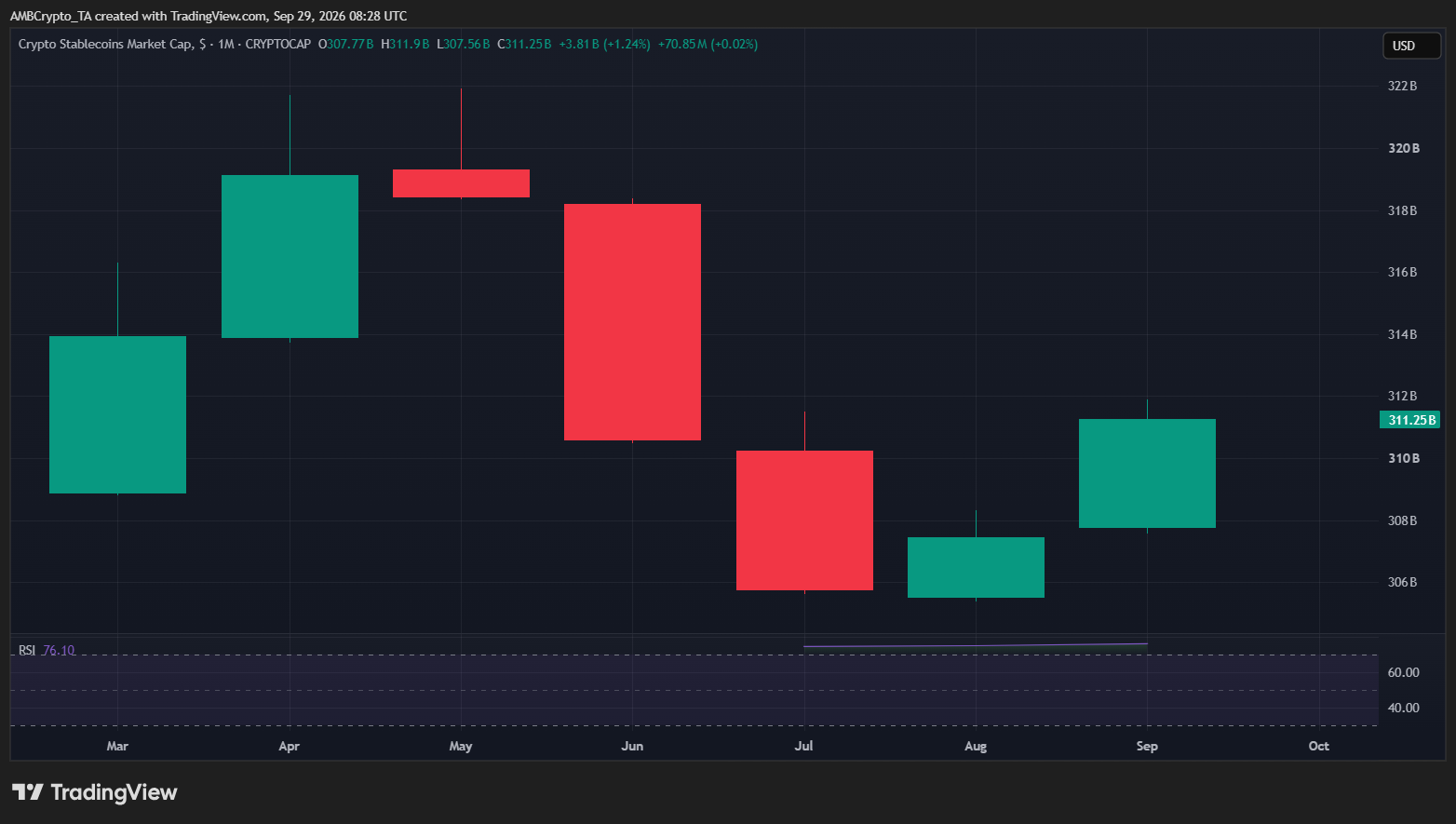
The broad cryptocurrency market recently endured a punishing correction, with the total digital asset market capitalization plunging by nearly 30% from its local peaks. This severe risk-off sentiment defined much of late Q2 and early Q3, during which nearly $15 billion was systematically wiped from the stablecoin market—marking the largest liquidity drain since the opening weeks of the year.
However, the tide has officially turned.
- The Monthly Expansion: The stablecoin market capitalization is currently up 1.24%, positioning itself for its strongest monthly expansion since the April cycle.
- The Capital Influx: More than $4 billion has re-entered the stablecoin ecosystem in recent weeks, completely reversing the outflow trend observed earlier in the summer.
- The Macro Backdrop: This liquidity rebound arrives precisely as macroeconomic fear, uncertainty, and doubt (FUD) begin to mount heading into Q4, providing a vital financial cushion for upcoming risk-on rallies.
- The L1 Divergence: While overall capital is returning, a stark divergence has emerged between top-tier blockchain networks regarding where this stablecoin supply is actually settling, reshaping the competitive landscape between Ethereum and TRON.
2. Chronology of the Liquidity Shift: From Summer Outflows to Q4 Inflows
To understand the weight of the current market structure, it is essential to trace the chronological trajectory of liquidity movements over the past two quarters:
Late Q1 to Early Q2: The Peak and Stagnation
At the start of the year, the stablecoin market enjoyed substantial growth, with Ethereum’s stablecoin supply peaking at approximately $182 billion in late 2025. This era of high liquidity supported aggressive risk-on behavior across decentralized exchanges and altcoin markets.

Late Q2 to Early Q3: The Great Liquidity Drain
As macroeconomic pressures mounted, interest rate anxieties grew, and broader financial markets experienced volatility, the crypto space saw a sharp risk-off rotation. Investors rushed to cash out digital assets into fiat currency or safe-haven assets. This resulted in the withdrawal of nearly $15 billion from the stablecoin market—the most aggressive liquidity outflow since early Q1. Concurrently, the total crypto market cap suffered a 30% drawdown as capital retreated to the sidelines.
Mid-September: The Turning Point
By mid-September, on-chain metrics began to signal a stabilization in capital outflows. Large holders and institutional funds started replenishing their stablecoin reserves. Within weeks, the market registered a net inflow exceeding $4 billion, arresting the downward spiral and setting the stage for a dramatic shift in market psychology.
Q4 Horizon: Positioning for the Next Risk-On Cycle
Entering the final quarter, the restored stablecoin supply is acting as a primary liquidity tailwind. Rather than being deployed immediately into volatile altcoins, this capital is currently resting in liquid stables, creating an immense pool of "dry powder" ready to be deployed at the first sign of a sustained macroeconomic or sector-specific catalyst.
3. Supporting Data: Inside the Numbers
On-chain analytics platforms provide a granular look at the mechanics driving the current stablecoin recovery and the shifting dominance among layer-1 blockchains.
Stablecoin Supply Dynamics: Ethereum vs. TRON
While Ethereum remains the undisputed king of decentralized finance and total value locked (TVL), its stablecoin supply has faced structural contraction over the past year.
- Ethereum’s Contraction: Stablecoin supply on the Ethereum blockchain has receded from its late-2025 peak of roughly $182 billion down to approximately $163 billion. This reflects a migration of capital toward scaling solutions, alternative Layer-1 networks, or simple cash-outs during the summer correction.
- TRON’s Expansion: Conversely, TRON [TRX] has defied broader market trends. Over the exact same timeframe, stablecoin supply on TRON has surged from approximately $78 billion to a robust $92 billion.
TRON’s Volume and Circulating Metrics
TRON continues to cement its status as a primary conduit for global stablecoin settlements, particularly in emerging markets where USDT acts as a digital dollar alternative.
- Lifetime Transfer Volume: TRON has processed an astronomical $30 trillion in lifetime transfer volume.
- Monthly Velocity: The network regularly logs roughly $25 billion in stablecoin transfers per month.
- Year-to-Date (YTD) Volume: TRON has already processed a total of $6 trillion YTD.
- Circulating Supply: More than $94 billion in USDT currently remains in active circulation on the TRON network, underscoring its immense utility for low-cost, high-speed value transfer.
4. Official Responses and Institutional Catalysts
The revival of stablecoin liquidity is not merely a retail phenomenon; it is deeply intertwined with a broader institutional convergence between Decentralized Finance (DeFi) and Traditional Finance (TradFi). Major financial institutions are no longer watching from the sidelines—they are actively embedding stablecoin rails into their core operational infrastructure.
Industry developments over the past month highlight this accelerating integration:
- Citi and Coinbase Partnership: In a landmark move for institutional banking, Citi partnered with Coinbase to open stablecoin-based payment capabilities to an estimated 150 million holders. This integration bridges traditional corporate banking accounts with crypto-native settlement rails, streamlining cross-border transactions and liquidity management.
- Circle and Volante Collaboration: Circle (issuer of USDC) joined forces with Volante Technologies to embed USDC directly into existing enterprise payment rails. This partnership allows traditional businesses to utilize dollar-backed stablecoins without overhauling their legacy accounting and payment software.
Market analysts view these convergence trends as the ultimate adoption barometer for the Q4 cycle. By lowering the friction between traditional bank accounts and blockchain networks, these integrations ensure that institutional capital can enter and exit the digital asset ecosystem with unprecedented speed and regulatory compliance.
5. Implications for the Q4 Cycle and Layer-1 Ecosystems
As the market navigates the final months of the year, the interplay between rising stablecoin liquidity, TradFi integration, and L1 competition carries profound implications for investors and developers alike.
The Return of Risk-On Momentum
With over $4 billion added to the stablecoin supply this month, the market possesses the foundational fuel required for a risk-on rally. Historically, expansions in stablecoin market capitalization precede upward momentum in major crypto assets like Bitcoin and Ethereum. As this dry powder is gradually deployed into spot markets, it can absorb selling pressure and provide the necessary bid to counteract lingering macroeconomic FUD.
The L1 Liquidity Battleground
The divergence between Ethereum and TRON highlights a maturing market where different blockchains serve distinct macroeconomic functions.
- Ethereum continues to dominate institutional tokenization, complex smart contract execution, and high-value DeFi protocols. Its contracting stablecoin supply reflects a period of consolidation and migration to Layer-2 rollups.
- TRON has successfully positioned itself as the high-velocity highway for global payments, remittances, and retail stablecoin usage. Its surging supply ($92 billion and climbing) points to sustained organic demand and strong on-chain fundamentals for its native asset, TRX.
Final Outlook
Ultimately, liquidity remains the lifeblood of the cryptocurrency economy. The swift rebound in stablecoin supplies—bolstered by major banking partnerships and expanding payment rails—suggests that the market is structurally healthier than its mid-summer drawdown implied. Whether this liquidity translates into a full-scale Q4 bull run will depend on macroeconomic data releases and regulatory clarity, but the foundational capital is undeniably back in the system, waiting for its next move.
