

The cryptocurrency landscape is currently navigating a period of profound uncertainty. As the broader market grapples with waning conviction, the catastrophic collapse of the Humanity Protocol [H] token on June 8th—which saw a valuation drawdown exceeding 85%—has acted as a flashpoint, exacerbating existing structural weaknesses. This event did not occur in a vacuum; it hit a market already reeling from macro-economic pressures and struggling to maintain key support levels. As investors look for signs of a recovery, the divergence between Bitcoin’s performance and the altcoin sector suggests that the expected "DeFi-led momentum" for the second quarter of 2026 remains elusive.
Main Facts: The Collapse of Humanity Protocol
On June 8, 2026, the Humanity Protocol [H] token experienced a precipitous decline, plummeting by over 85% in a matter of hours. The move wiped out the gains accumulated during its aggressive rally in late May, where the asset had climbed by over 150%.
This volatility is not merely a localized event for H holders; it serves as a bellwether for the "risk-off" sentiment permeating the broader altcoin market. Market analysts observe that the collapse has triggered a psychological ripple effect. In an environment where large-cap assets are already testing multi-month lows, the sudden evaporation of liquidity in a high-beta asset like H has forced traders to reconsider their exposure to smaller, more speculative projects.
Chronology of the Downturn
The current market cycle has been defined by a series of failed rallies and persistent selling pressure. To understand the gravity of the current situation, one must examine the timeline of events that led to the present fragility:
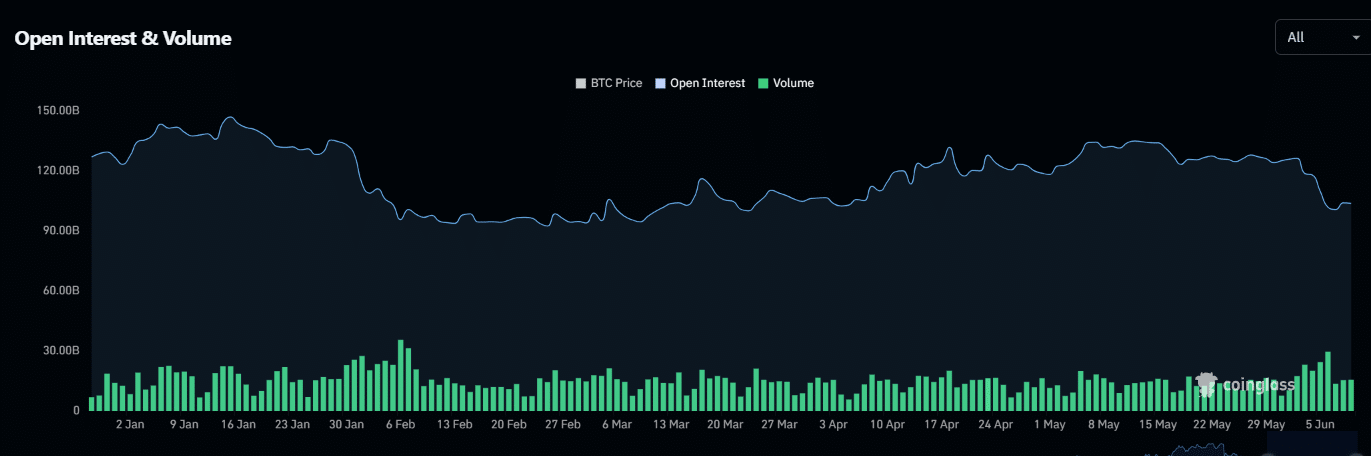
- January 2026: Altcoin Open Interest (OI) peaked near $150 billion, buoyed by early-year optimism and expectations of a sustained crypto bull run.
- March 2026: A period of stagnation began, with Open Interest gradually sliding as investors started pulling capital from the market.
- Late May 2026: Humanity Protocol [H] defied the broader trend, rallying over 150% and attracting significant speculative capital into its ecosystem.
- June 8, 2026: The sudden 85% drawdown of the H token occurred, breaking the short-term speculative momentum.
- June 9, 2026: Data from CoinGlass confirmed that aggregate altcoin Open Interest had regressed to mid-March levels of approximately $115 billion, reflecting a 25% decline from the January highs.
Supporting Data: Liquidity Flows and Market Positioning
The narrative of a "fragile market" is not based on conjecture but on hard data. According to CoinGlass, the retreat in Open Interest signals a significant cooling of speculative appetite. When capital leaves the derivatives market, it often indicates that institutional and retail traders are de-risking, preferring to sit in stable assets or cash rather than maintaining leveraged positions in altcoins.
The Non-USD Stablecoin Phenomenon
Perhaps the most telling metric in the current climate is the surge in non-USD stablecoin circulation. Data from Arkham Intelligence reveals that the circulating supply of non-USD stablecoins—led by assets like EURC, BRZ, and A7A5—has hit an all-time high of $2 billion, marking a 43% increase in 2026 alone.

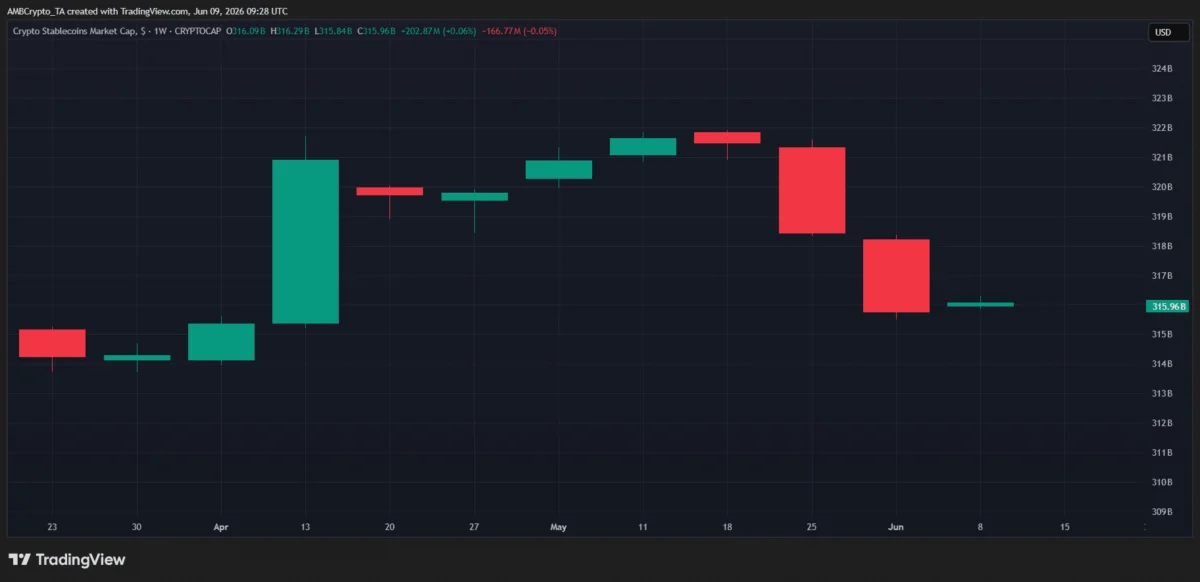
This trend suggests a pivot toward hedging. Investors are moving away from volatile risk assets and into stable-value tokens, likely as a defensive mechanism against the ongoing volatility in the Bitcoin and Ethereum markets. While the total stablecoin market cap has begun to recover to roughly $316 billion after weeks of outflows, this liquidity is currently acting as "dry powder" rather than "risk capital." It is not being deployed into DeFi protocols or altcoin projects; it is being held in reserve, waiting for a clearer macro signal.
The Bitcoin-Ethereum Divergence
The structural weakness is further highlighted by the performance of Ethereum. During this cycle, ETH has fallen more than 40%, performing roughly twice as poorly as Bitcoin. Historically, a weakening Bitcoin often leads to a rotation into Ethereum and other high-beta altcoins. However, that traditional "playbook" has failed to manifest this quarter. Instead, Ethereum’s underperformance confirms that the expected fundamentals-driven rally has yet to gain traction, leaving the entire ecosystem vulnerable to a deeper, more protracted correction.
Official Responses and Expert Analysis
While the Humanity Protocol developers have yet to issue a comprehensive post-mortem regarding the technical catalysts of the crash, independent analysts suggest that the failure was likely a combination of leveraged liquidation cascades and a sudden shift in sentiment.
Market strategists at leading analytics firms point out that "liquidity inflows" in the current context can be misleading. While fresh capital is entering the stablecoin ecosystem, it is not moving into the risk-asset buckets. Instead, it is being used to collateralize short positions or simply to exit the market safely. The "FUD" (Fear, Uncertainty, and Doubt) surrounding Bitcoin’s 25% correction has created a psychological ceiling, preventing the necessary confidence for a rebound in the altcoin sector.
Implications: A Deeper Correction Ahead?
The current market setup offers a sobering outlook for the remainder of the quarter. There are three primary implications of the recent collapse:
1. The Death of the "Altcoin Rotation" Narrative
The primary implication of the current data is that the rotation from Bitcoin into altcoins is currently broken. Traders are no longer treating altcoins as "higher-beta" opportunities to maximize profit when Bitcoin runs into resistance. Instead, they are treating altcoins as the first assets to be liquidated when macro uncertainty spikes. This decoupling from traditional cyclical behavior suggests that the market may require a significant "reset" before long-term growth can resume.
2. Heightened Sensitivity to Liquidity Shocks
The Humanity Protocol crash proved that the market is currently too thin to absorb large-scale sell-offs. Even mid-cap assets are showing extreme price sensitivity. If another project of similar scale were to face a liquidity crisis, the resulting ripple effect could force a wider deleveraging across the entire altcoin market, potentially dragging the market back to late 2025 lows.
3. The Shift toward Defensive Hedging
With the rise of non-USD stablecoins, the market is signaling a clear preference for capital preservation. Investors are not just moving to USDC or USDT; they are diversifying into localized stable assets, indicating that they are preparing for potential regulatory or macro-economic shifts in various jurisdictions. This defensive stance suggests that institutional money is not yet ready to participate in a "risk-on" phase.
Conclusion: Caution is the New Conviction
The events of June 2026 have effectively ended the speculative exuberance that characterized the late spring. The Humanity Protocol drawdown is not merely a story of one failed token; it is a symptom of a broader, systemic fragility. With Open Interest at a multi-month low and Bitcoin struggling to find a bottom, the altcoin sector faces an uphill battle.
For investors, the data suggests that patience is the most prudent strategy. Until there is evidence that stablecoin liquidity is being aggressively deployed into high-quality DeFi projects—and until Ethereum shows signs of relative strength against Bitcoin—the current environment remains one of extreme risk. The market is currently in a "wait-and-see" mode, and until the macroeconomic FUD subsides, the prospect of a deeper, more painful correction for the altcoin market remains a distinct and dangerous possibility. Investors should remain wary of false breakouts and focus on capital preservation as the market continues to search for a new, more stable foundation.
