

In a landmark development that signals the further maturation of the digital asset ecosystem, global banking giant Standard Chartered has announced a strategic partnership with Circle, the issuer of the USD Coin (USDC). This collaboration introduces an integrated service that allows institutional clients to mint and redeem USDC directly through bank-led rails, effectively removing the friction previously associated with navigating the crypto-native ecosystem.
By embedding USDC access directly within its institutional banking architecture, Standard Chartered has become the first Global Systemically Important Bank (G-SIB) to offer such a streamlined facility. This move, which marks a significant shift in how traditional financial institutions interact with stablecoins, is set to debut in the Dubai International Financial Centre (DIFC) before expanding into other key global markets.
The Core Innovation: Streamlining Institutional Liquidity
For years, institutional investors have faced a dichotomy: they either engaged with the traditional banking system or navigated the complex, often opaque, infrastructure of decentralized finance (DeFi). The partnership between Standard Chartered and Circle effectively collapses this divide.
Previously, institutional players looking to move capital into or out of USDC were required to establish distinct, often burdensome, relationships directly with stablecoin issuers. This necessitated separate compliance checks, custody arrangements, and liquidity management protocols. Under the new model, Standard Chartered will provide a unified interface where banking, custody, and digital asset services are consolidated.
This integration is more than just a convenience; it is a critical infrastructure upgrade. By leveraging the bank’s established regulatory compliance and capital management frameworks, institutional clients can move from fiat currency to USDC with greater confidence and operational efficiency. The bank acts as the intermediary, facilitating the minting and redemption process within the safety of its existing institutional service offering.
Chronology of a Strategic Shift
The trajectory toward this partnership has been defined by the gradual, yet inevitable, convergence of traditional finance (TradFi) and digital assets.
- Pre-2024 (The Foundation): As stablecoins like USDC transitioned from speculative instruments to essential tools for cross-border settlements and liquidity management, G-SIBs began to move from a stance of skepticism to one of integration.
- Early 2025 (Development Phase): Standard Chartered, through its digital asset custody and venture arms, began exploring ways to integrate blockchain-based rails into its global transaction banking platform.
- Mid-2026 (The Announcement): Standard Chartered and Circle officially unveiled their integrated service. The announcement highlighted that the service would first be operational in Dubai, a jurisdiction that has been at the forefront of providing clear regulatory frameworks for digital asset companies.
- Future Outlook (The Roadmap): The rollout is expected to move beyond simple minting and redemption. The institutions have signaled that the infrastructure is designed to support more complex payment-related use cases, potentially paving the way for instantaneous cross-border settlement and 24/7 treasury management.
Supporting Data: The Rising Tide of Stablecoins
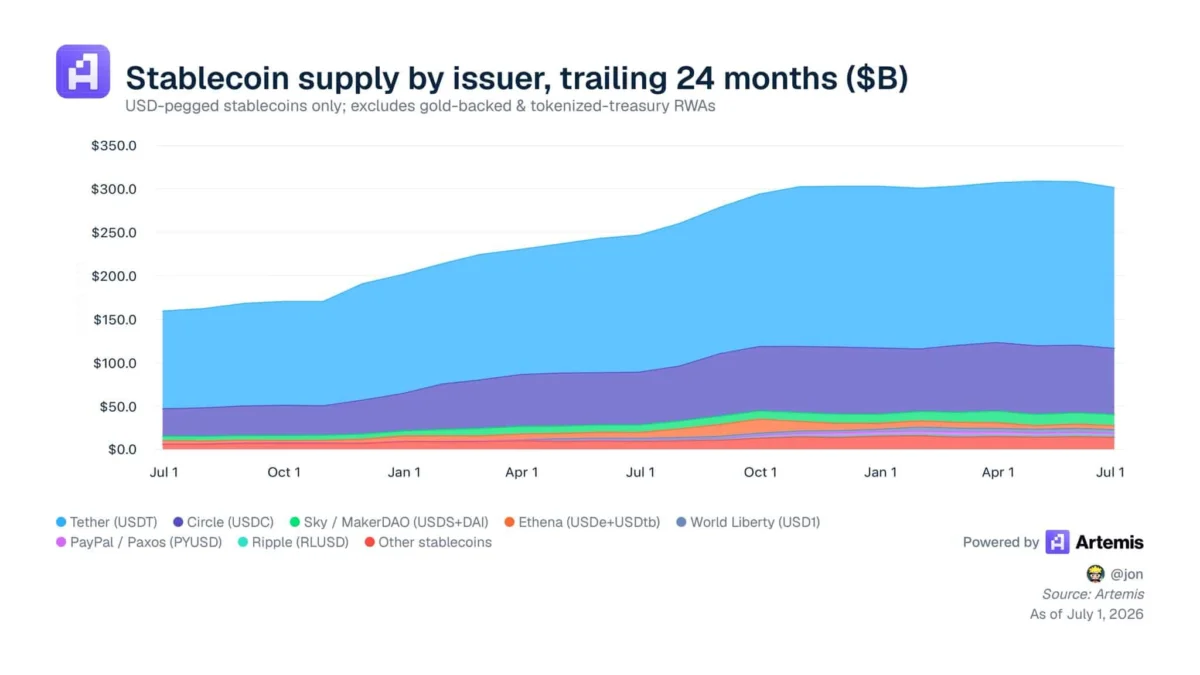
The timing of this partnership is far from coincidental. Stablecoins have evolved from niche assets utilized primarily by crypto-native traders into a cornerstone of modern financial infrastructure. According to data from industry analytics firm Artemis, the total supply of USD-pegged stablecoins has experienced a meteoric rise.
Over the past 24 months, the cumulative supply of these assets has nearly doubled, climbing from approximately $160 billion to an impressive $300 billion as of July 2026. This growth trajectory reflects a clear shift in market sentiment: stablecoins are being adopted as the primary medium of exchange for digital-native capital.
While Tether (USDT) continues to maintain its position as the market leader by volume, Circle’s USDC has cemented its reputation as the preferred stablecoin for institutional and regulated entities. USDC supply has remained remarkably resilient, hovering in the $70 billion to $80 billion range even amidst a surge of new entrants and regulatory scrutiny. This stability, combined with Circle’s commitment to transparency and compliance, makes it the ideal partner for a G-SIB like Standard Chartered, which cannot afford the reputational risks associated with less transparent digital assets.
Official Responses and Strategic Rationale
In their joint statement, representatives from both organizations emphasized that this partnership is about more than just technology; it is about building trust in a digital-first economy.

Standard Chartered noted that by "embedding USDC access directly within its institutional offering," the bank is providing a bridge that allows its clients to embrace the speed and efficiency of blockchain technology without sacrificing the security of a regulated banking environment. The bank’s leadership emphasized that this integrated approach is the next logical step in the evolution of transaction banking.
For Circle, the partnership represents a validation of its "corporate-first" strategy. By aligning with a bank of Standard Chartered’s stature, Circle is positioning USDC not merely as a cryptocurrency, but as a legitimate component of the global financial plumbing. This move effectively legitimizes stablecoins in the eyes of risk-averse institutional investors who might have previously stayed on the sidelines due to regulatory uncertainty.
Implications for the Future of Finance
The implications of this partnership are profound and far-reaching.
1. The Institutionalization of Crypto
By bringing minting and redemption processes into the purview of a G-SIB, the "crypto" aspect of the asset becomes secondary to its utility. This shift reduces the "fear of the unknown" that has historically deterred pension funds, insurance companies, and sovereign wealth funds from interacting with stablecoins.
2. Regulatory Standardization
The choice of Dubai’s DIFC as the initial rollout location is telling. It highlights the importance of jurisdictional clarity. As banks like Standard Chartered continue to roll out these services, they will likely advocate for similar regulatory frameworks in other global financial hubs, such as London, Singapore, and New York. This could lead to a global standard for stablecoin usage that satisfies the requirements of both central banks and market participants.
3. Efficiency in Cross-Border Payments
One of the most promising aspects of this collaboration is the potential for near-instant, 24/7 cross-border settlements. Traditional correspondent banking systems are notoriously slow, often taking days to clear international payments. By using USDC on the back end, facilitated by a bank that ensures compliance and KYC (Know Your Customer) requirements, the industry is moving closer to the "Internet of Value"—where money moves with the same speed and ease as information.
4. A New Competitive Landscape
This partnership sets a high bar for other financial institutions. We can expect to see a "stablecoin arms race" as other global banks scramble to partner with established issuers to prevent losing institutional clients to more forward-thinking competitors. The days of treating digital assets as a separate, isolated business line are drawing to a close.
Conclusion: The Convergence is Here
The collaboration between Standard Chartered and Circle marks a historic milestone. It is a clear signal that the financial industry is no longer merely "watching" the digital asset space but is actively building the infrastructure required to support it at scale.
As the supply of stablecoins continues to grow and institutional demand for efficient, blockchain-based capital movement intensifies, the role of banks as the ultimate gatekeepers and facilitators will be redefined. By providing a bridge between the fiat world and the blockchain, Standard Chartered and Circle are not just simplifying a process—they are laying the foundation for a more interconnected, transparent, and efficient global financial system.
The path forward will involve ongoing regulatory dialogue and technical refinement, but the trajectory is clear: the integration of traditional banking and digital assets is no longer a vision of the future—it is the reality of the present. As this service rolls out from the DIFC to the rest of the world, it will likely serve as the blueprint for how the next generation of global finance will be conducted.
