

In a move that underscores the accelerating institutional adoption of blockchain technology, South Korean automotive giant Hyundai has announced a successful pilot program utilizing stablecoins to streamline cross-border capital transfers. By moving away from traditional, sluggish interbank settlement systems, Hyundai is signaling a fundamental shift in how global enterprises manage liquidity, international remittances, and internal treasury operations.
The Paradigm Shift: Main Facts and Operational Efficiency
For multinational corporations like Hyundai, the movement of capital across borders has historically been a source of friction. Traditional cross-border payments, often reliant on the SWIFT network or legacy correspondent banking relationships, are frequently hampered by time zone disparities, regulatory bottlenecks, and intermediate banking fees. These transactions often require four hours or more to clear, and in many cases, can take several business days.
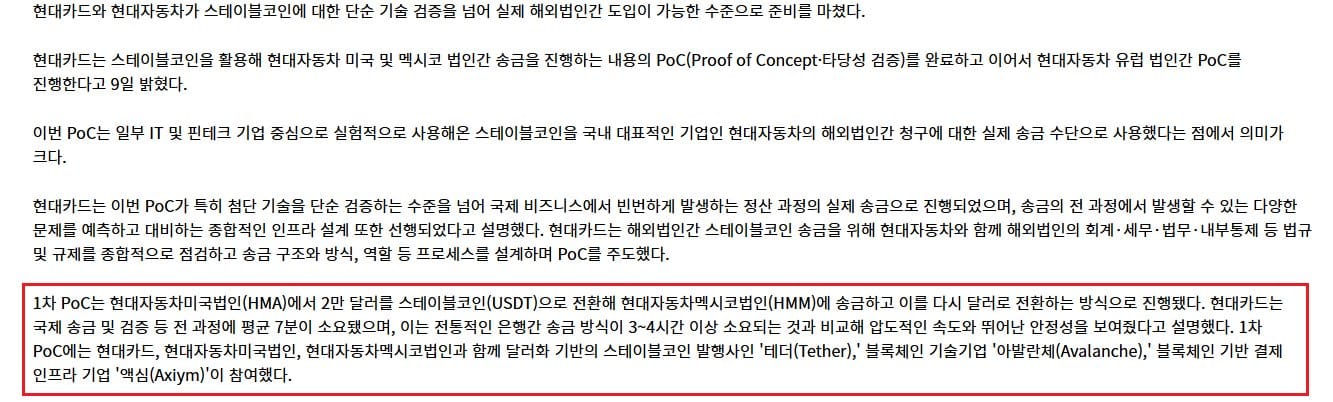
Hyundai’s recent pilot program, conducted between its subsidiaries in the United States and Mexico, successfully challenged this status quo. By leveraging Tether’s USDT on the high-performance Avalanche blockchain, the automaker achieved transfer times of approximately seven minutes. This represents a reduction in latency of more than 97% compared to traditional banking methods.
The pilot involved a multi-stakeholder collaboration designed to ensure enterprise-grade security and compliance. Key participants included:
- Hyundai Motor Group: Providing the operational framework and treasury use case.
- Hyundai Card: Serving as the financial arm overseeing the implementation.
- Avalanche: Providing the underlying blockchain infrastructure, chosen for its high throughput and near-instant finality.
- Tether (USDT): Serving as the stable asset to mitigate price volatility.
- Axiym: Acting as the payment integrator to bridge the gap between blockchain protocols and corporate financial systems.
Chronology: A Roadmap to Digital Transformation
Hyundai’s exploration of stablecoins is not an isolated experiment; it is the culmination of a broader strategic initiative to modernize its financial infrastructure.
Phase I: The U.S.-Mexico Corridor
The initial phase of the project focused on internal treasury management. By establishing a direct, programmable link between U.S. and Mexican operations, Hyundai sought to demonstrate that stablecoins could offer "overwhelming speed and superior stability" compared to conventional wire transfers. The success of this phase provided the proof-of-concept necessary to move toward more complex integrations.
Phase II: Expanding the Ecosystem
Following the successful completion of the U.S.-Mexico test, Hyundai signaled an immediate expansion. By the end of July, the company is set to launch a parallel pilot program involving Circle’s USDC and Visa. This phase is specifically designed to stress-test stablecoin transfers for European Union (EU) operations, likely in response to the tightening regulatory environment under the European Union’s Markets in Crypto-Assets (MiCA) regulation.
Phase III: Infrastructure Scaling
Beyond internal liquidity management, Hyundai has expressed a clear long-term vision. The firm has publicly committed to exploring and expanding various businesses that utilize stablecoins, specifically highlighting international remittance services and the development of new payment infrastructure that could eventually serve its broader consumer base.
Supporting Data: The Global Stablecoin Landscape
To understand why Hyundai is betting on stablecoins, one must look at the macro-economic data. Stablecoins have evolved from a fringe crypto-asset into a vital tool for global finance, addressing the dual needs of US dollar accessibility and efficient, low-cost cross-border settlement.
The current market landscape is defined by an intense competition between the two industry titans: Tether (USDT) and Circle (USDC). According to recent industry data provided by Visa, the stablecoin sector has seen record-breaking settlement volumes, totaling approximately $9 trillion annually.
The Competition for Dominance
The market share distribution has undergone a notable shift in 2026:
- USDC (Circle): Currently accounts for 63% of the annual stablecoin transaction volume, representing approximately $6 trillion. This surge is largely attributed to the implementation of the MiCA regime in the EU, which has provided a clearer, more compliant framework for stablecoin issuers, making USDC the preferred choice for regulated entities.
- USDT (Tether): Holds a 36% market share, totaling roughly $3.3 trillion in annual transaction volume. While it trails in total volume, USDT remains the dominant stablecoin in liquidity and emerging market usage.
This transition marks the first time that USDC has led in annual transfer volume. This shift is highly significant for enterprise adopters like Hyundai, as it suggests that regulatory compliance—a hallmark of the USDC ecosystem—is becoming just as important to corporate treasurers as raw transaction speed.
Official Responses and Industry Perspectives
The move by a global automotive powerhouse like Hyundai has drawn significant praise from the leaders of the stablecoin industry.
Paolo Ardoino, CEO of Tether, hailed the development as a major milestone for the digital asset space. In a public statement, Ardoino described the initiative as "impressive real-world adoption of USDT," noting that such use cases validate the utility of stablecoins as a medium of exchange for global commerce.
Bo Hines, CEO of Tether U.S., echoed this sentiment, framing the Hyundai integration as a glimpse into the future of global finance. "This is exactly what the future of finance looks like," Hines remarked, emphasizing that when major corporations begin to bypass legacy banking rails in favor of blockchain, the entire financial architecture of the world is forced to modernize.
The sentiment is clear: for industry leaders, this is no longer about the theoretical potential of blockchain; it is about the practical, immediate replacement of inefficient legacy systems.
Implications: The Future of Enterprise Finance
Hyundai’s foray into stablecoin-based remittances has far-reaching implications for the global economy.
1. Disintermediation of Banking
By using blockchain rails, companies can significantly reduce their reliance on correspondent banks. This disintermediation reduces the "toll" paid to intermediaries, effectively lowering the cost of doing business globally. For a company with the volume of Hyundai, even a small percentage reduction in transaction costs translates to millions of dollars in annual savings.
2. Regulatory Compliance as a Competitive Advantage
The fact that Hyundai is testing both USDT and USDC is telling. It suggests that corporations are seeking a "multi-stablecoin" strategy, balancing the high liquidity and widespread availability of USDT with the regulatory clarity and institutional acceptance of USDC. As MiCA continues to shape the European landscape, other corporations are likely to follow Hyundai’s lead in prioritizing compliant, regulated stablecoin providers.
3. A Precursor to Programmable Payments
The most significant implication lies in the "programmability" of these assets. Unlike a standard bank transfer, a stablecoin transfer can be bundled with smart contracts. This allows for conditional payments—for example, a payment that is only released upon the automated verification of a shipment of car parts. Hyundai’s move into "payment infrastructure" suggests that they are not just looking for faster transfers, but for a new, automated way to execute complex global supply chain contracts.
4. Setting the Standard for Automotive Peers
Hyundai is effectively setting a new industry standard. As competitors observe the speed, cost-effectiveness, and transparency of Hyundai’s new system, the pressure on other major automotive manufacturers to modernize their treasury departments will intensify. This creates a "network effect" where the adoption of stablecoins could become the baseline requirement for international trade in the automotive sector.
Conclusion
The transition from a testing environment to a scalable business model for stablecoin transfers marks a turning point for global corporate finance. Hyundai’s successful pilot confirms that the friction of international finance is not an inevitability, but an inefficiency that can be solved with the right technology.
As the competition between stablecoin issuers like Tether and Circle continues to drive innovation and regulatory compliance, enterprises like Hyundai are the ultimate beneficiaries. By embracing this technology, the automaker is not just improving its bottom line; it is helping to build the foundational infrastructure for the next generation of global trade. Whether this momentum will lead to a broader adoption across the entire automotive supply chain remains to be seen, but one thing is certain: the era of the seven-minute global settlement has officially arrived.
