

On June 9, a pivotal moment in the evolution of digital asset regulation occurred as the Hyperliquid Policy Center (HPC) and the venture capital heavyweight Paradigm issued a joint formal comment letter to the U.S. Treasury. This submission, directed at the Office of Foreign Assets Control (OFAC) and the Financial Crimes Enforcement Network (FinCEN), signals a critical pushback against the current trajectory of stablecoin compliance rules linked to the GENIUS Act.
While the industry acknowledges the necessity of oversight, the joint intervention by Paradigm and HPC highlights a growing anxiety: that overly rigid compliance frameworks, if misapplied to decentralized infrastructure, could stifle innovation and inadvertently drive the burgeoning DeFi ecosystem toward offshore jurisdictions.
The Core Conflict: Balancing Innovation with Oversight
At the heart of the discourse is the GENIUS Act, a legislative effort aimed at bringing order to the stablecoin sector. While stakeholders generally support the premise of the act—specifically FinCEN’s decision to focus issuer obligations on the primary market—there is significant concern regarding the ambiguity surrounding secondary-market interactions.
In their letter, the organizations noted:
"We broadly support the proposed rule, and in particular FinCEN’s decision to tailor most issuer obligations to the primary market, but write to recommend that certain secondary market obligations be clarified or narrowed to avoid unintended consequences for permissionless blockchain infrastructure and the DeFi ecosystem."
This statement encapsulates the "DeFi dilemma": how to apply traditional Anti-Money Laundering (AML) and Know Your Customer (KYC) standards to decentralized, permissionless networks where a centralized gatekeeper may not exist.
Chronology of Regulatory Tension
The current regulatory landscape is the result of years of rapid growth in stablecoin adoption, which has outpaced legislative development.
- Initial Growth Phase: Stablecoins emerged as the backbone of the crypto economy, providing a bridge between fiat currency and decentralized protocols.
- The GENIUS Act Introduction: Designed to provide federal oversight, the Act sought to standardize the issuance and management of stablecoins, placing them under a rigorous compliance umbrella.
- The NYDFS Blueprint: Following federal momentum, the New York State Department of Financial Services (NYDFS) recently proposed its own regulatory framework, aiming to align state oversight with the federal mandates established under the GENIUS Act.
- The June 9th Intervention: Paradigm and the HPC formally challenged the scope of these rules, arguing that without specific carve-outs for secondary-market activity, the regulations could become technically impossible to implement on public blockchains.
The Six Pillars of Regulatory Reform
Paradigm and the HPC have proposed six specific areas where the current regulatory draft requires refinement to remain compatible with the realities of blockchain technology.
1. Defining Secondary-Market Obligations
The groups argue that the current language fails to differentiate between a centralized issuer and a decentralized protocol. They demand precise rules that clarify where an issuer’s responsibility ends and the immutable nature of the blockchain begins.
2. Transaction Handling Clarity
There is significant ambiguity regarding the mandatory "block, freeze, or reject" protocols. In a decentralized environment, an issuer may not have the technical capability to unilaterally freeze assets. The groups are calling for a framework that respects the technical constraints of smart contracts.
3. Strengthening Safe Harbor for SARs
Financial institutions are required to file Suspicious Activity Reports (SARs). The coalition is pushing for enhanced safe harbor protections to ensure that firms providing blockchain infrastructure are not penalized for reporting (or failing to report) activities that fall outside their direct control.
4. Adherence to Government Directives
The coalition seeks clarity on the extent to which decentralized networks must comply with government directives. They advocate for a standard that is actionable and does not require the impossible—such as mandating compliance from an anonymous, decentralized validator network.
5. Revamping Customer Due Diligence (CDD)
Existing CDD rules were written for traditional banking. Applying them to non-custodial wallets is a technical mismatch. The groups suggest a modern interpretation of CDD that accounts for the pseudonymous nature of blockchain transactions without compromising the goal of preventing illicit finance.
6. Sanctions Compliance Programs
Finally, the groups demand a concrete definition of an "effective sanctions compliance program." They argue that a one-size-fits-all approach is doomed to fail in the DeFi space and that regulators should focus on outcome-based compliance rather than procedural rigidity.
The CLARITY Act and the Yield Debate
A major point of contention within the GENIUS Act is the prohibition of stablecoin issuers paying yields to holders. This restriction has been a point of frustration for the industry, as it limits the utility of stablecoins in decentralized finance.
In response, the proposed CLARITY Act has emerged as a potential remedy. By maintaining activity-based stablecoin rewards, the CLARITY Act would permit exchanges and third-party businesses to allocate yield in a manner that aligns with compliance standards. This legislative counter-proposal is seen as a necessary "pressure release valve" for the industry.
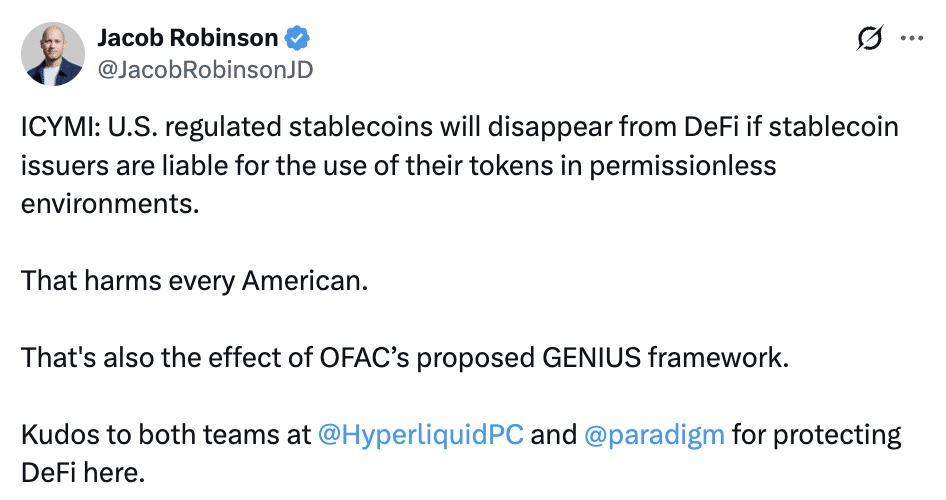
Prominent figures in the space, including Jacob Robinson, host of Law of Code, have praised the push for legislative clarity. Robinson’s commentary emphasizes that the goal is not to avoid regulation, but to ensure that regulation is "technically feasible and commercially viable."
Implications: The Risk of "Regulatory Flight"
The primary fear shared by Paradigm, the HPC, and the broader developer community is the phenomenon of "regulatory flight." If the U.S. imposes compliance standards that are incompatible with the decentralized architecture of blockchains, businesses will not simply vanish—they will move.
Impact on DeFi Innovation
DeFi relies on composability—the ability for different applications to interact seamlessly. If every layer of the stack is forced to act as a regulated financial institution, the "permissionless" nature of these protocols—which allows anyone in the world to participate—will be effectively destroyed.
The Global Competition
As the U.S. refines its approach, other jurisdictions are positioning themselves as "crypto-friendly" hubs. By creating a regulatory environment that is overly stringent, the U.S. risks losing its leadership position in the next generation of financial technology to regions with more nuanced frameworks.
A Call for Pragmatism
The joint submission by Paradigm and the HPC is a masterclass in regulatory advocacy. Rather than taking an adversarial stance, they have positioned themselves as partners in the legislative process. By acknowledging the legitimacy of the GENIUS Act’s goals while identifying the technical pitfalls of its implementation, they are advocating for a "digital-first" approach to oversight.
For policymakers, the challenge is clear: the U.S. financial system needs to adapt to a world where money moves at the speed of the internet. If the regulators listen to these industry experts, the resulting framework could serve as a global gold standard—one that protects consumers and stops illicit actors without breaking the foundational technology that makes modern DeFi possible.
Final Summary
- The Problem: The GENIUS Act’s current language poses a threat to the technical integrity of decentralized blockchain networks.
- The Action: Paradigm and the HPC have formally petitioned the Treasury for six specific refinements to the rules.
- The Solution: A push toward the CLARITY Act, which would provide a more balanced approach to stablecoin yields and secondary-market operations.
- The Stakes: If these concerns remain unaddressed, the U.S. risks a massive exodus of blockchain innovation to offshore markets, undermining the country’s long-term competitive advantage in the financial sector.
The coming months will be critical. As the Treasury reviews the comments provided by the HPC and other stakeholders, the crypto industry will be watching closely, waiting to see if the U.S. chooses a path of rigid, legacy-style oversight or one of pragmatic, future-proof innovation.
