

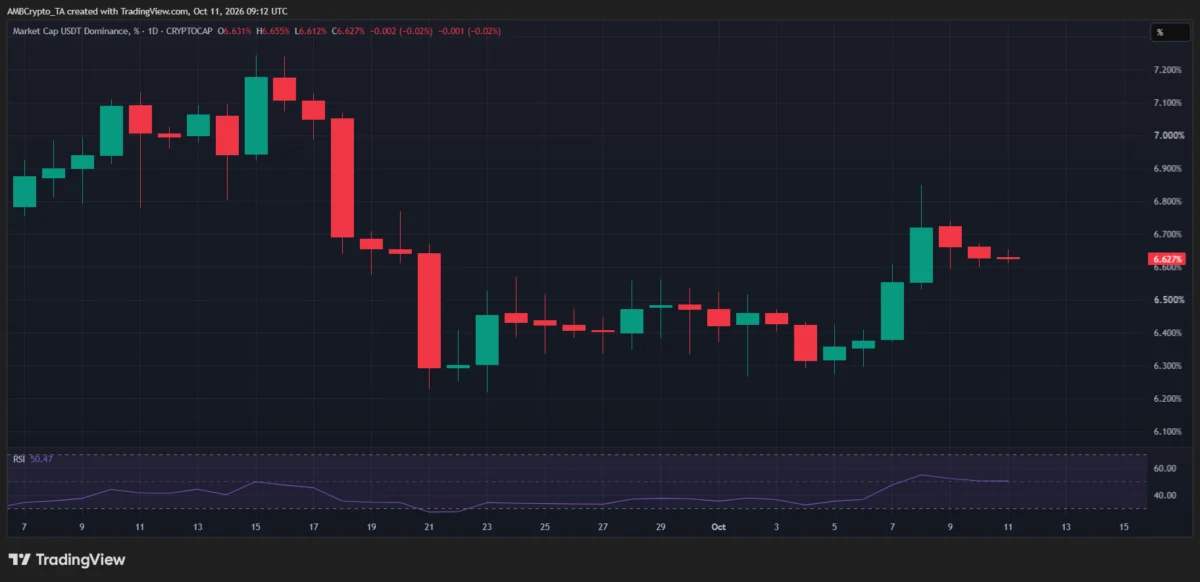
Introduction: Is USDT the Catalyst for the Next Market Rebound?
As the cryptocurrency market navigates a period of macro-economic uncertainty and technical volatility, all eyes are increasingly turning toward stablecoins as the ultimate barometer of market health. Tether (USDT), the undisputed heavyweight of the stablecoin sector, has once again found itself at the center of critical on-chain developments. Recently, Tether’s market capitalization notched its third consecutive daily increase, signaling a slow but steady influx of fresh capital into the digital asset ecosystem.
However, this growth in liquidity—estimated at approximately $310 billion overall—has been relatively subdued, failing to ignite an immediate "risk-on" sentiment across the broader market. Amid this cautious backdrop, Tether executed a pivotal maneuver: unfreezing $1.45 million worth of USDT tied to four THORChain vaults on the TRON blockchain.
While modest in nominal terms, this regulatory and operational about-face has sent ripples through decentralized finance (DeFi) circles, alleviating immediate anxieties regarding choppy stablecoin infrastructure. Coupled with shifting on-chain dynamics, including a noticeable retracement in USDT dominance, market analysts are left questioning whether Tether’s latest moves are laying the foundational groundwork for a broader market rebound.
Chronology of Events: The THORChain Vault Freeze and Rapid Reversal
To fully grasp the significance of Tether’s recent intervention, it is essential to examine the sequence of events that unfolded on the TRON network and within THORChain’s cross-chain liquidity architecture.
The Initial Crackdown
The controversy began when blockchain intelligence and security monitors flagged a sudden enforcement action by Tether. The stablecoin issuer implemented a freeze on four distinct THORChain USDT vaults operating on the TRON blockchain. In the decentralized finance space, a freeze of this magnitude is severe; it immediately halts all trading, swapping, and liquidity provision functions associated with the targeted addresses.
For THORChain—a decentralized cross-chain liquidity protocol that relies heavily on seamless asset swaps—this sudden intervention threatened to disrupt user operations and fracture liquidity pools. The abruptness of the freeze stirred immediate concern among market participants, compounding existing anxieties about the fragility of cross-chain stablecoin bridges and centralized controls embedded within fiat-backed stablecoins.
The Swift Pivot: Unfreezing the Vaults
Demonstrating remarkable agility, Tether reversed its decision just three hours after the initial implementation. The four targeted TRON addresses were unlocked, restoring full functionality to the affected THORChain vaults and allowing frozen capital to flow back into the network’s liquidity streams.
It is worth noting that while these four vaults were granted a reprieve, Tether maintained strict enforcement measures elsewhere, keeping 19 other blockchain addresses frozen as part of its ongoing compliance and security protocols. Nevertheless, the rapid unfreezing of the THORChain-linked assets successfully averted a localized liquidity crisis, neutralizing a potential flashpoint for market panic and restoring confidence in the immediate operability of cross-chain swaps.

Supporting Data: TRON’s Dominance and Tether’s Market Metrics
The drama surrounding THORChain cannot be viewed in isolation; it highlights the critical and rapidly expanding role that the TRON blockchain plays in the global distribution and utilization of USDT.
TRON’s Ascendancy in USDT Transfers
According to data compiled by on-chain analytics platform Lookonchain, the supply of USDT residing on the TRON network has experienced explosive growth. Over the past year alone, USDT supply on TRON surged by an impressive $18.67 billion, bringing the network’s total USDT reserves to a staggering $94.25 billion. This translates to a massive 24.7% year-over-year expansion.
+-------------------------------------------------------------+
|               TRON USDT Supply Growth (YoY)                 |
+-------------------------------------------------------------+
|  Absolute Increase: +$18.67 Billion                         |
|  Total TRON USDT:   $94.25 Billion                          |
|  Percentage Growth: +24.7%                                  |
+-------------------------------------------------------------+
With nearly a hundred billion dollars worth of Tether concentrated on TRON, any operational bottleneck, regulatory freeze, or network congestion carries systemic implications. Traders and liquidity providers relying on TRON for fast, low-cost settlements are particularly vulnerable to sudden policy interventions. Consequently, the brief interruption to the THORChain vaults—though quickly resolved—served as a stark reminder of the delicate plumbing that supports modern decentralized finance.
Macro Stablecoin Metrics and Investor Sentiment
Beyond the TRON ecosystem, broader macroeconomic indicators present a nuanced picture of market liquidity:
- Market Cap Momentum: Tether’s market capitalization has recorded three consecutive days of positive liquidity inflows, indicating that capital is actively entering the stablecoin ecosystem rather than fleeing to fiat bank accounts.
- Muted Retail Demand: Despite the rising stablecoin market cap, these inflows have not yet translated into aggressive retail buying. Retail demand for alternative cryptocurrencies remains dormant, with Google search interest for phrases like "Buy Altcoins" hovering near multi-year lows matching levels not seen since early 2026.
- Bitcoin and Technical Resistance: From a technical perspective, the wider market is currently enduring a risk-off phase, with Bitcoin’s critical psychological and technical threshold at $80,000 coming under sustained downward pressure.
Official Responses and Ecosystem Reactions
The crypto community and decentralized finance protocols have long maintained a complex relationship with Tether’s centralized freezing capabilities. While market participants rely on USDT for its deep liquidity and ubiquity, the power to freeze funds at the smart contract level introduces counterparty and operational risks.
Following the recent THORChain incident, developers and liquidity providers have voiced cautious optimism regarding Tether’s willingness to swiftly correct operational disruptions. By reversing the freeze within three hours, Tether demonstrated a degree of responsiveness to the DeFi ecosystem’s operational needs, mitigating potential systemic contagion.
However, legal and structural friction remains a persistent theme. Similar recent disputes—such as legal challenges filed against Tether by entities like Conduit over contested freezes—underscore the ongoing tension between centralized compliance mandates (such as freezing funds linked to illicit activity or security breaches) and the decentralized ethos of permissionless finance. Stakeholders continue to debate the exact thresholds and justifications required for Tether to withhold or release user funds, making transparent communication from the issuer more critical than ever.
Implications: Navigating the Road to a Market Rebound
As the dust settles on the THORChain unfreeze, analysts are shifting their focus to what these on-chain developments signal for the months ahead. Several key indicators suggest that the current macroeconomic and liquidity environment is quietly preparing for a potential trend reversal.
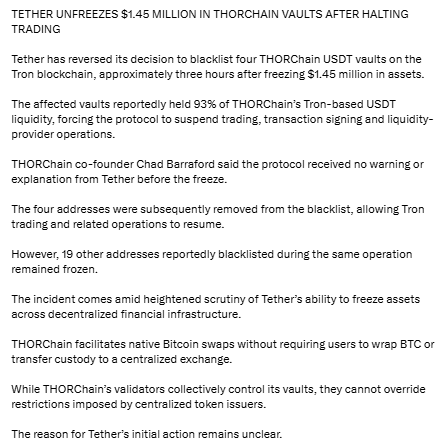
1. The Decline in USDT Dominance (USDT.D)
One of the most compelling technical signals currently flashing is the behavior of USDT dominance (USDT.D). After touching a notable resistance level in mid-September around 6.7%, USDT dominance has begun to retrace.
USDT Dominance (USDT.D) Trend:
[ Mid-Sept Resistance: 6.7% ] ---> [ Current Trajectory: Retracing ]
Implication: Investors deploying sidelined "dry powder" back into risk assets.
In cryptocurrency market cycles, rising USDT dominance typically signifies fear, with investors liquidating risk assets and parking their capital in stablecoins as safe haven "dry powder." Conversely, a retraction in USDT dominance indicates that investors are beginning to deploy that sidelined capital back into risk assets like Bitcoin, Ethereum, and altcoins. The ongoing drop in USDT.D suggests that the pool of idle stablecoins is shrinking as capital slowly rotates outward.
2. Debunking the "Market Top" Narrative
Concerns often arise during periods of high stablecoin issuance that the market may be nearing a cyclical top. However, data compiled by market research outlets like AMBCrypto suggests otherwise. The combination of expanding stablecoin market caps and receding USDT dominance points away from an imminent cycle exhaustion. Instead, it indicates a consolidation phase where liquidity is quietly accumulating, waiting for a definitive technical catalyst to ignite a renewed buying wave.
3. Cross-Chain Resilience
The prompt resolution of the THORChain vault freeze reinforces the resilience of modern cross-chain architectures. As liquidity increasingly fragments across multiple layer-1 blockchains (such as TRON, Solana, and Ethereum) and layer-2 scaling solutions, the ability of protocols and issuers to coordinate and resolve friction points will determine the overall health of the DeFi economy. By unfreezing the $1.45 million in assets, Tether helped preserve the velocity of cross-chain capital, ensuring that liquidity could continue to circulate without permanent structural damage.
Conclusion
Tether’s recent unfreezing of $1.45 million in USDT across four TRON-based THORChain vaults may appear as a minor footnote in the grand scale of the multi-billion-dollar crypto economy, but its timing and implications are profound. By averting a localized liquidity bottleneck against the backdrop of TRON’s massive $94.25 billion USDT supply growth, Tether has helped stabilize cross-chain DeFi operations during a jittery market phase.
When combined with consecutive daily increases in Tether’s overall market capitalization, a retreating USDT dominance metric, and the gradual deployment of sidelined capital, the stage is set for a potential market rebound. While retail enthusiasm remains subdued and Bitcoin tests critical support levels near $80,000, the underlying plumbing of crypto liquidity is healing. If capital continues to rotate out of stablecoin reserves and back into risk assets, Tether’s strategic interventions may well be remembered as the quiet catalyst that kept the gears turning before the next major market cycle.
