

In the world of decentralized finance (DeFi) and smart contract platforms, liquidity is the lifeblood of innovation. While market sentiment is often driven by speculative hype and social media discourse, the most reliable metric for gauging the health of a network remains on-chain activity. Specifically, the movement of stablecoins—the primary medium of exchange in the crypto-economy—serves as a clear indicator of institutional and retail conviction.
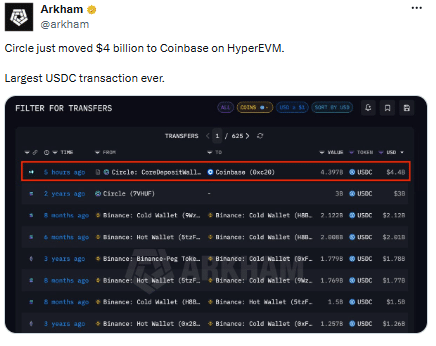
Recent data provided by Arkham Intelligence has sent shockwaves through the market, revealing a staggering $4 billion transfer of USDC from Circle to a Coinbase-linked address operating within HyperEVM, the Ethereum-compatible environment powering the Hyperliquid ecosystem. This event, which ranks among the largest stablecoin transactions in recent history, is not merely a logistical movement of capital; it is a profound signal of strategic positioning. As capital flows into trading desks, liquidity pools, and borrowing protocols, it marks a pivotal moment for Hyperliquid, potentially cementing its status as a premier destination for high-performance on-chain trading.
Main Facts: Decoding the Transfer
The core of the recent market activity centers on a single, massive transaction: Circle, the issuer of the USDC stablecoin, moved $4 billion into a wallet address associated with Coinbase on the HyperEVM network.
To understand the significance, one must look at the roles of the entities involved. Circle serves as the architect and issuer of USDC, while Coinbase acts as a critical infrastructure partner, facilitating distribution and deep-liquidity management. The fact that this capital arrived on HyperEVM—an environment designed to handle high-frequency, high-throughput smart contract interactions—suggests that this is not idle capital. Instead, it is highly likely that this liquidity is being earmarked for deep market-making activities or institutional-grade trading strategies.
Currently, USDC has established dominance within the Hyperliquid ecosystem, accounting for over 95% of its total stablecoin supply. Recent reports indicate that the USDC supply on the chain has surged by 20% in the last month alone, bringing the total value deployed on HyperEVM to over $6 billion. In contrast, USDT maintains a relatively minor footprint, with roughly $192 million currently residing on the chain. This lopsided distribution underscores the institutional preference for USDC within the Hyperliquid architecture.
Chronology of Growth: A Rapid Expansion
The trajectory of Hyperliquid over the past year has been nothing short of meteoric. To grasp the implications of the $4 billion transfer, we must examine the timeline of the network’s expansion:
- October 2025: The launch of Hyperliquid’s HIP-3 ecosystem provided the infrastructure necessary to scale complex financial primitives. This marked the starting point of a sustained growth phase.
- Late 2025 – Q1 2026: Throughout the winter, the platform saw an exponential increase in both user adoption and developer activity. The integration of high-performance order books allowed the network to handle transaction volumes that previously would have been confined to centralized exchanges (CEXs).
- Early June 2026: The stablecoin supply within the ecosystem hit a record high of $7.04 billion, a 20% increase from the previous month. This influx of liquidity mirrored the rising interest in perpetual futures.
- Mid-June 2026: The $4 billion USDC transaction occurs, acting as the climax to a period of aggressive capital allocation.
This timeline indicates that the recent massive inflow was not an isolated incident, but rather the latest chapter in a broader, orchestrated expansion of the network’s financial capacity.
Supporting Data: The Institutional Pivot
The evidence for a maturing ecosystem is found in the numbers. When analyzing the current state of Hyperliquid, three key metrics stand out: Open Interest (OI), cumulative trading volume, and the velocity of stablecoin deployment.
Perpetual Futures and Open Interest
Hyperliquid has seen its perpetual futures Open Interest climb past the $8 billion threshold. In market mechanics, high OI generally indicates a high level of confidence among traders that the current price trends will continue. When combined with a growing base of underlying collateral (USDC), it suggests that market participants are not just betting with high leverage, but are increasingly backing those positions with substantial, real-world capital.
Trading Volume
According to recent data from Grayscale, the Hyperliquid ecosystem has generated over $200 billion in cumulative trading volume since the inception of the HIP-3 framework. This figure puts the platform in direct competition with legacy centralized exchanges, validating the thesis that on-chain perpetuals can offer a superior user experience with the added benefit of transparency.
The "New Money" Theory
A common criticism of crypto-growth is that it is often driven by traders simply increasing leverage on existing, stagnant capital. However, the data from June 2026 refutes this. The rise in stablecoin supply is occurring in lockstep with the rise in trading volume. This indicates that "fresh money" is entering the ecosystem. Institutional players are moving their USDC into the Hyperliquid ecosystem to capture yields or facilitate trades, rather than simply cycling existing tokens.
Market Context: The "SpaceX IPO" Effect
The timing of the transfer coincides with a broader shift in the global risk-asset landscape. Market momentum has been bolstered by the recent SpaceX IPO, which has acted as a catalyst for renewed interest in high-beta, speculative, and growth-oriented assets.
Investors are currently seeking platforms that can handle the volatility and high-volume trading associated with such market shifts. Hyperliquid, with its low-latency, high-throughput environment, has positioned itself as the primary venue for this activity. The $4 billion transfer, therefore, can be viewed as "dry powder"—capital sitting in a high-liquidity environment, ready to be deployed into the next wave of speculative opportunities or market-making strategies that arise in the wake of broader equity market movements.
Implications: What This Means for HYPE
The most significant implication of this massive capital inflow is the impact on HYPE, the native token of the Hyperliquid ecosystem. The network is currently entering a phase of "price discovery," where its market valuation is attempting to find a equilibrium based on its actual utility and liquidity depth.
- Increased Network Utility: As more stablecoins flow into the ecosystem, the demand for the native HYPE token—required for governance, staking, and potentially as a secondary collateral asset—is likely to rise.
- Institutional Validation: A $4 billion injection from major market players provides a level of institutional validation that is difficult for competitors to replicate. It signals that Hyperliquid is now "too big to ignore" for major market makers.
- Liquidity Moat: The disparity between the $6 billion in USDC and the mere $192 million in USDT creates a competitive advantage. By establishing itself as the "USDC-native" chain for perps, Hyperliquid reduces friction for institutional traders who prefer the stability and liquidity of Circle’s stablecoin.
Conclusion: A New Frontier
The movement of $4 billion in USDC into the Hyperliquid ecosystem is a watershed moment. It reflects a sophisticated, data-driven approach to capital deployment in the decentralized era. While the short-term impact of such a large transaction may lead to temporary market volatility, the long-term implication is clear: Hyperliquid is successfully transitioning from an experimental platform to a cornerstone of the global DeFi architecture.
As the ecosystem continues to grow, all eyes will be on how this capital is utilized. If the current trends in Open Interest and trading volume hold, Hyperliquid is well-positioned to lead the next cycle of on-chain financial innovation. The "timing" of this move—capitalizing on both the growth of the HIP-3 ecosystem and the broader momentum in risk assets—suggests that those behind the transaction are betting on a future where on-chain liquidity is the primary engine of global market activity.
