

For any Layer 1 blockchain, stablecoins serve as the lifeblood of the ecosystem—the direct gateway to on-chain activity. The economic logic is elementary: the more liquidity a network attracts, the more friction-less the environment becomes for users to trade, borrow, lend, and bridge capital. In recent weeks, Solana has demonstrated an undeniable magnetism, attracting massive tranches of stablecoin capital. Yet, despite this influx, the native token, SOL, has struggled to maintain its momentum. This divergence between liquidity growth and price performance has ignited a debate among market analysts: is Solana entering a new era of structural maturity, or is it merely trapped in a high-velocity speculative loop?
The Anatomy of the USDC Surge
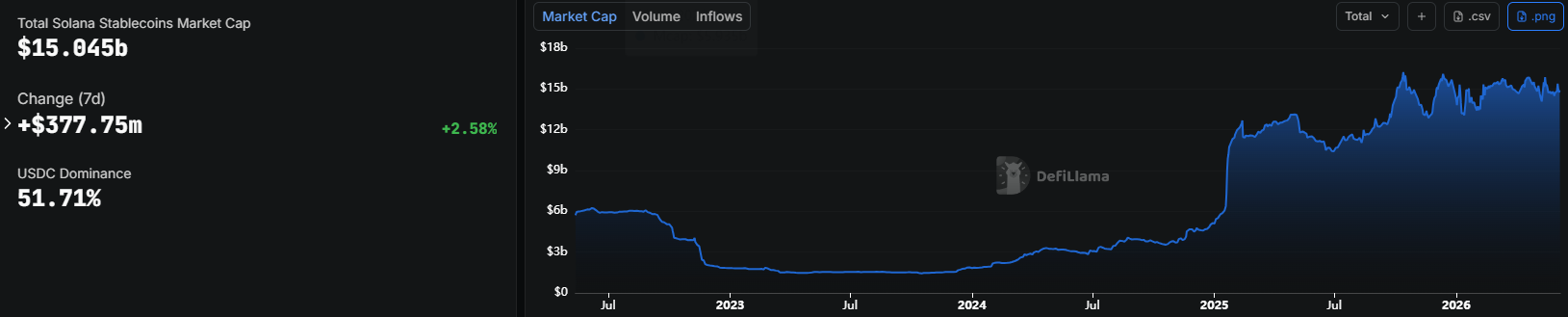
Solana’s stablecoin market capitalization is currently barreling toward its all-time high of $16 billion. Over the past seven days alone, more than $370 million in fresh liquidity has flowed into the Solana ecosystem. Perhaps most tellingly, Circle—the issuer of USDC—recently minted another $500 million worth of the asset directly on the Solana network. This represents a staggering 6% increase in supply within a single week.
To put this in perspective, while Ethereum remains the dominant fortress of stablecoin liquidity, holding roughly 64% of the total USDC supply, Solana’s 10.3% share is rapidly evolving. The contrast is sharp: while USDC supply on Ethereum contracted by 1.48% over the same period, Solana’s supply surged. This suggests a tectonic shift in capital allocation, with fresh liquidity increasingly viewing Solana as a primary entry point for decentralized finance (DeFi) activity.
A Chronology of the Recent Liquidity Shift
The current trend is not an overnight anomaly but rather the culmination of a months-long aggressive expansion strategy within the Solana ecosystem.
- Q1 2026: Solana saw a steady increase in institutional-grade stablecoin integration, bolstered by improved network uptime and throughput, which attracted liquidity providers looking for higher yield environments than those found on legacy chains.
- Early May 2026: Perpetual decentralized exchange (DEX) volumes on Solana began to decouple from the broader market, signaling an uptick in high-leverage trading strategies.
- Late May 2026: Total perp DEX volume on the network shattered all previous records, hitting $64.5 billion. This period marked the most significant month of speculative activity in the chain’s history.
- June 2026 (Present): The current surge in USDC minting confirms that while the speculative fervor may be cooling, the capital remains on-chain, transitioning from idle holdings to active trading collateral.
Supporting Data: Liquidity vs. Price
The most confounding aspect of the current market cycle is the disconnect between network utility and asset price. Despite the influx of capital, the SOL/ETH ratio has declined by nearly 3% this week. SOL itself has retreated to multi-month lows, with its Relative Strength Index (RSI) signaling that the asset is deeply oversold.
This "liquidity-to-price" mismatch suggests that the capital entering the system is not necessarily being used to accumulate and hold SOL. Instead, it is being utilized as "dry powder" for on-chain volatility. As DeFiLlama data indicates, the record-breaking perp DEX volumes are a direct reflection of a market obsessed with derivatives and short-term price discovery. When liquidity is tied primarily to leverage rather than long-term asset backing, it fails to exert the upward price pressure that investors typically associate with increased stablecoin inflows.
The "Speculative Engine": Memecoins and Perp DEXs
A central theme in current market discourse is Solana’s heavy reliance on "degen" activity. Platforms like Pump.fun have become the poster children for Solana’s revenue generation model. By enabling the rapid creation and trading of memecoins, these platforms have successfully attracted a massive, albeit highly volatile, user base.
Critics argue that this creates a "circular economy" of speculation. USDC flows into the network, is swapped for speculative memecoins or utilized as margin in perp DEXs, and then sits on the sidelines during market downturns. Because this capital is fundamentally tethered to the lifecycle of speculative trends, it does not represent "sticky" or "durable" capital formation. In institutional finance, durable capital refers to assets held for yield or long-term governance; in the current Solana context, the liquidity is highly transient, designed to chase the next 10x or 100x pump.
Official Perspectives and Market Implications
While the Solana Foundation has maintained a focus on infrastructure upgrades and institutional partnerships, the current market reality forces a harder look at the nature of this growth.
Market analysts remain divided on the implications:
- The Bullish Case: Proponents argue that high-velocity liquidity is a necessary precursor to institutional adoption. By proving the network can handle massive throughput and liquidity spikes, Solana is building the "plumbing" required for real-world assets (RWAs) and enterprise-grade applications.
- The Bearish Case: Skeptics warn that if the network’s primary use case remains speculative gambling, it risks a "liquidity exodus" once the current trend cycles subside. If the USDC is only there to trade tokens with no fundamental value, the network’s total value locked (TVL) could prove to be an illusion of growth.
Strategic Implications for Investors
For the retail and institutional investor alike, the current data offers a critical lesson in market analysis: liquidity does not always equal demand for the native asset.
Investors should watch for two specific indicators in the coming weeks:
- The Conversion Rate: How much of the USDC currently sitting on Solana is moving into long-term staking or lending protocols versus remaining on high-leverage DEXs?
- The "Stickiness" of USDC: If USDC inflows continue to climb even as memecoin activity wanes, it would signal that users are building legitimate, long-term DeFi positions on Solana.
Conclusion: A Network at a Crossroads
Solana is currently a victim of its own success. Its speed, low costs, and ease of use have made it the premier destination for speculative capital, yet this same efficiency has made it difficult for the network to transition from a "casino" for crypto-traders into a foundational layer for the global economy.
The surge in USDC supply is objectively a sign of a healthy, active, and thriving infrastructure. However, the price stagnation of SOL suggests that the market is waiting for more than just volume. Investors are looking for signals of long-term conviction—capital that stays, develops, and builds, rather than just bets and exits. Until that shift in capital behavior occurs, the "Solana Paradox"—where liquidity grows but price falters—is likely to persist. Whether this is a temporary phase in the network’s evolution or a systemic hurdle remains the most important question for the Solana ecosystem in the second half of 2026.
