

In a move that highlights the volatile interplay between speculative trading and fundamental technological innovation, dYdX Labs—the development force behind the renowned decentralized exchange (DEX) dYdX—has officially unveiled "Arcus." This new platform, built upon the Robinhood Chain, represents a significant expansion of the dYdX ecosystem. However, the market reaction to the unveiling serves as a cautionary tale in crypto-economics, where the "sell-the-news" phenomenon triggered a violent correction for the native DYDX token, effectively wiping out days of speculative gains.
The Genesis of Arcus: Bridging TradFi and DeFi
Arcus is positioned as a distinct entity, separate from the primary dYdX Chain. Its core value proposition is the integration of high-frequency, perpetual futures trading with the robustness of the Robinhood infrastructure. By leveraging the deep liquidity pools inherent to the Robinhood Chain, Arcus aims to provide traders with a seamless, 24/7 trading experience.
The platform launches with an initial suite of 95 tokenized stocks and perpetual contracts, offering a streamlined interface designed to lower the barrier to entry for retail participants. Perhaps most notably, Arcus has introduced a zero-fee structure, a move intended to incentivize volume and liquidity in an increasingly crowded DEX landscape.
The strategic vision behind Arcus is clear: to democratize financial access. Seong Seog Lee, Director of Product Management at Robinhood Crypto, emphasized the alignment between this project and Robinhood’s broader mission. "Robinhood has always believed that the financial system should work for everyone," Lee stated. "Arcus is the natural extension of that mission into the on-chain world."
Chronology of a Market Event
The trajectory of the DYDX token over the past week provides a textbook example of how market participants interact with anticipated news.
The Five-Day Ramp-Up
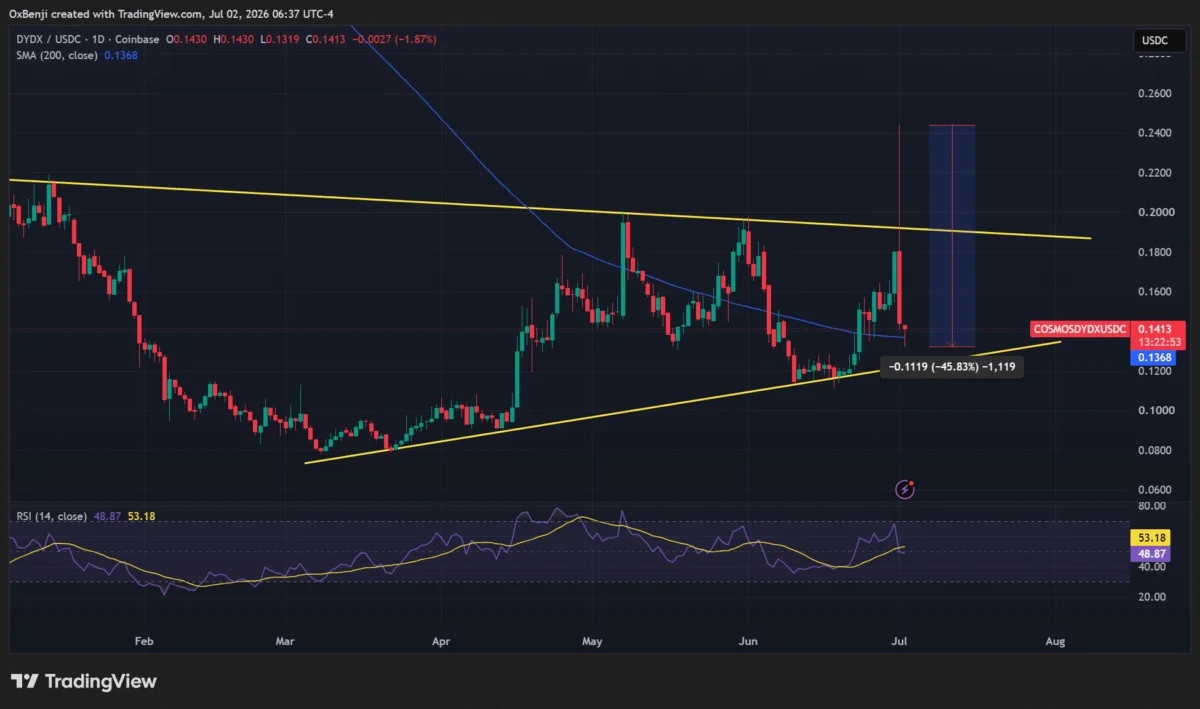
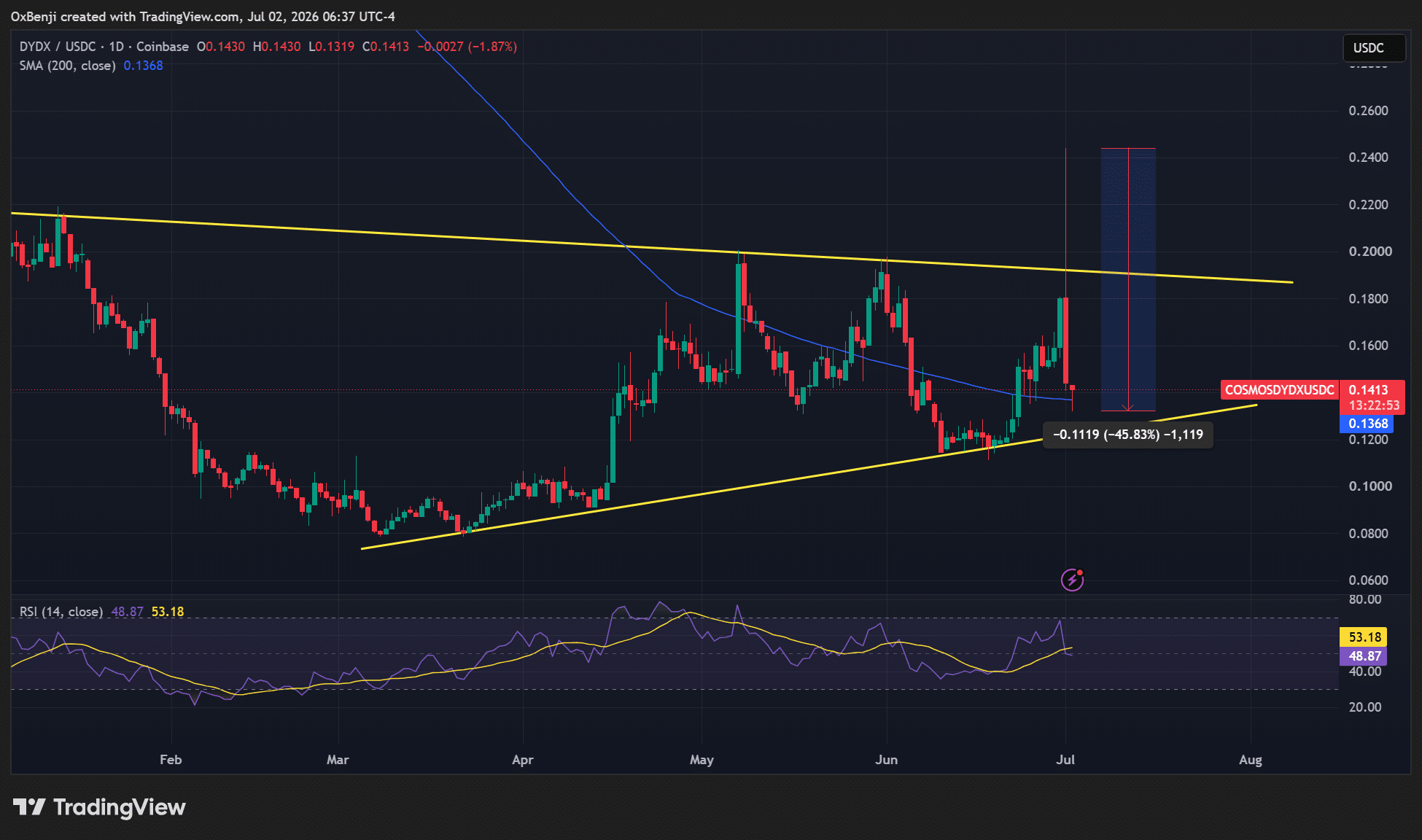
For five days leading up to the official launch, rumors regarding the "major ecosystem announcement" began to circulate through social media and crypto-trading forums. Speculation served as a powerful engine, driving market participants to front-run the news. During this period, the DYDX token experienced a meteoric rise, nearly doubling in valuation as traders sought to capitalize on what was widely perceived as a "game-changing" development.
The Launch and the "Sell-the-News" Reversal
As the official announcement hit the wires, the sentiment shifted instantaneously. The market, which had already priced in a significant premium, reacted with a swift, aggressive sell-off. As of the time of reporting, the DYDX token has plummeted by 45%, erasing the entirety of the gains accumulated during the preceding week. This classic "buy the rumor, sell the news" event highlights the fragility of sentiment-driven rallies in the digital asset space.
Analyzing the Disconnect: Why the Token Crashed
A critical point of confusion for many retail investors was the perceived relationship between the new Arcus platform and the DYDX governance token. Despite the frenzy, the dYdX Foundation was quick to issue a clarifying statement to stabilize market expectations.
"DYDX is, and remains, the governance and staking token of dYdX Chain," the Foundation clarified. "Its mechanics, supply, and operational characteristics remain unchanged."
This statement was the catalyst for the subsequent dump. Investors who had purchased the token under the impression that Arcus would somehow integrate or benefit the tokenomics of the native DYDX asset realized that the two entities were operationally decoupled. Without a direct value-accrual mechanism connecting the Arcus platform to the DYDX token, the speculative demand evaporated overnight.
Data-Driven Insights: Beneath the Surface
Analysis from on-chain data providers like Santiment offers a deeper look at the mechanics of the crash. While the "Weighted Sentiment" of the token reached record highs during the buildup, the underlying flow of tokens told a different story.
Exchange Flows and Accumulation
Data reveals that while the price was surging, the supply of DYDX on exchanges spiked. Conversely, the volume of tokens held in cold wallets or off-exchange remained relatively stagnant. This divergence is a classic "red flag" in technical analysis. It indicates that long-term holders were not necessarily accumulating the token; rather, speculators were moving their holdings onto exchanges in anticipation of selling into the liquidity provided by the hype-driven rally.
Technical Support and Future Outlook
Despite the sharp decline, technical analysts are pointing to potential "price floors." The 200-day Moving Average (MA) and historical trendline support are being watched closely by market participants. For the current decline to reverse into a buying opportunity, broader market sentiment—which is currently tethered to macroeconomic factors and the wider crypto-market cycle—must stabilize. If the token can consolidate above these key support levels, it may signal that the "weak hands" have been shaken out, leaving a more stable foundation for long-term holders.
Implications for the dYdX Ecosystem
The launch of Arcus has significant implications for the future of dYdX, even if the short-term price action of the token was chaotic.
Expanding the Product Suite
The roadmap for Arcus is ambitious. Beyond the initial offering of perps and stocks, the platform intends to integrate pre-IPO offerings and, in a significant evolution, allow tokenized stocks to be used as collateral. This would essentially bridge the gap between traditional equities and DeFi lending protocols, a feat that would solidify the dYdX ecosystem as a leader in the evolution of decentralized finance.
Regulatory and Strategic Considerations
The partnership with the Robinhood ecosystem brings both opportunities and scrutiny. By leveraging Robinhood’s infrastructure, dYdX is tapping into a massive, compliant retail user base. However, this also subjects the project to the complexities of regulatory oversight in the U.S. and beyond. The ability of Arcus to maintain its decentralized ethos while operating within a framework that interfaces with TradFi giants will be the ultimate test of its longevity.
The Path Forward: Can Arcus Thrive?
The "Arcus Paradox"—where the success of a technological launch coincides with a decline in the value of the governance token—serves as a reminder that DeFi protocols must clearly articulate the relationship between their products and their tokens.
For dYdX, the focus must now shift from the hype of the launch to the utility of the product. The success of Arcus will be measured not by the price of the DYDX token in the short term, but by the volume of trade, the diversity of the asset pool, and the efficiency of the zero-fee execution.
If Arcus can successfully facilitate a high volume of trades and provide a seamless user experience, it will eventually generate utility that may, in turn, affect the broader dYdX ecosystem. Until then, the market has demonstrated that it is unwilling to pay a premium for speculative potential when the tokenomics remain unchanged.
Conclusion
The launch of Arcus on the Robinhood Chain stands as a milestone for decentralized perpetual trading, yet the immediate market aftermath highlights the risks of speculative front-running. As the dust settles on the 45% correction, the industry is left with two distinct realities: a promising new platform that could redefine retail access to complex financial instruments, and a token that must find its footing based on actual governance value rather than hype.
For investors, the event is a sober reminder that in the crypto-economy, the most critical news is often not the headline itself, but the underlying structure of the assets involved. As Arcus begins its journey, its performance will likely serve as a barometer for how traditional and decentralized finance can, or cannot, be successfully bridged in the coming years. Whether this correction represents a bottoming out or a transition into a longer period of consolidation remains to be seen, but one thing is certain: the eyes of the DeFi community will be firmly fixed on the growth of the Arcus platform.
