

The promise of Decentralized Finance (DeFi) has always been rooted in the democratization of capital and the optimization of market efficiency. At the heart of this promise lies the concept of "concentrated liquidity"—a mechanism designed to allow liquidity providers (LPs) to allocate their assets within specific price ranges, thereby maximizing capital efficiency and earning potential. However, a damning new report from data analytics firm Dune reveals that this architectural innovation has hit a significant snag: a staggering volume of user-contributed liquidity remains dormant, failing to facilitate trades or generate yield for its providers.
The Core Problem: A Multi-Million Dollar Drain
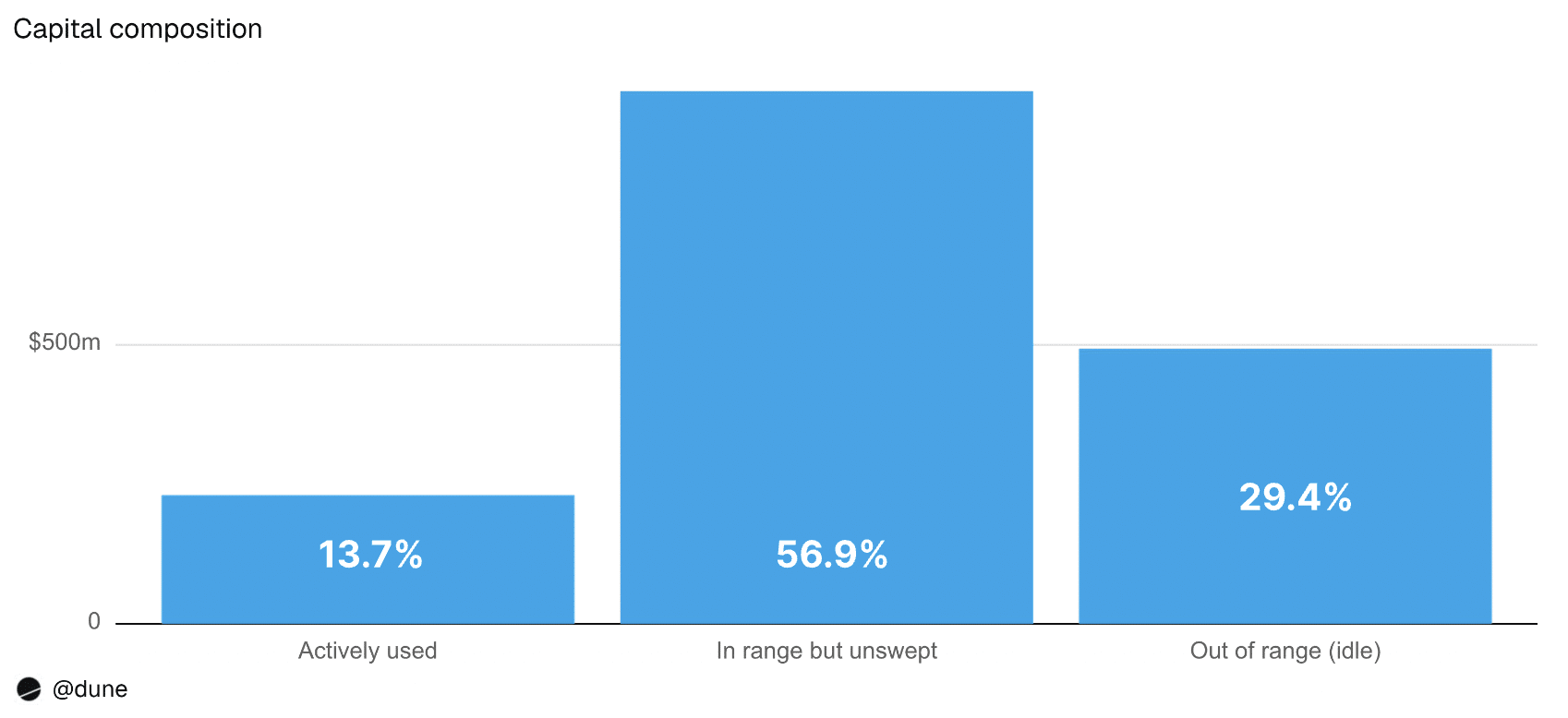
According to the comprehensive study conducted throughout the first half of 2026, approximately 29.4% of all liquidity provided to major decentralized exchanges (DEXs) sits entirely outside the range of active trading. When liquidity is "out of range," it effectively becomes invisible to the market’s price discovery mechanism. Consequently, these funds generate zero trading fees, turning what was intended to be an active, high-yield asset into a stagnant, unproductive holding.
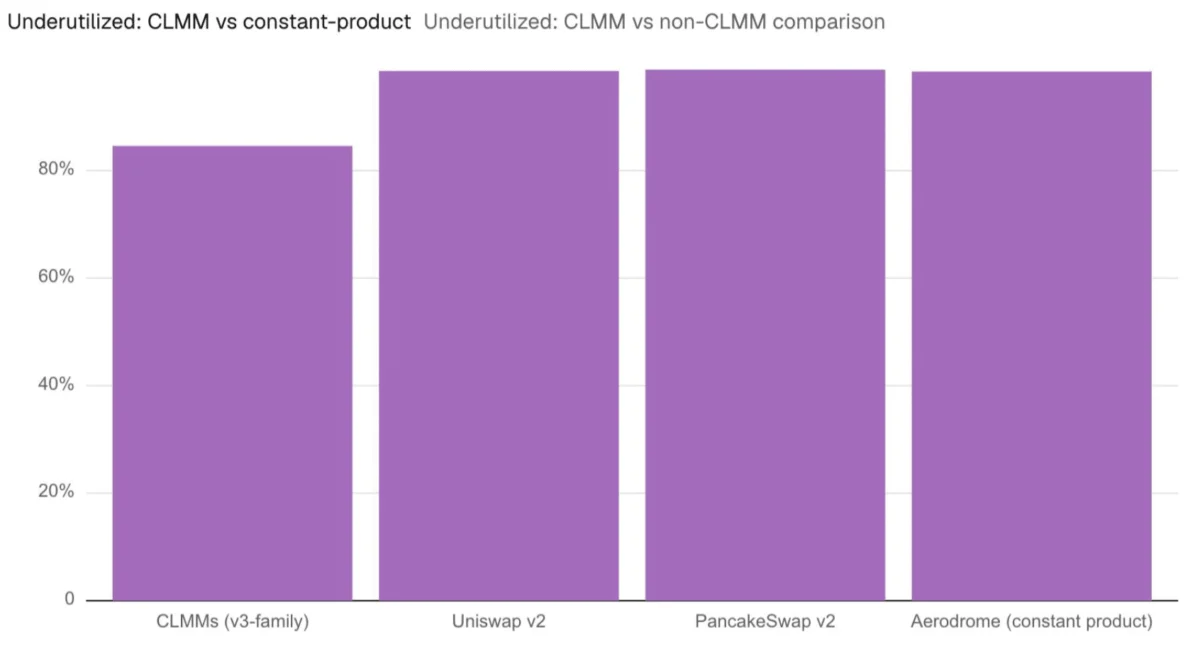
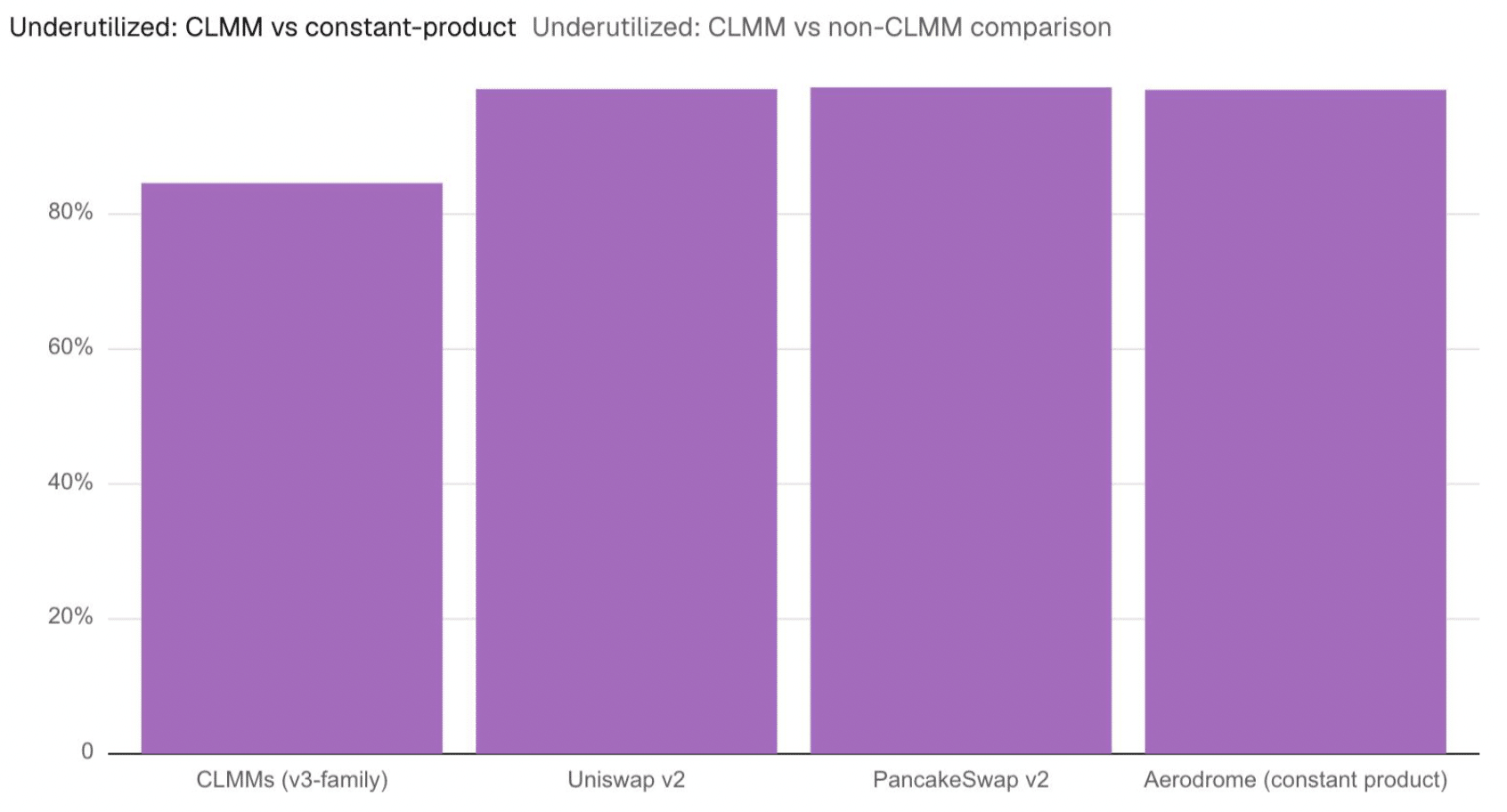
The scale of this inefficiency is immense. The report, which analyzed four prominent protocols—Uniswap v3, Uniswap v4, PancakeSwap v3, and Aerodrome Slipstream—estimates that this phenomenon accounts for approximately $542 million in idle capital per week. Extrapolated over a full year, this represents a loss of roughly $150 million in fee income that should have been captured by LPs. Perhaps more alarming is the finding that when considering liquidity that is technically available but functionally underutilized, a massive 85% of total capital is failing to reach its full potential.

Chronology of the Crisis: The Rise and Stagnation of Concentrated Liquidity
To understand how the industry reached this point, one must look at the evolution of automated market makers (AMMs).
- The Pre-Concentrated Era: Early versions of DEXs utilized "x*y=k" models, where liquidity was spread across the entire price curve from zero to infinity. While simple, this was notoriously capital-inefficient.
- The V3 Revolution: The introduction of Uniswap v3 popularized concentrated liquidity. By allowing LPs to define specific price "ticks," the protocol drastically increased the efficiency of capital. In theory, this meant smaller amounts of money could provide deeper liquidity and earn more fees.
- 2024–2025 Adoption: As protocols like PancakeSwap v3 and Aerodrome Slipstream adopted similar models, the complexity of managing these positions increased. LPs began to realize that maintaining a "range" required constant monitoring of market volatility.
- The 2026 Reality Check: As of the first half of 2026, the Dune data suggests a market-wide failure to manage these complex positions. The "set it and forget it" mentality has left hundreds of millions of dollars stranded as asset prices drifted outside of the pre-set, narrow bands defined by users.
Supporting Data: Dissecting the Idle Capital
The data indicates that this is not merely a temporary market fluctuation, but a structural behavioral issue. The report highlights that over $200 million in idle liquidity has remained in a stagnant state for more than 90 days. This duration serves as a smoking gun: if a significant portion of capital is not being repositioned for three months, it is clear that many liquidity providers lack the technical tools, time, or expertise to actively manage their positions.
The Retail-Institutional Divide
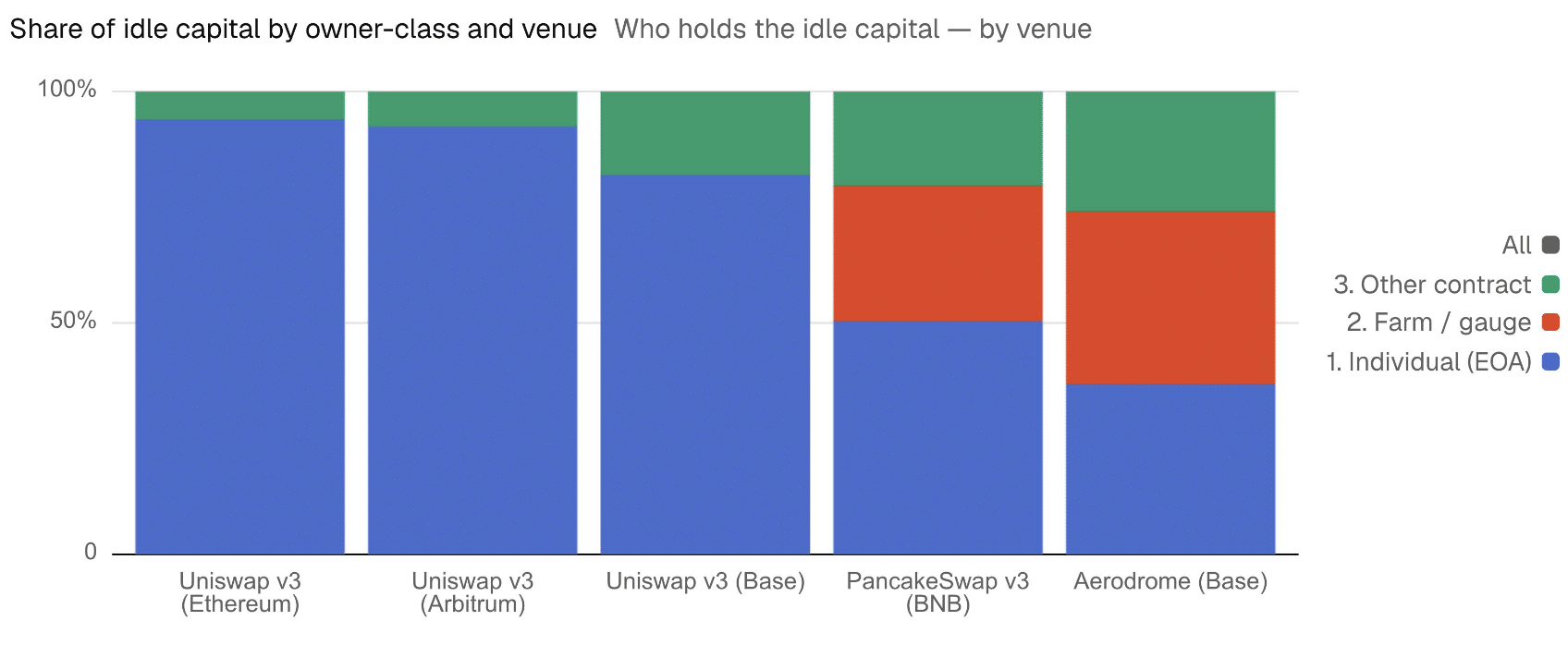
The study provides a striking breakdown of who is actually losing money. It reveals that individual retail investors are bearing the brunt of the inefficiency, while automated managers—often operated by sophisticated institutional entities or algorithmic strategies—maintain significantly higher capital activity.
- Ethereum (Mainnet): Individual wallets accounted for 94% of idle capital and 91% of the total liquidity within Uniswap v3.
- Arbitrum: On this Layer 2 network, individuals oversaw 92% of all idle liquidity.
- Base: A more nuanced picture emerged here, where smart contracts held roughly 50% of total liquidity; however, individual users still accounted for 82% of the idle capital.
In stark contrast, automated management solutions show a success rate that dwarfs the individual user. Only 6.5% of positions managed by automated bots fall out of range, compared to the roughly 30% failure rate observed in manual, individual-managed wallets.
The Uniswap v4 Dilemma: Innovation Without Resolution
One might expect that the transition to Uniswap v4 would resolve these liquidity issues. The latest iteration of the protocol introduced "hooks"—customizable code that allows developers to integrate external logic into liquidity pools. The industry hoped these hooks would enable "active liquidity management," where idle capital could automatically be deployed into secondary yield-generating strategies (such as lending protocols) when it is not being utilized for trading.
However, the Dune report delivers a sobering verdict: the idle liquidity issue persists even in the v4 ecosystem. Approximately 30.5% of liquidity on Uniswap v4 is currently out of range, mirroring the inefficiencies found in v3. Furthermore, the adoption of the very tools designed to solve this is lagging; only 10% of v4’s Total Value Locked (TVL) actually utilizes hooks. Even more concerning is the finding that none of the currently deployed hooks are successfully generating yield from idle liquidity.
Implications for the Future of DeFi
The implications of these findings are profound for both the future of decentralized exchanges and the LPs who fuel them.
1. The Death of "Passive" LPing
The era of passive liquidity provision on advanced AMMs is effectively over. The data proves that manual, retail-level management of concentrated liquidity is a losing game. As the market becomes more volatile, the requirement for active, real-time rebalancing becomes more stringent. This creates a high barrier to entry for the average user.
2. The Rise of "Liquidity-as-a-Service"
If retail users cannot manually manage their liquidity, they will increasingly delegate this responsibility to third-party automated managers. We are likely to see a surge in demand for "vaults" and "managed pools" where users deposit their assets and pay a performance fee to an algorithm that handles the range-shifting. While this solves the efficiency problem, it introduces a new risk: centralization. If the majority of liquidity is funneled through a few dominant, automated vault providers, the "decentralized" nature of these exchanges could be compromised.
3. A Call for Protocol-Level Automation
The failure of Uniswap v4 hooks to meaningfully address the idle capital problem suggests that the solution may need to be baked directly into the protocol core rather than left as an optional feature for developers. If DEXs want to remain competitive against centralized exchanges (CEXs), they must find a way to make liquidity "self-healing." This could involve dynamic, self-adjusting ranges or native integration with lending protocols that automatically sweep idle assets into active use.
4. Market Sentiment and User Retention
The loss of $150 million in annual fees is not just a statistical anomaly; it is a direct blow to the attractiveness of DeFi. If LPs consistently see their earnings eroded by capital inefficiency, they will eventually move their funds to more lucrative avenues, such as staking or traditional yield-bearing assets. For DeFi to survive and thrive, the user experience must bridge the gap between technical complexity and financial performance.
Conclusion
The Dune report serves as a wake-up call for the entire DeFi ecosystem. While the technical architecture of concentrated liquidity was a breakthrough, it has outpaced the capabilities of the average user. The "Efficiency Paradox"—where a system designed for maximum efficiency results in systemic underutilization—is a clear indication that the infrastructure of tomorrow must be more intuitive, more automated, and more resilient. Until the gap between idle capital and active liquidity is closed, the promise of decentralized finance will remain only partially fulfilled.
