

Uniswap, the decentralized finance (DeFi) ecosystem’s premier automated market maker (AMM), has taken a decisive step toward transforming its economic model. In a move that has sparked intense debate across the blockchain industry, the protocol has officially submitted three governance proposals aimed at activating fees across multiple versions of the DEX and across several blockchain networks.
This pivot toward a more aggressive revenue-capture strategy marks a pivotal moment for Uniswap, as it attempts to balance the interests of its liquidity providers (LPs), its governance token holders, and the long-term sustainability of the protocol in an increasingly crowded market.
The Core Proposals: Scaling Revenue Across the Ecosystem
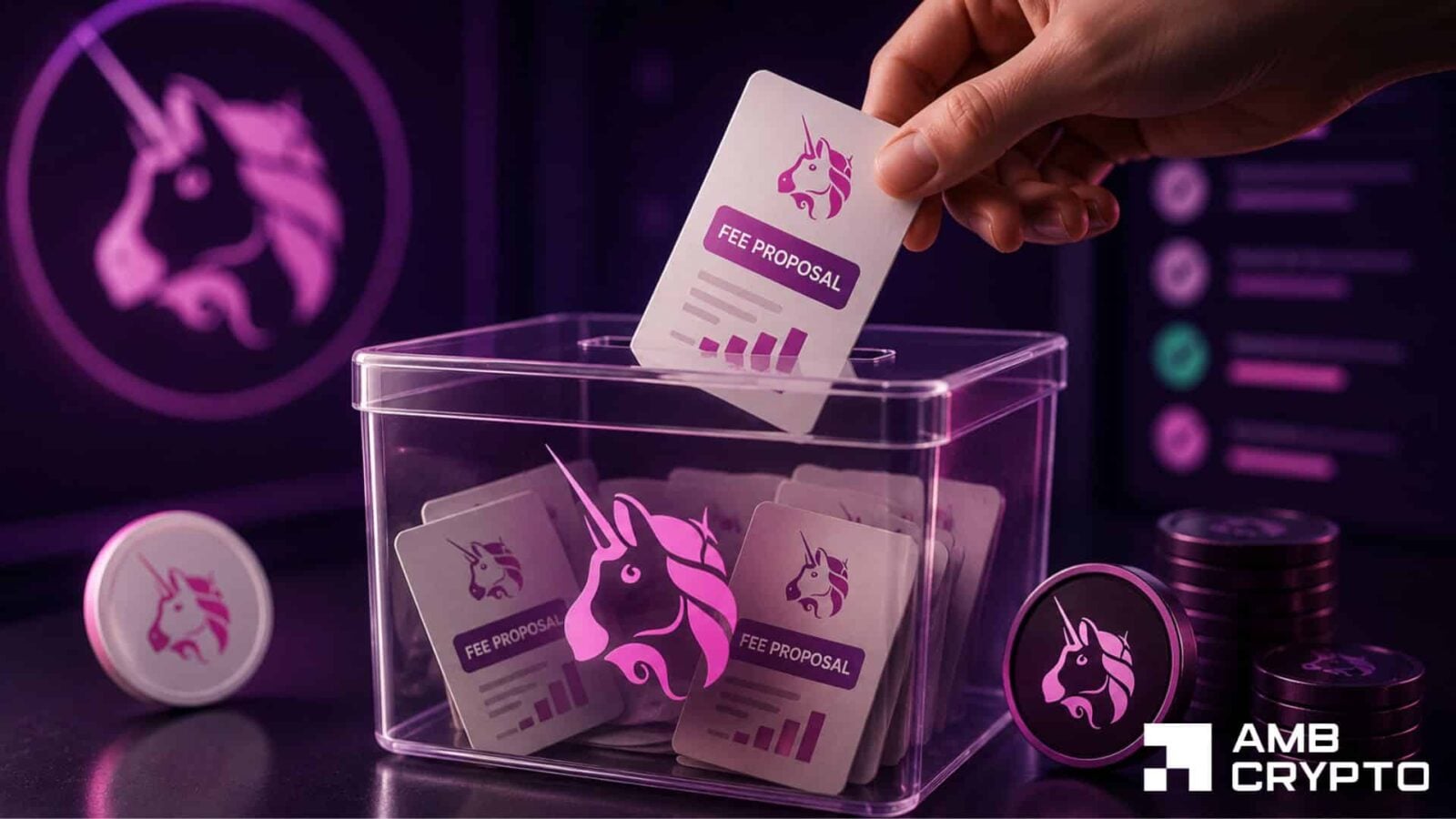
The latest governance offensive centers on three primary proposals designed to redirect a portion of swap fees directly into the UNI burn mechanism.
The first proposal targets Uniswap V2 and V3 deployments on the newly launched Robinhood chain. Since its debut earlier this month, the Robinhood L2 has demonstrated rapid growth, acting as a magnet for decentralized applications. Uniswap’s performance on this new chain has been notable; in just over a week, the DEX surpassed $1 billion in trading volume, signaling a strong user base eager to capitalize on the L2’s efficiency.
The second and third proposals are aimed at the protocol’s most advanced iteration, Uniswap V4. These proposals seek to activate fees across a broad spectrum of networks, including Ethereum, Base, Arbitrum, the Robinhood chain, BNB Chain, Polygon, and Optimism. Hayden Adams, the CEO of Uniswap, has confirmed that an additional proposal covering the remaining V4-enabled chains is currently in the pipeline and will be submitted shortly.
Adams has been clear regarding the strategic intent behind these moves: “Both direct all new protocol fees into the existing UNI burn mechanism. Based on current volumes, especially on the Robinhood chain, we expect the impact on the UNI burn rate to be substantial.”
A Chronology of the Shift
To understand the weight of this decision, one must look at the historical relationship between Uniswap and its revenue model. Since its inception in 2018, the protocol has prioritized liquidity provider incentives, effectively acting as a high-volume, low-margin utility for the DeFi space.
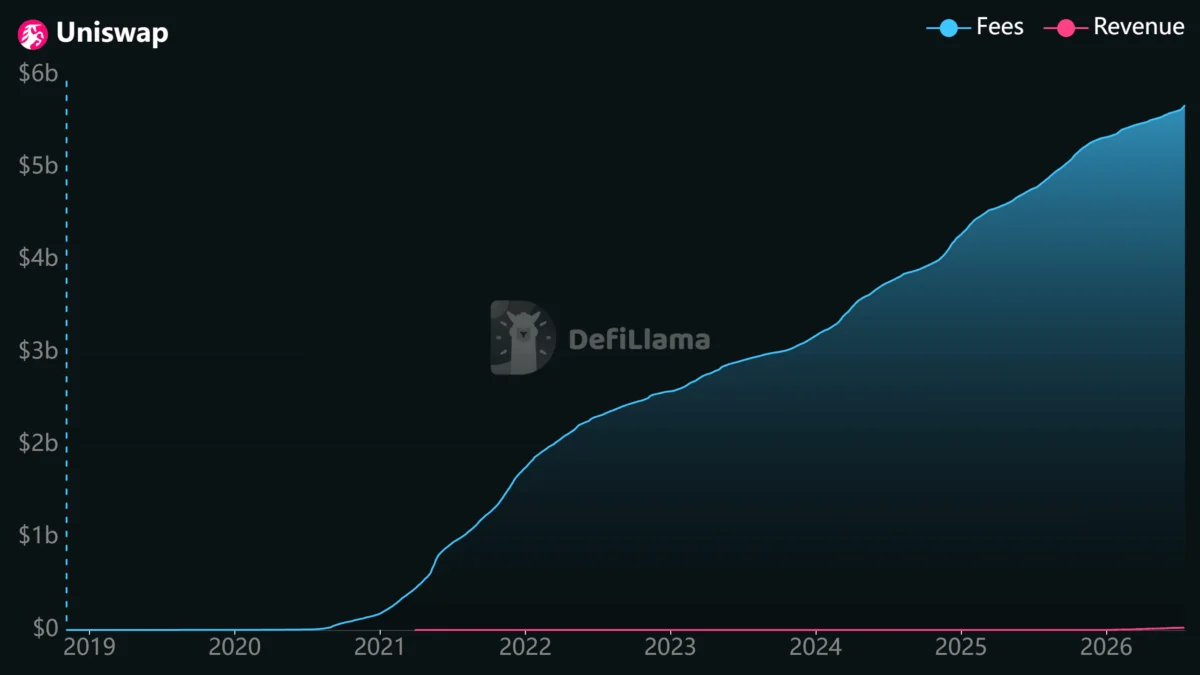
- 2018–2023: The LP-Centric Era: For years, the vast majority of swap fees collected by the DEX went directly to the LPs, who provide the capital necessary for trades to occur. Cumulative fees paid to LPs since 2018 have reached a staggering $5 billion. In stark contrast, the protocol itself has generated only $25 million in cumulative revenue.
- Early 2026: The Rise of L2s: The launch of the Robinhood L2 and the subsequent surge in volume signaled a new phase for Uniswap, prompting governance participants to revisit the question of protocol-level fee extraction.
- July 2026: Formal Proposals: The governance community formally submitted the three-part fee activation plan, initiating a period of fierce public debate regarding the impact on market competitiveness.
The Economic Implications: Burning vs. Earning
At the heart of the debate is the concept of "protocol revenue." In a DEX, fees are typically paid by traders and collected by LPs to compensate them for the risks of impermanent loss and capital allocation. By activating protocol fees, Uniswap effectively takes a "cut" of these swap fees, which are then diverted to the UNI token economy through a burn mechanism.
The potential impact on the UNI token is significant. As of the latest reporting, the protocol has burned a total of 107.49 million UNI tokens. The recent uptick in activity, combined with the anticipation of these fee activations, has already seen the weekly burn rate surge by 300%—climbing from $51,000 to over $160,000 in just seven days.
However, critics argue that this shift represents a "tax" on liquidity. If the cost of providing liquidity increases, LPs may migrate to rival platforms, potentially leading to increased slippage and higher costs for traders.
Stakeholder Reactions: The Debate Over Competitiveness
The proposal has been met with mixed reactions, exposing a rift between those who prioritize long-term protocol treasury growth and those who fear for the immediate health of the liquidity ecosystem.
The Opposition: Gamma Strategies and the Competitive Landscape
Among the most vocal critics is Gamma Strategies, a liquidity management firm that provides essential services to Uniswap users. Gamma has formally opposed the V4 fee proposals, arguing that they jeopardize the protocol’s competitive edge.
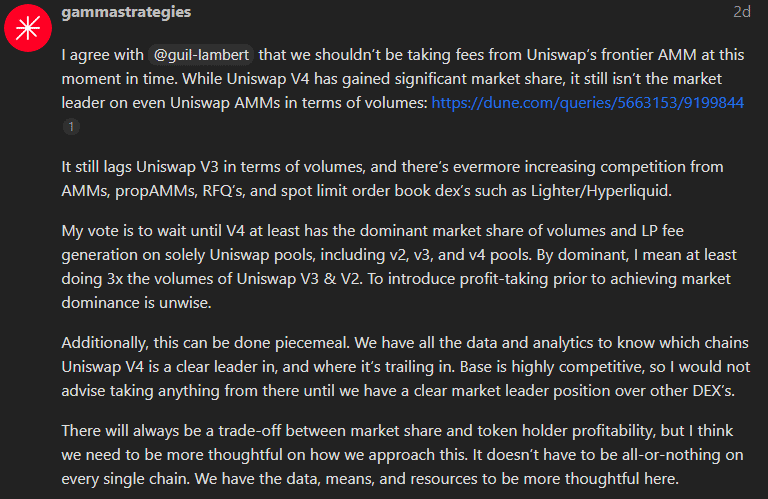
In a written response, the team at Gamma noted: “It (V4) still lags Uniswap V3 in terms of volumes, and there’s ever-more increasing competition from AMMs, propAMMs, RFQs, and spot limit order book DEXs such as Lighter/Hyperliquid.”
The core of their argument is that Uniswap is not a monopoly. In an era where decentralized exchange options are proliferating, implementing a fee that effectively reduces LP yield could drive capital toward more "LP-friendly" competitors.
The Proponents: Strengthening the UNI Token
On the other side of the aisle, supporters of the fee activation argue that a sustainable protocol requires a sustainable treasury. By creating a deflationary pressure on the UNI token, the protocol can increase the incentive for long-term holding and governance participation. For these stakeholders, the $25 million in historical revenue is a missed opportunity that has left the DAO’s treasury underfunded compared to the sheer volume of trades it facilitates.
Market Analysis: The UNI Price Trajectory
The market has been closely tracking the news, with the price of UNI showing high sensitivity to the governance developments. The integration with the Robinhood L2 was heavily front-run by traders, leading to a 41% price surge in July, climbing from $2.70 to $3.80.
However, this momentum has faced headwinds. The price has struggled to break through the 200-day Moving Average, a key indicator for long-term sentiment. Technical analysts suggest that while the current fee proposals provide a fundamental narrative for growth, the price action remains tied to the broader market and the sustained adoption of the Robinhood L2.
If the proposals pass and the market perceives the move as a successful monetization of the protocol without significant loss of liquidity, we could see a push toward higher price levels. Conversely, if the community perceives a decline in trading volume due to increased fees, the price may find support in the $3.00 range as the initial hype fades.
Future Outlook: A Delicate Balancing Act
The road ahead for Uniswap is complex. The protocol is effectively moving from a phase of "growth at all costs" to a phase of "value extraction." This is a natural evolution for a mature DeFi project, but one that is fraught with the risk of platform fragmentation.
If the governance community can successfully implement these fees without triggering a mass exodus of liquidity, Uniswap will have established a robust, sustainable revenue model that could set a new standard for decentralized organizations. However, if the warnings from LPs like Gamma Strategies prove prophetic, the protocol may find itself in a race to the bottom against more agile, lower-cost competitors.
For investors and developers alike, the coming weeks will be crucial. The governance process will serve as a stress test for the DAO’s decision-making capabilities. Will the community prioritize short-term token burning at the expense of liquidity, or will they find a tiered fee structure that keeps the protocol competitive while generating the revenue needed to secure the future of the Uniswap ecosystem?
As Hayden Adams and the rest of the Uniswap leadership navigate these proposals, the crypto community watches on. The result will not only define the future of the UNI token but will likely shape the economic landscape of decentralized trading for years to come. Whether this transition leads to a new golden age for Uniswap or opens the door for its competitors remains the most pressing question in the current DeFi landscape.
