

The landscape of decentralized finance (DeFi) is marked by rapid innovation and, occasionally, abrupt transitions. In the latest development shaking the aggregator sector, the operating entity behind Odos—a prominent DeFi liquidity and routing protocol—has officially announced that it will permanently wind down its operations. This decision marks the end of an era for the platform, which had positioned itself as a critical bridge for users navigating the fragmented liquidity of decentralized exchanges.
As the company prepares to shutter its doors, users are facing a strictly defined timeline for exiting their positions. The announcement, released this week, provides a clear roadmap for the platform’s final days, emphasizing that while the corporate entity is dissolving, the underlying blockchain components remain decentralized and operational.
The Shutdown Chronology: A Multi-Stage Exit
The wind-down process for Odos is not an instantaneous event but a structured, multi-phase withdrawal of services designed to give users ample opportunity to secure their assets. The team behind the protocol has outlined the following critical dates:
- Immediate Effect: The platform has already implemented restrictive measures. New account registrations, the creation of new wallets, and the placement of new limit orders have been strictly disabled. This move is designed to prevent new capital from being locked into a system that will soon lose its interface support.
- July 27 (Read-Only Mode): The application will transition to a "read-only" state. During this period, users will no longer be able to execute swaps or interact with the protocol’s UI for active trading. Instead, the interface will serve as a historical ledger, allowing users to view their transaction history and remaining balances.
- July 30 (Final Cessation): This marks the permanent end of all company-operated services. Beyond this date, the team has confirmed that there will be no further development, technical support, or infrastructure maintenance. The interface will be fully taken offline.
The urgency of this timeline cannot be overstated. For users who have utilized Odos’s social or email-based login features to create wallets, the team has issued a stern directive: users must transfer their assets to self-custodial wallets or export their private keys immediately. While the team noted that access instructions will persist on a static support page post-shutdown, the lack of active maintenance means that reliance on these legacy systems carries inherent risks.
Understanding the Decentralized Distinction
A critical aspect of the Odos shutdown—and one that the team has gone to great lengths to clarify—is the distinction between the "operating company" and the "protocol."
In the world of DeFi, "non-custodial" is the standard for trustless interaction. The Odos team underscored that because the platform is non-custodial, the underlying assets of its users remain on-chain at all times. The company’s closure does not imply a "liquidation" of user funds in the traditional financial sense; rather, it implies the removal of the specific web portal that facilitated the interaction.
Furthermore, the team moved to decouple the fate of the project’s native token, ODOS, from the fate of the company. The ODOS token will continue to exist on the blockchain, governed by its existing smart contracts, independent of the entity that built the front-end. Similarly, the Odos DAO (Decentralized Autonomous Organization) operates independently of the corporate entity. The DAO will retain its governance structure and will be responsible for determining its own future path, separate from the company’s decision to cease operations.
Security Warnings and the Threat of Opportunistic Scams
In the wake of the shutdown announcement, the Odos team has issued a categorical warning to the community regarding potential security threats. Historically, when a DeFi project announces a wind-down or a transition, bad actors capitalize on the confusion to launch phishing campaigns.
The team was explicit in its communication: There will be no token migrations, no new product launches, no token claims, and no airdrops.
This warning serves as a vital safeguard for the community. The team cautioned users to treat any direct messages, unofficial support accounts, or third-party websites claiming to offer "migration services" or "emergency claims" as sophisticated scams.
"Never share your seed phrase," the team reiterated. "Never sign transactions from websites claiming to facilitate an Odos migration unless that information is explicitly confirmed through the DAO’s official, verified channels." The risk of "drainer" websites—which look like the original interface but are designed to siphon funds from a connected wallet—is exceptionally high during periods of platform instability.
Market Reaction: The ODOS Token in Focus
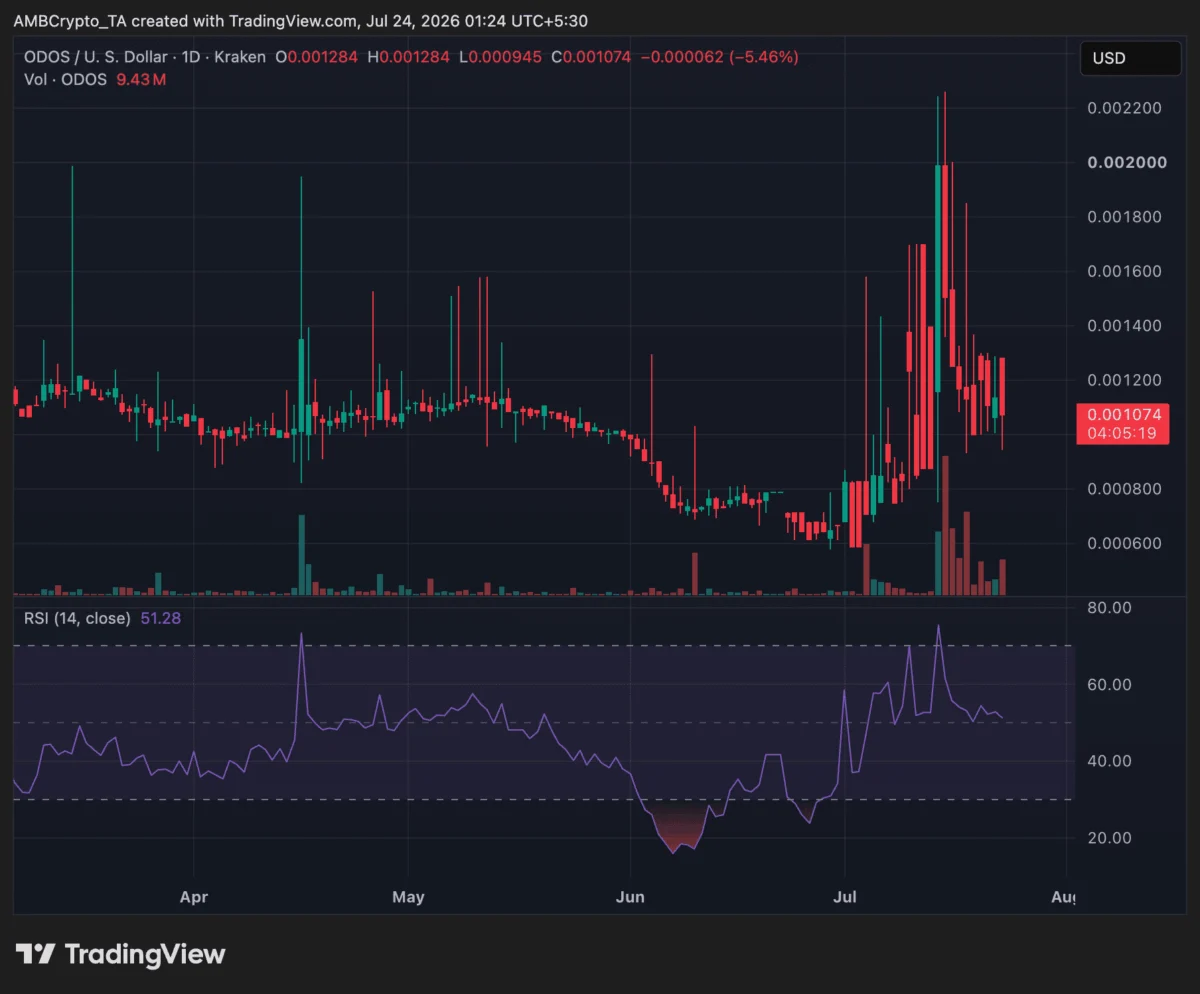
The news of the impending shutdown triggered an immediate, albeit measured, reaction in the secondary markets. Following the announcement, the ODOS token saw a noticeable decline in value. At press time, TradingView data indicated that the token was trading around $0.00107, representing a decline of approximately 5.5% over a 24-hour window.
While a 5.5% drop in the volatile world of crypto-assets may seem modest, it occurred alongside significantly elevated trading volumes. This indicates that a segment of the token holder base chose to exit their positions immediately upon hearing the news, while others remained to observe the market’s reaction.
Technical analysis provides a nuanced view of the situation. Despite the downward pressure, the token’s Relative Strength Index (RSI) was hovering near 51. In technical terms, an RSI of 51 suggests that the token is currently in a "neutral" zone. It is neither deeply oversold (which would typically be below 30) nor overbought (above 70). This suggests that while the news was undoubtedly bearish for the token’s short-term prospects, the market has not yet devolved into a panic-driven fire sale. Investors appear to be waiting for further clarification from the DAO regarding the future utility of the token.
Broader Implications for the DeFi Aggregator Space
The closure of the company behind Odos serves as a poignant reminder of the fragility of the "middle layer" in DeFi. Aggregators perform the essential service of finding the best prices across multiple decentralized exchanges, saving users time and slippage costs. However, these services are often run by centralized teams that must navigate high operational costs, regulatory uncertainty, and the challenges of maintaining complex routing algorithms.
When a team decides to wind down, it raises existential questions for the protocol. Can the DAO sustain the infrastructure without the original developers? Is the code base open-source enough to be picked up by community maintainers?
For the broader DeFi ecosystem, this event underscores the importance of true decentralization. While the "company" is gone, the "protocol" survives. This is the promise of Web3: that software, once deployed, can continue to function in its immutable state. However, the reliance on a front-end portal remains the Achilles’ heel for many users who are not technically proficient enough to interact directly with smart contracts via block explorers.
Looking Ahead: What Happens Next?
As July 30 approaches, the focus for the Odos community will shift from the company’s exit to the DAO’s potential pivot. The governance forums are expected to become the primary venue for discussing whether the protocol should be archived or if a community-led effort can revive or maintain the service.
For now, the priority for all stakeholders remains the orderly withdrawal of assets. The transition from an active, company-supported platform to a decentralized, community-owned relic is a process that requires vigilance and caution.
In the final summary, the story of Odos is a cautionary tale about the lifecycle of DeFi ventures. It highlights that in this ecosystem, "permanence" is a feature of the blockchain, not necessarily the organization. As users navigate these final days, the primary takeaway is the necessity of self-reliance. By moving assets to secure, personal wallets and ignoring the sirens’ song of opportunistic scammers, users can ensure that their experience with the protocol concludes safely, even as the lights go out on the platform that made it possible.
As the calendar turns toward the end of July, the crypto community will be watching closely to see how the Odos DAO navigates its newfound independence—and whether this shutdown marks the final chapter or merely a difficult transition for the protocol’s legacy.
