


Is a familiar, chilling wind blowing through the corridors of Decentralized Finance (DeFi)? For investors and developers alike, the landscape of the crypto market is once again dominated by a pervasive sense of Fear, Uncertainty, and Doubt (FUD). Just as the sector appeared to be finding its footing after a brutal first half of the year, a string of new exploits has cast a long shadow over the ecosystem, forcing the industry to confront its most persistent weakness: the structural insecurity of cross-chain bridges.
The Context: A Market Still Healing from Q1-Q2
To understand the gravity of the current situation, one must look back at the harrowing cycle of the first and second quarters of 2024. That period was defined by three massive, back-to-back security breaches that drained over $600 million in total value from the DeFi ecosystem. The fallout was catastrophic; liquidity fled protocols in a panic, causing the Total Value Locked (TVL) in DeFi to crater to just over $65 billion.
The contagion was rapid. Ethereum, the bedrock of decentralized applications, saw more than $10 billion in liquidity evaporate in less than 48 hours. This period served as a painful reminder of how fragile the "trustless" promise of DeFi can be when smart contract vulnerabilities are exposed. As the market entered July, analysts were optimistic, noting that TVL had climbed by more than $10 billion, marking the strongest monthly recovery since the spring. However, that recovery is now under siege.
Chronology of the Recent $35.55 Million Wave
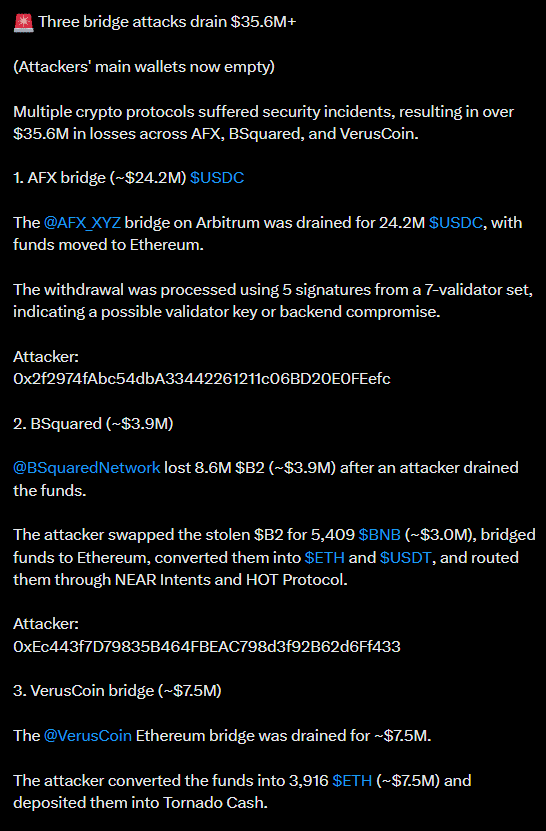
The latest turbulence began with a flurry of activity that left the industry reeling. In a single, dark day for decentralized finance, three separate protocols were compromised, resulting in an aggregate loss of $35.55 million. While the nominal value of these hacks is lower than the massive heists of the previous quarter, the psychological impact has been disproportionately high, with many market participants labeling it the worst 24-hour period for DeFi security in months.
The Breakdown of the Exploits:
- AFX (The Largest Hit): The primary target of this wave was the AFX bridge. Attackers successfully drained $24.2 million in USDC from its Arbitrum bridge. The stolen funds were quickly bridged to the Ethereum mainnet, further obfuscating the trail and demonstrating a sophisticated understanding of cross-chain liquidity movement.
- VerusCoin: Shortly after the AFX incident, it was discovered that VerusCoin had also fallen victim to a bridge exploit. The attackers made off with approximately $7.5 million, highlighting the systemic nature of these vulnerabilities.
- BSquared Network: Completing the trifecta of chaos, the BSquared Network saw 8.6 million of its native B2 tokens drained, valued at roughly $3.9 million.
The Achilles’ Heel: Cross-Chain Bridge Infrastructure
The most alarming aspect of these three exploits is not just the volume of stolen funds, but the uniformity of the attack vector. All three protocols suffered from vulnerabilities in their cross-chain bridge architecture.
Bridges are the "connective tissue" of the multi-chain ecosystem, allowing assets to move from one blockchain (such as Arbitrum) to another (such as Ethereum). However, they are also the most complex and difficult-to-secure parts of the DeFi stack. By design, they require high levels of trust in the relayers or the underlying smart contracts that lock assets on one side and mint them on the other.

The fact that three different protocols—each with their own development teams and security audits—fell to the same category of attack suggests that there is a broader, systemic failure in how bridges are architected. These exploits have once again shifted the spotlight onto bridge security, raising existential questions about whether the industry has prioritized rapid interoperability over robust safety.
Ghost of the Past: The Drift Protocol Resurfaces
Adding a layer of complexity to this already volatile situation is the movement of funds associated with the infamous Drift Protocol hack. Earlier this year, the industry was shaken to its core when the Drift Protocol suffered a staggering $285 million exploit. This incident was arguably the catalyst for the risk-off sentiment that dominated the Q1-Q2 period.
For months, those funds had remained largely stagnant. However, as the latest bridge hacks unfolded, on-chain intelligence firm Onchain Lens identified significant movement of these stolen assets. The attacker began funneling Ethereum through the Tornado Cash Router—a privacy-preserving mixer—in consistent 100 ETH batches.
While the act of moving funds does not definitively signal an immediate liquidation into fiat, it serves as a grim reminder of the industry’s past trauma. The timing of this "cleaning" process, occurring simultaneously with new bridge exploits, has amplified the feeling that the ecosystem is under a coordinated, multi-front attack.
Supporting Data: DeFiLlama Trends and Investor Sentiment
Data from DeFiLlama confirms that the recovery seen in July was not a hallucination—it was a tangible influx of capital. The $10 billion increase in TVL reflected a growing appetite for yield and a return of institutional and retail confidence. Yet, the current $35 million hit serves as a stark warning.
Security experts suggest that the "FUD factor" in crypto is cyclical. When total value locked grows, it increases the "honey pot" incentive for hackers to dedicate more resources to finding zero-day exploits. The current environment is precarious: if another high-profile hack occurs, the momentum built in July could vanish, triggering a secondary liquidity outflow that might test the support levels of major protocols once again.
Implications for the Future of DeFi
The current security climate has several profound implications for the future of decentralized finance:
1. A Shift Toward "Security-First" Development
The market is likely to see a sharp pivot away from rapid cross-chain expansion. Projects that focus on security audits, decentralized multisig bridge validators, and "circuit breaker" mechanisms (which pause withdrawals during suspicious activity) will likely gain favor over those that prioritize speed and chain-agnostic interoperability.
2. Regulatory Pressure
The recurrence of multi-million dollar hacks, particularly those utilizing privacy tools like Tornado Cash, will inevitably draw the attention of global regulators. Lawmakers have long cited DeFi’s lack of consumer protection and susceptibility to hacks as a reason to impose stricter AML/KYC frameworks on the sector. Further losses will only strengthen the hands of those calling for heavy-handed oversight.
3. The "Insurance" Narrative
We may see a resurgence in the demand for decentralized insurance protocols. As investors become increasingly wary of protocol-level risks, the ability to hedge against smart contract failure will become a premium service, potentially leading to a bifurcation in the market between "insured/safe" protocols and "high-risk/uninsured" experiments.
Conclusion: Navigating the Storm
The DeFi sector is at a crossroads. While the technology continues to mature, the persistent vulnerability of bridge infrastructure remains a critical barrier to mainstream adoption. The recent $35.55 million in losses, compounded by the chilling movement of funds from the Drift hack, has successfully dampened the optimism of early summer.
Whether this represents the beginning of another "winter" of hacks or a temporary setback depends largely on how the affected protocols and the broader community respond. For now, investors are keeping a watchful eye on the on-chain data, waiting to see if the recent wave of volatility will subside or if the "hack-driven" selloff is destined to repeat its history. One thing is certain: in the world of DeFi, security is not just a technical requirement—it is the ultimate currency of trust.
