

The Decentralized Finance (DeFi) sector, once hailed as the bastion of trustless, transparent, and immutable financial architecture, is currently embroiled in a profound existential crisis. The epicenter of this controversy is a startling declaration from Manuel Aráoz, the founder of OpenZeppelin—a cornerstone firm in blockchain security. Aráoz’s public assertion that the entire DeFi ecosystem is fundamentally "unsafe" has sent shockwaves through the industry, triggering a high-stakes debate between security purists and the builders who champion the resilience of modern decentralized protocols.
The Catalyst: A Bold Claim and Its Repercussions
The controversy erupted earlier this week when Aráoz revealed that he had advised his own friends and family to liquidate all their positions in major DeFi protocols, including industry titans like Aave, MakerDAO, and Compound. His reasoning centers on the rapid, aggressive evolution of artificial intelligence. According to Aráoz, the defensive measures currently protecting the DeFi landscape are being outpaced by "superhuman" AI-powered offensive agents capable of scanning, analyzing, and exploiting smart contract vulnerabilities with unprecedented speed and precision.
Aráoz’s stance represents a pessimistic evolution of cybersecurity thought: he argues that the inherent complexity of financial dApps, combined with the adversarial efficiency of AI, makes the current security paradigm unsustainable. To him, no amount of auditing can keep pace with an automated adversary.
Chronology of the Debate
The fallout from Aráoz’s comments was near-instantaneous. The crypto-community, often known for its penchant for tribalism, quickly coalesced into two distinct camps: those who view the threat as an existential "black swan" event, and those who see it as a reactionary, overblown take that ignores the rapid maturation of the industry.
- Initial Declaration: Manuel Aráoz issues his warning, citing the threat of AI in exploiting codebases, and confirms he has exited his DeFi positions.
- The Industry Pushback: Within 48 hours, prominent figures in the DeFi space, most notably Aave founder Stani Kulechov, issued public rebuttals.
- OpenZeppelin’s Disassociation: Facing significant public pressure and questions regarding the integrity of their own services, OpenZeppelin officially distanced itself from its founder’s personal views, clarifying that these did not represent the firm’s technical assessment.
- Expert Consensus: Analysts began weighing in, highlighting a clear divide between "codebase vulnerabilities" and "operational security failures."
Supporting Data: The Anatomy of Modern Exploits
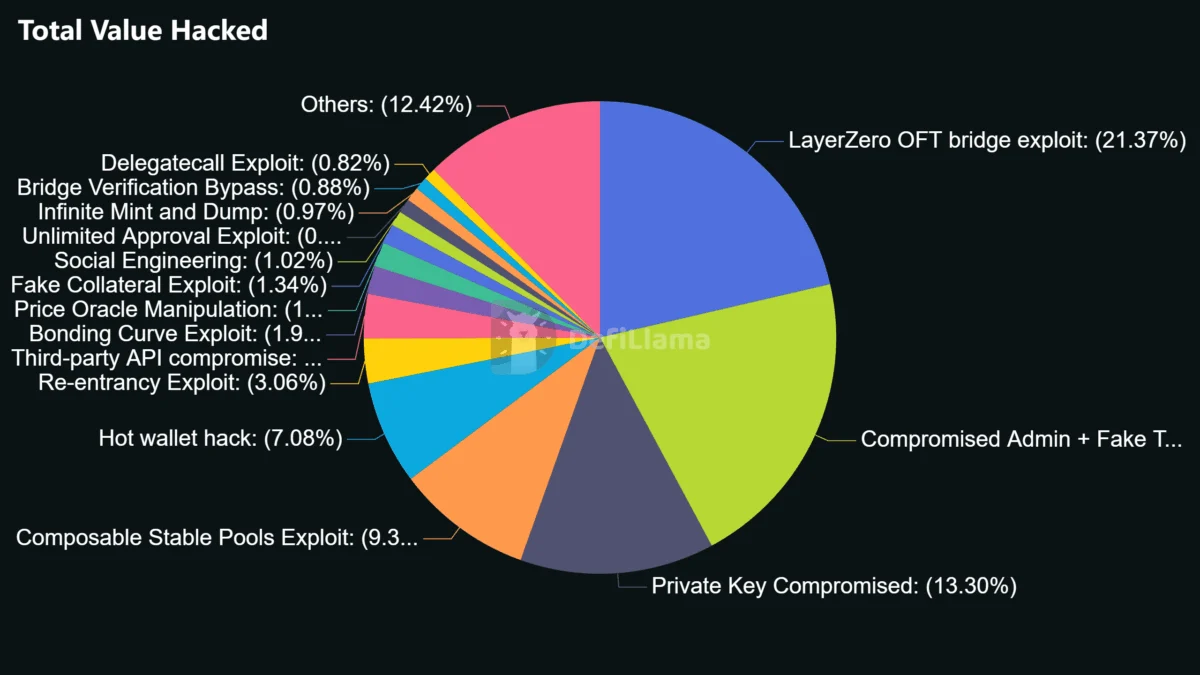
To evaluate whether DeFi is truly "unsafe," one must look at the data—and the data reveals a nuanced reality. In 2025, less than 10% of all DeFi hacks were attributed to deep-seated bugs within the underlying smart contract code. This statistic is vital; it suggests that the core "blue chip" protocols, which undergo rigorous, multi-layered audits, are becoming increasingly robust.
Conversely, over 50% of recent exploits have been tied to operational security (opsec) failures, such as compromised administrative private keys, flaws in bridged assets, and poor parameter configuration. These are "human" errors rather than "code" errors.

However, Aráoz’s counter-argument remains potent: if AI agents reach a point where they can simulate and brute-force these human errors or identify subtle configuration vulnerabilities faster than any human operator can detect them, the distinction between "code risk" and "opsec risk" may vanish.
According to industry trackers, the year-on-year (YoY) impact of these exploits has been staggering, with approximately $1.45 billion siphoned from the ecosystem. This fiscal reality has contributed to a broader cooling of the sector, with 2026 witnessing a $45 billion capital outflow. The total value locked (TVL) in DeFi has shrunk by 35% to roughly $80 billion, a figure that highlights a growing investor wariness exacerbated by both security fears and macroeconomic headwinds.
Official Responses: Building vs. Fearing
The response from the "builder" class has been one of staunch defiance. Stani Kulechov, in his critique of Aráoz’s assessment, noted that "DeFi infra today is materially more resilient than in prior cycles." Kulechov argues that Aráoz is ignoring the positive impact of AI on the defense side. He suggests that just as AI helps attackers, it is being weaponized by protocols to conduct continuous, real-time auditing, automated monitoring of suspicious transaction patterns, and the deployment of "circuit breakers" that can pause protocols before an exploit is finalized.
Sam MacPherson, co-founder of Sky (formerly MakerDAO), added weight to this perspective by emphasizing the evolution of professionalized security. "Most of the recent major hacks have been opsec issues," MacPherson stated. "Smart contracts of blue chips are quite safe these days." His sentiment is shared by many in the DAO governance sphere, who argue that the shift toward decentralized multisig wallets and time-locked governance has mitigated the risk of malicious or incompetent administrative intervention.
OpenZeppelin, meanwhile, finds itself in an awkward position. As a firm whose primary business model relies on the premise that DeFi can be made secure through their tools and services, they were effectively forced to issue a statement clarifying that their founder’s opinion was a personal viewpoint. The move underscores the delicate nature of branding in the security industry: if the founder of a premier security firm says the industry is broken, the firm’s own market valuation and reputation face an immediate, tangible threat.
The Implications: Is DeFi at a Crossroads?
The implications of this debate extend far beyond a Twitter spat between industry elites. They touch upon the core value proposition of decentralized finance.

1. The Professionalization of Opsec
The high rate of hacks caused by poor operational security suggests that the industry is transitioning from a "code-first" security phase to an "operational-first" phase. Future protocols will likely require more rigorous institutional-grade custody solutions, potentially moving away from individual private key management toward multi-party computation (MPC) and hardware-backed security modules.
2. The AI Arms Race
We are witnessing the onset of an AI-driven arms race in blockchain security. If the "attacker" AI can find vulnerabilities that human auditors miss, the "defender" AI must move from passive auditing to active, real-time threat neutralization. This suggests that the next generation of DeFi protocols will be characterized by "autonomous security layers" that operate independently of human governance.
3. Investor Confidence and Capital Flight
The $45 billion in outflows cannot be dismissed as mere market correction. It represents a loss of faith. For DeFi to reclaim its previous highs, the industry must move beyond simply declaring itself "safe" and start providing verifiable, transparent, and perhaps even insured, security models. The rise of DeFi insurance protocols, which provide a hedge against smart contract failure, will likely become a prerequisite for institutional adoption.
4. The "Blue Chip" Divergence
The debate highlights a growing divergence between established "blue chip" protocols and experimental "degen" projects. The data supports the view that mature protocols are, in fact, becoming safer. However, the ecosystem’s long-tail of experimental projects remains a playground for exploiters. This polarization may lead to a bifurcated market where capital flows almost exclusively into heavily audited, battle-tested protocols, while early-stage innovation struggles to find liquidity due to a risk-averse environment.
Final Summary: Navigating the Uncertainty
The current tension within the DeFi community serves as a necessary, albeit painful, maturity test. While Manuel Aráoz’s warning is alarmist in its call to abandon the sector, it serves as a vital wake-up call regarding the speed at which the threat landscape is evolving. Conversely, the pushback from leaders like Kulechov and MacPherson provides a balanced view: the infrastructure is not failing; it is being forced to adapt to a new, hyper-competitive threat environment.
Ultimately, the future of DeFi does not hinge on whether it is "safe" in an absolute sense—no financial system is—but on whether its defensive mechanisms can evolve faster than the adversaries looking to compromise it. As the industry integrates more advanced AI, institutional-grade security practices, and robust insurance frameworks, the definition of "safe" will continue to shift. The current $80 billion TVL, while lower than its peak, still represents a massive, resilient core of value that continues to function despite the constant, evolving pressure of the digital frontier. The debate, then, is not the end of DeFi; it is a critical chapter in its ongoing evolution.
