

The decentralized finance (DeFi) sector has weathered a tumultuous second quarter in 2026, marked by a brutal contraction in Total Value Locked (TVL) and a pervasive atmosphere of Fear, Uncertainty, and Doubt (FUD). What began as a standard market correction quickly spiraled into a systemic exodus of capital, driven by a series of high-profile security breaches that rattled investor confidence. However, as the industry transitions into the third quarter, early indicators suggest a rotation of capital back on-chain, potentially signaling the early stages of a market bottom.
The Anatomy of the Q2 Liquidity Crisis
The second quarter of 2026 will be remembered for the aggressive "risk-off" sentiment that gripped the crypto ecosystem. Unlike previous drawdowns primarily driven by macro-economic headwinds or token price volatility, the Q2 decline was fundamentally exacerbated by a crisis of security.
Back-to-back protocol exploits resulted in over $600 million in cumulative losses, a figure that acted as a catalyst for widespread capital flight. As users rushed to unstake assets and minimize their exposure to potentially compromised smart contracts, the liquidity drain became self-reinforcing.
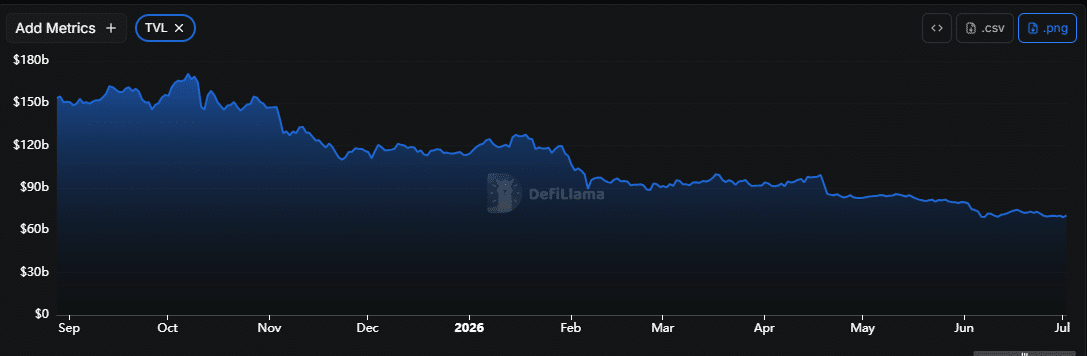
To quantify the scale of the carnage, more than $20 billion in liquidity exited DeFi protocols within a three-month window. This mass exodus pushed the sector’s aggregate TVL down to roughly $70 billion, a staggering fall from the pre-October 2025 peak of approximately $150 billion. This contraction represents the sharpest quarter-over-quarter decline in TVL since the volatility of 2021, underscoring the severity of the panic that dominated the market landscape.
Aave: The Bellwether of Market Sentiment
The plight of Aave, the industry’s flagship lending protocol, serves as a microcosm of the broader DeFi struggle. Following the high-profile KelpDAO exploit, confidence in lending markets wavered significantly. In the 24 hours immediately following the incident, Aave witnessed an 18% evaporation of its TVL, plummeting to $17.8 billion as liquidity providers pulled assets in a bid for safety.
This reaction was not an isolated incident. The contagion of fear spread rapidly across the DeFi landscape, with Ethereum-based protocols bearing the brunt of the pressure, resulting in an additional $10 billion drop in Ethereum’s native TVL.
Chronology of the Shift: From Panic to Accumulation
The narrative of the crypto market in 2026 has been defined by a rapid pivot from unchecked growth to defensive positioning.
- Pre-October 2025: The market reached a zenith with TVL approaching $150 billion, characterized by high leverage and aggressive yield farming.
- Q2 2026 (The "Great Deleveraging"): A series of security exploits acted as the "Black Swan" events that triggered a mass exodus. Investors moved from high-yield, high-risk protocols to cold storage or stable assets.
- Late Q2/Early Q3 2026: A pivotal shift emerged. On-chain data began to reflect a divergence between centralized finance (CeFi) and decentralized finance (DeFi), with a noticeable migration of capital back into permissionless protocols.
The most compelling evidence of this shift arrived recently when Aave on Ethereum recorded 1,806 new wallet addresses in a single 24-hour period. This statistic marks the protocol’s most significant network growth since October 2021, suggesting that while the industry is still recovering from the trauma of the previous quarter, a new cohort of participants—or returning veterans—is beginning to re-engage.
Supporting Data: Stablecoins as the Canary in the Coal Mine
Stablecoins have long served as the ultimate barometer for market risk appetite. When capital flows into stablecoins on-chain, it is a precursor to "buying the dip" or re-entering the DeFi ecosystem. Current data from Q3 confirms that liquidity is beginning to accumulate across major Layer 1 (L1) networks.
Cross-Chain Liquidity Trends
- Solana: The network concluded Q2 2026 with a record-breaking $16.6 billion in stablecoin supply, proving that despite the volatility, the demand for high-speed, low-cost DeFi remains resilient.
- Stellar: A 32.6% surge in 30-day stablecoin transfer volume highlights a renewed velocity of money on the network.
- Cardano: According to DeFiLlama, Cardano has seen a 20%+ increase in its native stablecoin supply over the last week, a metric that indicates a concentrated effort by investors to prepare for on-chain deployment.
This data is further contextualized by a recent report from CryptoQuant, which revealed that CeFi lending contracted by 6% quarter-over-quarter to $23.3 billion. This is the first recorded decline in CeFi lending since Q3 2024, providing compelling evidence of a "CeFi-to-DeFi" rotation.
The Expert Perspective: Implications of a Market Reversal
Industry analysts are interpreting these figures as a sign of a structural shift. The decline in centralized lending, coupled with the uptick in DeFi-specific wallet growth and stablecoin inflows, points toward a maturation of the investor base.
"The flight from CeFi to DeFi is not merely a matter of convenience; it is a fundamental shift in trust," says one market strategist. "Investors who were burned by centralized transparency issues or high-risk lending platforms are increasingly turning back to the composability and transparency of audited DeFi protocols."
What This Means for Q3
The implications for the remainder of 2026 are profound. If the current trend of stablecoin accumulation continues, the market may see a bottoming out of the TVL levels. However, recovery is contingent on three critical factors:
- Security Audits: Protocols must continue to undergo rigorous, real-time security monitoring to prevent a repeat of the Q2 exploit wave.
- Regulatory Clarity: As institutional capital begins to reconsider DeFi, the regulatory framework governing stablecoin issuance will play a vital role in sustaining the momentum.
- User Experience: The ease with which users can move capital from centralized exchanges into DeFi protocols will determine the speed of the current rotation.
Conclusion: A New Foundation for Growth?
While one day of high network growth or a single week of stablecoin inflows does not guarantee a bull market, the data paints a coherent picture of a sector that is actively healing. The Q2 shakeout, while painful, served to purge unsustainable leverage and highlight the necessity of robust security.
As the industry pivots toward Q3, the return of capital to on-chain protocols suggests that the "risk-off" sentiment of the previous quarter is beginning to thaw. Investors are showing signs of increased comfort in deploying capital back into the DeFi ecosystem, potentially laying the groundwork for a broader, more sustainable recovery. The coming months will be critical in determining whether this nascent rotation is a temporary fluctuation or the start of a sustained upward trajectory for the decentralized economy.
For the observant market participant, the signals are clear: the focus has shifted from speculation to utility, and the foundation for the next phase of DeFi growth is currently being laid, block by block.
