

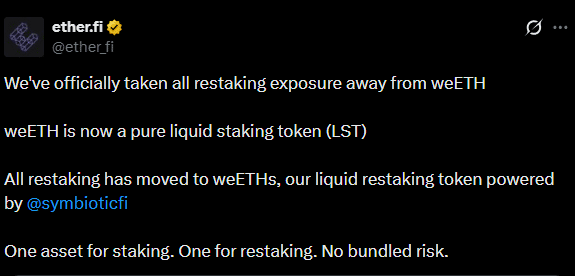
In a significant strategic pivot that signals a cooling period for the once-explosive liquid restaking sector, Ether.fi, a dominant force in the Ethereum staking ecosystem, has announced a fundamental restructuring of its flagship asset, weETH. Effective August 7, the platform has removed all restaking exposure from the token, effectively transitioning weETH back to its roots as a "pure" liquid staking token (LST).
This decision marks a departure from the complex yield-looping strategies that defined the 2023–2024 DeFi bull run. By exiting the EigenLayer ecosystem and shifting its restaking activities to Symbiotic, the project aims to insulate its users from the "bundled risks" inherent in multi-layered yield generation. As the DeFi landscape grapples with tightening risk frameworks and a contraction in total value locked (TVL), Ether.fi’s move serves as a bellwether for the broader industry’s pivot toward safety and sustainability.
The Core Shift: From Yield Farming to Risk Mitigation
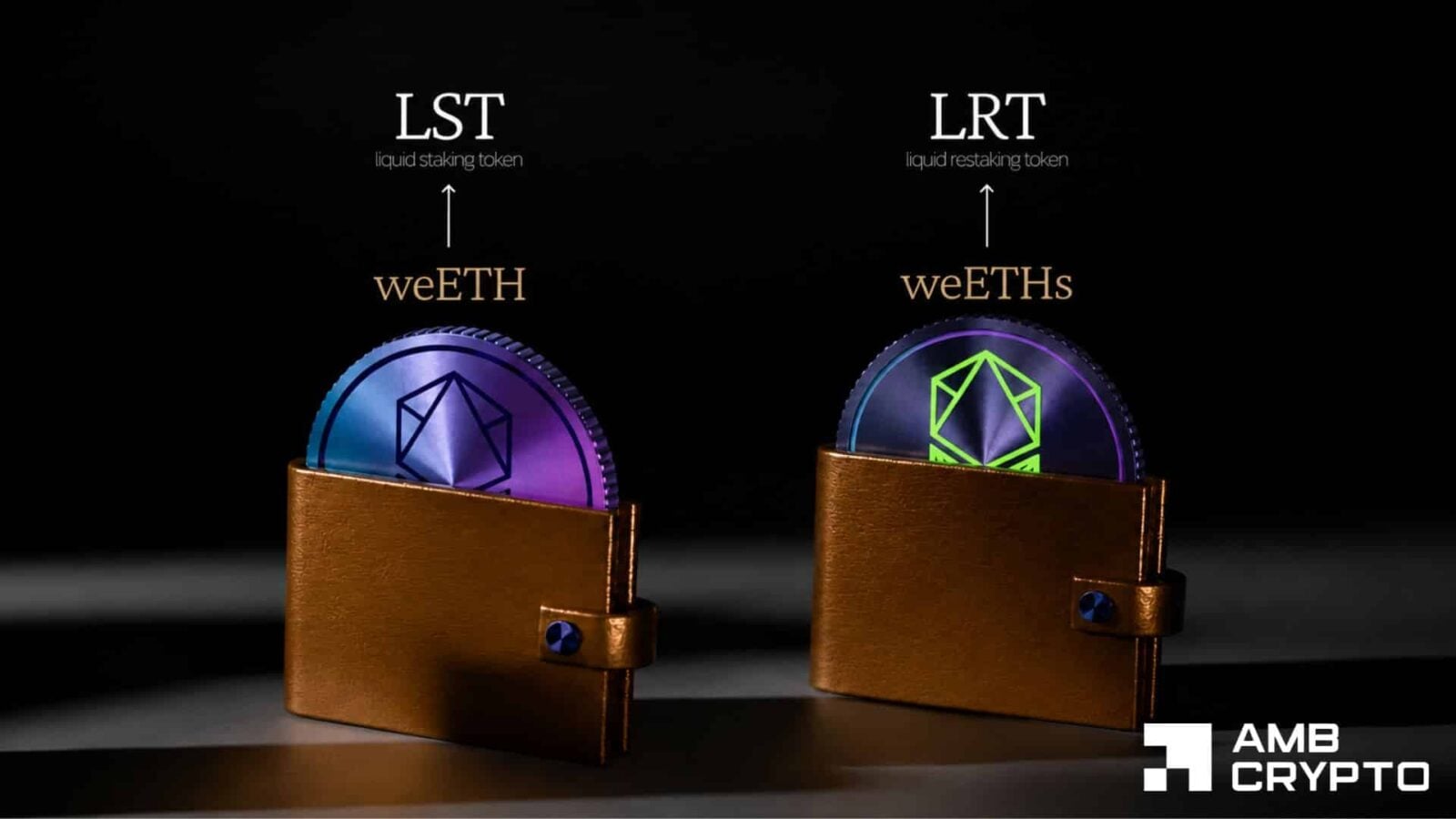
The distinction between Liquid Staking Tokens (LSTs) and Liquid Restaking Tokens (LRTs) has been the primary driver of capital efficiency in Ethereum DeFi. While LSTs allow users to stake their ETH while maintaining liquidity, LRTs introduced a "yield-on-yield" paradigm, allowing assets to be redeployed into various restaking protocols.
However, the pursuit of these incremental basis points (bps) created a complex web of dependencies. By "looping" assets through protocols like Aave and Pendle, users were exposed to cascading liquidation risks and smart contract vulnerabilities. Ether.fi’s decision to strip weETH of its restaking layer is a direct response to these systemic vulnerabilities. By decoupling from the broader EigenLayer restaking exposure, Ether.fi is prioritizing the stability of its primary token, effectively signaling that the market’s appetite for high-risk, high-yield "degen" strategies has reached a point of exhaustion.
A Chronology of the Restaking Boom and Retrenchment
To understand the weight of this decision, one must look at the meteoric rise and subsequent correction of the restaking market.
- Q4 2023: The "Restaking Summer" begins. Projects like EigenLayer gain traction, and Ether.fi emerges as a leading conduit for users to earn native ETH rewards plus EigenLayer points.
- Early 2024: The proliferation of looping strategies. Protocols like Pendle Finance enable complex yield trades, while Aave becomes the primary venue for utilizing LRTs as collateral to borrow more ETH, further driving leverage.
- Mid-2024: Market saturation and the onset of risk awareness. High-profile exploits, including the $292 million KelpDAO-related incidents, send shockwaves through the ecosystem.
- July 2024: Aave, the largest lending protocol in DeFi, implements an aggressive "risk cleanup," deprecating several assets and limiting the collateralization of risky, low-adoption tokens.
- August 7, 2024: Ether.fi officially announces the removal of restaking exposure from weETH, citing the need to eliminate bundled risk and adapt to a changing market environment.
Supporting Data: The Contraction of the Restaking Sector
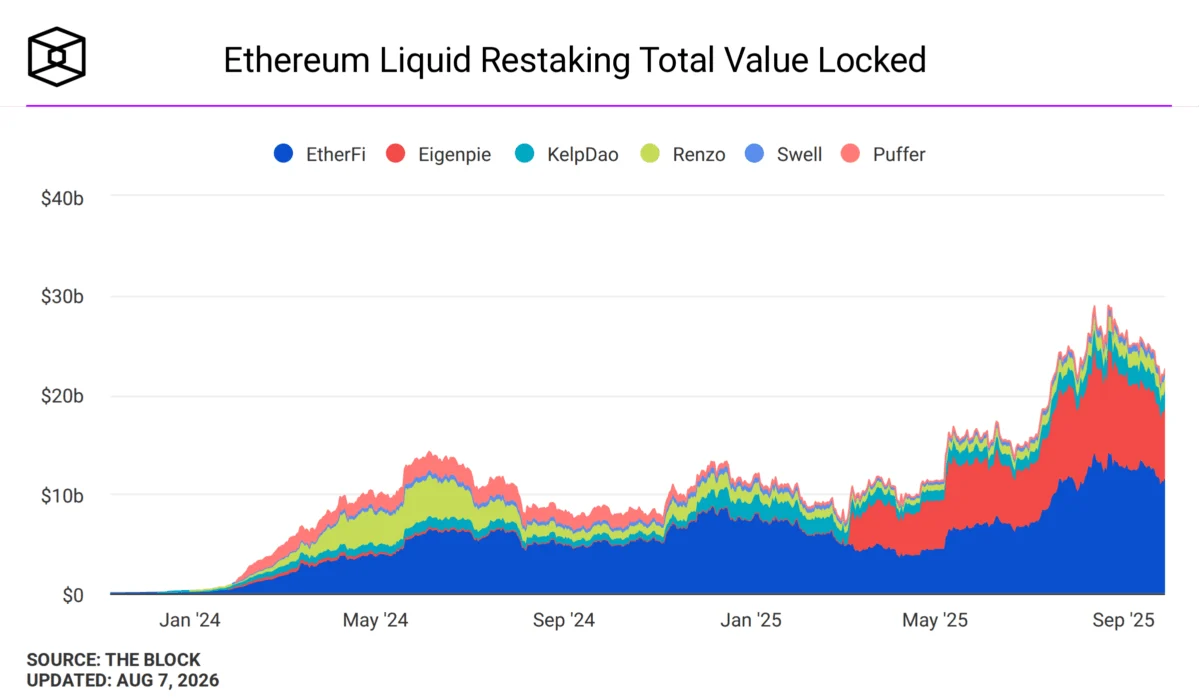
The data paints a clear picture of a market in transition. Since its peak in October of last year, the liquid restaking market has seen its total value locked (TVL) decline from roughly $29 billion to approximately $22 billion. This contraction is not necessarily a reflection of waning interest in Ethereum itself—staking participation continues to hit record highs—but rather a flight to quality.
Market Dynamics
Ether.fi continues to command a dominant market share, holding approximately $11.4 billion in TVL. Despite this, the reduction in total market liquidity suggests that the "easy yield" phase of DeFi is effectively over. The Aave cleanup, which saw the protocol purge over $98 million worth of underperforming or high-risk assets, has acted as a catalyst for this shift. By limiting the ability to loop LRTs, Aave has effectively forced other protocols to reassess their own risk management frameworks.
The Role of Yield-Looping
As noted by Tom Wan of Entropy Advisors, Ether.fi and EigenLayer were the primary architects behind the first wave of ETH looping. These strategies allowed users to extract an additional 50–100 basis points on top of native staking rewards. While lucrative in a low-volatility environment, these strategies essentially relied on the "infinite" growth of the restaking ecosystem. When the market hit a ceiling, the risks of these loops—namely, mass liquidations during periods of price volatility—outweighed the marginal yield benefits.
Official Responses: The "End of an Era"
The leadership at Ether.fi has been candid about the necessity of this shift. Mike Silagadze, CEO of Ether.fi, addressed the community with a tone of sober reflection.
"End of an era. Sad," Silagadze noted in a public statement. "I still think restaking will come back in one form or another; I think it was just a bit too early."
This sentiment reflects a broader industry consensus that while the fundamental concept of restaking—extending Ethereum’s security to other decentralized services—is sound, the implementation via rapid-fire DeFi composability was premature. By pivoting now, Ether.fi is attempting to preserve its core utility while awaiting a more mature, less volatile environment for complex yield products.
Implications for the Future of DeFi
The decision by a top-tier player like Ether.fi to simplify its product suite carries several profound implications for the future of decentralized finance.
1. The Rise of "Risk-Adjusted" DeFi
We are witnessing a shift from "deploy everywhere" to "quality over quantity." As lending giants like Aave continue to tighten their collateral standards, protocols that fail to demonstrate robust, sustainable risk management will likely see their assets deprecated. This trend favors protocols that emphasize transparency and security over aggressive APY chasing.
2. The Potential for Ripple Effects
The ripple effect of this "readjustment" will likely hit cross-chain protocols and smaller restaking startups hardest. If the leading platforms are abandoning complex loops, the secondary protocols that rely on those loops for liquidity will face a severe "liquidity crunch." This could lead to a wave of mergers, acquisitions, or total project closures as the sector consolidates.
3. The Future of Restaking
Despite the current contraction, the underlying technology of restaking remains a cornerstone of Ethereum’s future. The industry is likely moving toward a "Phase 2" of restaking, characterized by:
- Institutional-Grade Infrastructure: Moving away from experimental, high-yield loops toward institutional custody and regulated yield generation.
- Better Risk Frameworks: Integrating real-time auditing and automated liquidation safety measures that weren’t present during the initial boom.
- Sustainability: Focusing on the security of Actively Validated Services (AVS) rather than speculative yield farming.
4. Regulatory Pressures
The increased scrutiny on DeFi, particularly following major hacks, has pushed projects toward more conservative architectures. By "cleaning up" their token structures, projects like Ether.fi are also insulating themselves against potential regulatory interventions that often target complex, opaque financial products.
Conclusion
The evolution of weETH from a complex restaking vehicle to a streamlined liquid staking token is emblematic of the "maturation" of the DeFi ecosystem. The era of unchecked yield looping and high-risk composability is facing a mandatory correction.
For users, this means lower headline yields but a significantly safer environment. For the developers, the challenge now lies in rebuilding trust and developing products that offer real value without relying on dangerous leverage. Ether.fi’s retreat from the front lines of the restaking "looping wars" is not an admission of defeat, but a tactical withdrawal designed to ensure the protocol’s long-term survival in a more disciplined, risk-conscious market.
As we look toward the remainder of 2024 and beyond, the industry will likely watch closely to see if other protocols follow suit, potentially signaling a widespread "flight to safety" that could define the next chapter of Ethereum’s growth. While the "era" of aggressive looping may be ending, the lessons learned from this period of volatility will be essential in building the resilient, sustainable DeFi architecture of the future.
