

The Decentralized Finance (DeFi) ecosystem is currently navigating its most precarious period in recent history. Once heralded as the unstoppable future of global finance, the sector is now grappling with a sobering reality: a sustained, months-long hemorrhage of liquidity. Data indicates that investor confidence—the bedrock of any financial system—is eroding, fueled by a relentless barrage of security breaches that have turned the once-thriving landscape into a minefield for retail and institutional participants alike.
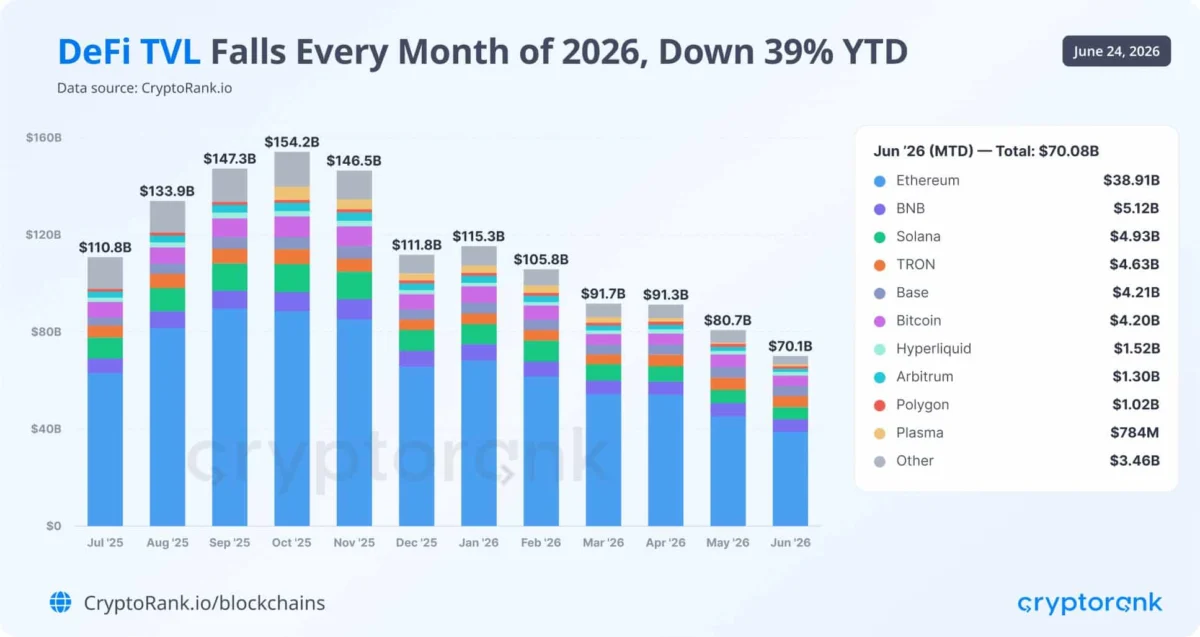
As we reach the midpoint of 2026, the metrics paint a grim picture. From a high-water mark of over $150 billion in late 2025, the Total Value Locked (TVL) across the DeFi landscape has plummeted. This is not merely a transient market correction; it is a systemic migration of capital as liquidity providers exit riskier protocols in favor of safety, stablecoins, or off-chain assets.
The Shrinking Pool: Analyzing the 39% TVL Collapse
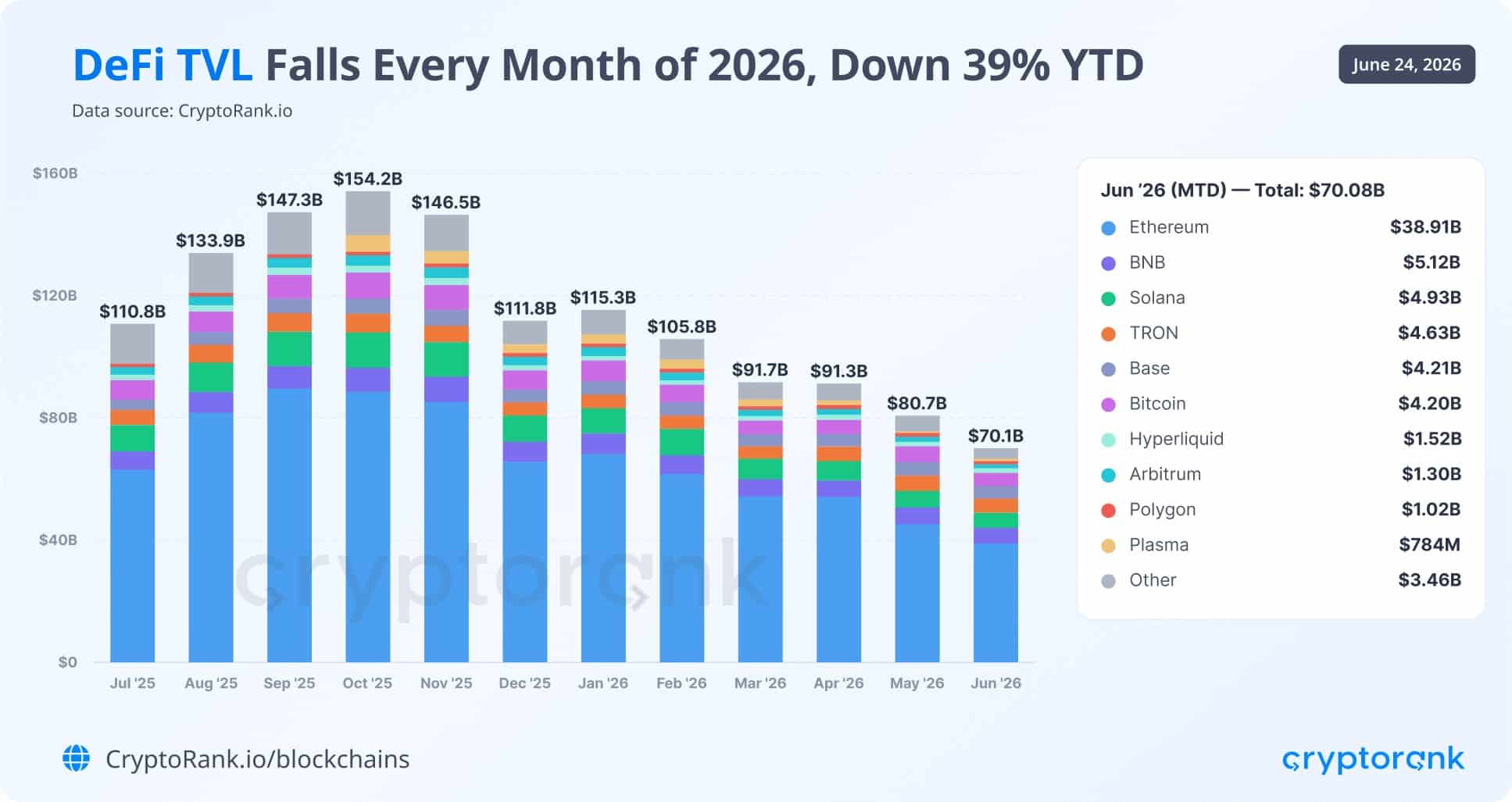
The trajectory of DeFi’s capital base throughout 2026 has been defined by a relentless downward slope. According to analytics firm CryptoRank, the industry has failed to record a single month of growth in total TVL this year.
In January 2026, the sector commanded a respectable $115 billion. By the close of June, that figure had withered to approximately $70 billion. This represents a staggering 39% year-to-date (YTD) decline. To understand the magnitude of this shift, one must look back to the fervor of late 2025, when the industry flirted with valuations north of $150 billion. The transition from that period of exuberance to the current climate of caution reflects a fundamental change in investor psychology.
Selective Liquidity and Chain Dominance
While Ethereum remains the undisputed king of DeFi, commanding the largest share of the remaining TVL, even its gargantuan ecosystem has been unable to escape the gravity of the sector-wide downturn. The pressure is felt ubiquitously across major chains, as capital becomes increasingly discerning.
However, the landscape is not entirely monolithic. In an environment defined by contraction, a few outlier protocols have managed to defy the trend. TRON (TRX) and Hyperliquid (HYPE) have emerged as rare success stories, posting growth figures of 5% and 7%, respectively. Analysts suggest that these gains are likely driven by specific utility-based incentives or unique market niches that provide a sense of stability, or at least utility, that is currently lacking in more volatile, experimental protocols.
Chronology of a Security Crisis: Q2 2026 as the Inflection Point
The decline in TVL does not exist in a vacuum; it is intrinsically linked to a surge in malicious activity. The relationship between security and capital retention has never been more apparent than in the second quarter of 2026.
A Record-Breaking Quarter for Malice
Q2 2026 has officially gone down in the annals of crypto history as the busiest quarter for exploits by incident count. Data indicates that there were 85 recorded hacks during this three-month window. When combined with the first quarter of the year, the total number of hacks for 2026 has already reached 121, with cumulative losses nearing the $1 billion mark.
- January–March (Q1): The year began with a steady stream of exploit reports, which many initially dismissed as "the cost of doing business" in an emerging sector.
- April–June (Q2): The frequency of attacks spiked exponentially. The sheer volume of incidents—averaging nearly one significant hack per day—shattered the illusion of "smart contract immunity."
While the total dollar value of the stolen assets has not yet surpassed the historical peaks seen in the 2021–2022 era, the frequency of these attacks is arguably more damaging to the ecosystem. Frequent, smaller-scale breaches have a "death by a thousand cuts" effect, eroding the long-term trust of retail users who can no longer distinguish between a battle-tested protocol and a potential honeypot.
Supporting Data: Where is the Capital Going?
A common question among market observers is: If $45 billion has evaporated from DeFi, where has it gone?
Data provided by recent market reports highlights a curious trend. While the TVL in yield-bearing protocols and decentralized exchanges has fallen, the total supply of stablecoins has remained remarkably resilient, hovering near $315 billion. This discrepancy suggests that capital has not necessarily left the broader crypto ecosystem; rather, it has been "de-risked."
Investors are effectively rotating out of the complex, multi-layered yield farming strategies that defined the 2025 boom and moving toward "parked" capital in stablecoins or high-liquidity assets. This shift indicates a flight to quality. Investors are no longer willing to expose their capital to smart contract risk for marginal APY gains. They are demanding proof of solvency and security audits that go beyond the basic checkboxes of previous years.
Official Responses and the Industry Reaction
Industry leaders and security firms have been forced to respond to the mounting pressure. Many prominent DeFi developers have issued public statements acknowledging the "trust deficit."
Several major protocols have announced a pivot toward "Security-First" roadmaps. This includes:
- Mandatory Multi-Audits: Protocols that previously relied on a single audit are now being pressured by DAOs and governance committees to secure at least three independent audits from top-tier security firms.
- Increased Bug Bounty Allocations: Funds previously earmarked for marketing are being reallocated to record-breaking bug bounty programs to incentivize white-hat hackers to find vulnerabilities before they are exploited.
- Insurance Integration: There is a growing push for native insurance modules within DeFi protocols, allowing users to hedge their liquidity against the risk of a smart contract failure.
Despite these efforts, the institutional response remains guarded. Large capital allocators—who were beginning to dip their toes into DeFi in 2025—have largely paused their deployments, waiting for the "security dust" to settle before committing further funds.
Implications: The Road to Recovery
The implications of this 39% decline are profound. The DeFi sector is currently facing an existential test. It is no longer enough to build "innovative" financial primitives; the sector must now prove that those primitives are resilient.
The Survival of the Fittest
The current bear cycle in TVL will likely result in a "great pruning" of the ecosystem. Projects that lack robust security, transparency, or a genuine product-market fit are unlikely to survive the current liquidity crunch. We are moving toward a tiered system where "Blue Chip" protocols—those with audited, battle-tested code—will capture the lion’s share of liquidity, while smaller, experimental projects will likely find it impossible to attract TVL.
A Pivot to Regulation and Accountability
As the frequency of hacks continues to grab headlines, the pressure for regulatory oversight is mounting. While DeFi was built on the ethos of permissionless, anonymous finance, the industry is reaching a point where some form of institutional-grade security standards may become inevitable to regain the trust of the masses.
Final Summary: The Path Ahead
The DeFi ecosystem stands at a crossroads. The data is clear: investors have lost their appetite for risk, and the market is punishing those who cannot guarantee the safety of capital. With 121 hacks occurring in less than six months and nearly $1 billion in losses, the message from the market is loud and clear: security is the new currency of trust.
For the sector to recover, it must transition from a "growth-at-all-costs" mentality to a "security-first" architecture. Until protocols can demonstrate a consistent ability to safeguard user assets against the rising tide of exploits, the recovery of Total Value Locked will remain, at best, uneven.
As we look toward the second half of 2026, the question is not just how much capital will return, but whether the DeFi industry can re-engineer its foundation to ensure that the next cycle of growth is built on a bedrock of security rather than the shifting sands of speculative hype. The window for the sector to mature is narrowing, and the cost of further inaction will be measured not just in dollars, but in the permanent loss of investor faith.
