

The cryptocurrency market is witnessing a period of heightened volatility, with XRP, the native token of the Ripple ecosystem, currently navigating a precarious technical landscape. Following a failed attempt to maintain its momentum above the $1.1550 threshold, the asset has entered a corrective phase, mirroring broader market downturns seen in major digital assets like Bitcoin and Ethereum. Traders and institutional observers are now closely monitoring key support levels, as the current price action signals a potential shift in market sentiment from consolidation to a more pronounced bearish trend.
The Anatomy of the Recent Downturn: Main Facts
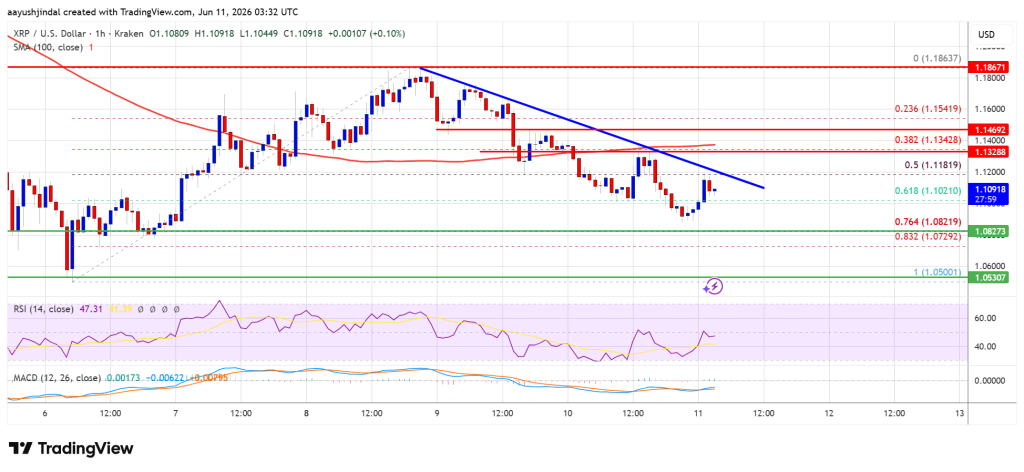
The current market environment for XRP is defined by a transition from bullish optimism to technical caution. After testing the $1.1862 high—a point of significant interest for market participants—XRP faced a swift rejection. The failure to sustain levels above $1.150 triggered a series of sell-offs, pushing the price below the 50% Fibonacci retracement level calculated from the $1.050 swing low to the recent peak.
As of the current trading session, XRP is trading under pressure, consistently failing to clear the $1.1350 resistance zone. The price has slipped below its 100-hour Simple Moving Average (SMA), a critical indicator that typically serves as a barometer for short-term trend health. This technical breakdown has left the market vulnerable, with bulls struggling to maintain the $1.10 support floor. The formation of a bearish trend line on the hourly chart, with overhead resistance locked at $1.120, suggests that selling pressure remains dominant in the immediate term.
Chronology of Price Action
The recent price trajectory of XRP can be divided into three distinct phases over the past 72 hours:

- The Rejection Phase: XRP reached a local peak of $1.1862. This was met with immediate profit-taking, as the broader market began to show signs of fatigue, impacting liquidity across major altcoins.
- The Correction Phase: Within hours of the peak, the asset surrendered the $1.1550 and $1.1500 support levels. The breach of these psychological barriers acted as a catalyst for automated sell orders, accelerating the descent toward the $1.10 level.
- The Current Consolidation/Struggle: XRP is currently oscillating between $1.080 and $1.120. While the $1.10 support has held briefly, the lack of buying volume suggests that this may be a temporary reprieve rather than a definitive bottom. The price is currently trapped beneath the 100-hour SMA, indicating that the path of least resistance remains to the downside.
Supporting Data and Technical Indicators
To understand the depth of the current bearish sentiment, one must look at the quantitative data provided by standard technical analysis tools:
- Hourly MACD (Moving Average Convergence Divergence): The MACD histogram for XRP/USD is losing momentum within the bearish zone. The convergence of the signal line toward the zero axis, combined with the lack of bullish crossover potential, reinforces the narrative that selling pressure is not yet exhausted.
- Hourly RSI (Relative Strength Index): The RSI is currently positioned below the 50-level, confirming that the market is currently under the control of sellers. A neutral-to-bearish stance is maintained, as the indicator has failed to reclaim the 50-level, which would be necessary to signal a potential reversal.
- Fibonacci Retracement Levels: The $1.080 mark is of particular concern as it represents the 76.4% Fibonacci retracement level of the move from $1.050 to $1.1862. Historically, a failure to hold this level often invites a retest of the initial swing low, which in this case is the $1.050 region.
Implications for Investors and Traders
The current market structure poses significant risks for both short-term traders and long-term holders. For the short-term, the inability to break through the $1.1350 resistance suggests that any attempt at a rally is likely to be sold into by institutional players looking to exit or hedge positions.
Should the price decisively break below the $1.080 support level, it would likely signal a "capitulation" event. If this scenario unfolds, the next major support levels to watch are $1.0650 and $1.050. A break below $1.050 could lead to an accelerated decline toward the $1.020 level, with the psychological barrier of $1.00 acting as the ultimate defense for the bulls.
Conversely, for the bulls to regain control, a sustained move above the $1.1420 resistance level is essential. Such a move would be required to neutralize the bearish trend line and set the stage for a recovery toward $1.1550, and eventually, the $1.1840 major hurdle. However, given the current confluence of technical indicators, the likelihood of a rapid V-shaped recovery remains low without a significant catalyst or a positive shift in the broader macroeconomic environment.

The Broader Context: Why XRP is Struggling
It is important to note that XRP is not moving in a vacuum. Its performance is deeply intertwined with the sentiment surrounding Bitcoin and Ethereum. When the flagship assets face liquidity crunches or regulatory uncertainty, capital often flows out of the broader altcoin market.
The current environment is characterized by a "risk-off" sentiment. Investors are currently weighing the impact of global interest rate policies and the evolving regulatory landscape for digital assets. XRP, having navigated a complex legal history, remains highly sensitive to both technical price action and macro news cycles. The current "red" signal on the charts is a reflection of the market’s wait-and-see approach, where participants are waiting for a clear signal from the broader market before committing significant capital to the XRP/USD pair.
Expert Perspective: Technical Analysis vs. Fundamental Reality
Financial experts, such as Aayush Jindal, have long noted that technical analysis in the cryptocurrency space is a tool for mapping probability rather than predicting certainty. In the case of XRP, the current technical structure suggests that the market is in a state of "exhausted momentum."
The integration of software engineering principles into trading—specifically the use of algorithmic modeling—has allowed sophisticated traders to identify these support and resistance levels with greater precision than ever before. However, even the most robust models cannot account for sudden "black swan" events or macro-economic shocks. As such, the current analysis serves as a roadmap for risk management. For the average investor, the current price action demands a disciplined approach: either protecting capital through stop-loss orders or awaiting a clear confirmation of a trend reversal before increasing exposure.
Conclusion: Navigating the Uncertainty
The current outlook for XRP is cautious. The asset is at a critical juncture where the battle between bulls and bears will define its trajectory for the coming week. The immediate focus remains on the $1.10 support; if this fails to hold, the focus will inevitably shift toward the $1.050 and $1.00 psychological support levels.
Traders are advised to exercise extreme caution, prioritize capital preservation, and closely monitor the $1.1350 resistance level as a potential pivot point. As always, the crypto market remains inherently volatile, and historical performance—whether bullish or bearish—does not guarantee future results. Investors should ensure their portfolios are balanced and that they remain informed through reputable sources, conducting their own due diligence before making significant moves in the market.
Disclaimer: The information contained in this article is for educational and informational purposes only and should not be construed as financial, investment, or legal advice. Trading cryptocurrencies involves substantial risk of loss and is not suitable for every investor. The volatility and unpredictable nature of the crypto markets mean that any investment decision should be made only after thorough research and consultation with a professional financial advisor. The authors and publishers of this content assume no responsibility for any financial losses incurred.
