


The intersection of Traditional Finance (TradFi) and Decentralized Finance (DeFi) has become the most contentious debate in the modern financial landscape. As global banking giants, payment processors, and venture capital titans race to capture the next evolution of monetary settlement, a fundamental question has emerged: Will TradFi fully embrace the ethos of permissionless, open-source DeFi, or will it merely co-opt blockchain technology to optimize its existing, closed-loop systems?
This debate reached a fever pitch recently when Andreessen Horowitz (a16z), one of the industry’s most influential venture capital firms, challenged the prevailing narrative of convergence. In a stark assessment, a16z suggested that "TradFi does not want DeFi; it only wants blockchain." This provocative stance has drawn sharp criticism from Ark Invest, whose analysts argue that such a perspective is dangerously reductive.
The Core Argument: Convergence vs. Co-option
The fundamental disagreement lies in the motivation behind institutional blockchain adoption. a16z posits that the dream of TradFi integrating with DeFi is a "comforting story" that ignores the harsh realities of corporate incentives. According to the firm, major financial institutions are not driven by the philosophical benefits of decentralization—such as censorship resistance or financial inclusion—but rather by the pragmatic pursuit of cost reduction and operational efficiency.
"Here’s the more honest version: where TradFi can use a blockchain to make its existing business better, it will," a16z noted in its recent commentary. "Not because it has embraced decentralization, but because it’s a compelling COGS (Cost of Goods Sold) story."
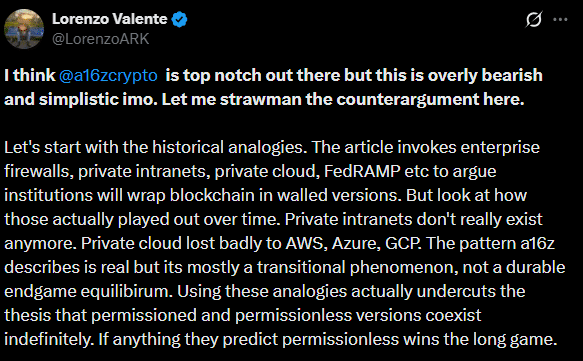
In contrast, Lorenzo Valente, Director of Crypto Research at Ark Invest, has publicly dismissed these claims. Valente characterized the a16z outlook as "overly bearish and simplistic," suggesting that it overlooks the organic, market-driven demand for open, permissionless financial infrastructure. For Ark Invest, the trajectory of finance is moving inexorably toward public chains, regardless of initial institutional resistance.

Chronology of the Debate: From Pilots to Prototypes
To understand the weight of these arguments, one must look at the timeline of institutional blockchain adoption. The evolution has progressed through three distinct phases:
Phase I: The Private Permissioned Era
For years, the financial sector focused exclusively on "private chains." Banks and consortia sought to replicate the efficiency of distributed ledgers while maintaining absolute control over the validator set and transaction transparency. Projects like R3’s Corda and early iterations of private ledger technology dominated the conversation.
Phase II: The Tokenization Pivot
As stablecoins gained traction, the narrative shifted toward asset tokenization. The introduction of platforms like Canton, designed for institutional privacy, allowed banks to experiment with tokenized securities and debt instruments. This period solidified the belief that "blockchain" was a useful tool for back-office settlement, even if it lacked the "DeFi" component.
Phase III: The Public-Private Blur
We are currently in the third phase, marked by the coexistence of corporate chains and public networks. With the launch of initiatives like Stripe’s Tempo and the Google Cloud Universal Ledger (GCUL), the market is seeing a flood of new infrastructure. Simultaneously, the success of BlackRock’s BUIDL fund on public chains has forced a re-evaluation of whether private chains can truly compete with the liquidity and composability of public networks.
Supporting Data: Where the Battle for Market Share Stands
The data provides a nuanced picture, supporting both sides of the argument depending on the asset class in question.
The Stablecoin Supremacy
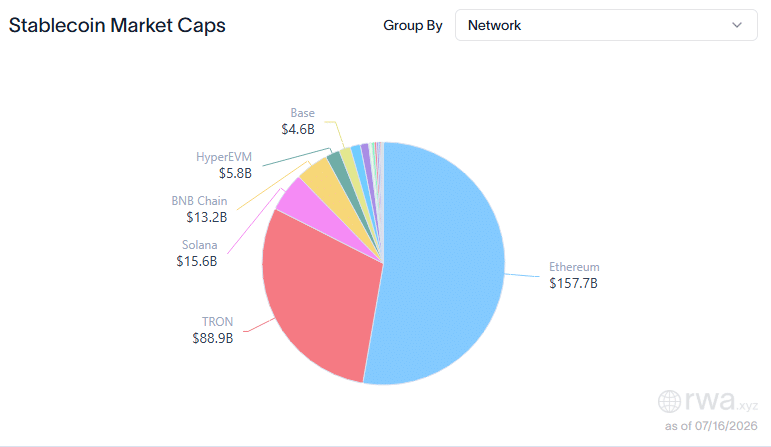
When it comes to payments, public chains are the undisputed winners. The market is dominated by stablecoins like USDT and USDC, which rely on the security and openness of public networks like Ethereum and Tron. Together, these two chains control nearly 75% of the stablecoin sector. This dominance suggests that when the goal is global liquidity and transferability, institutions are increasingly willing to use—or at least interact with—public infrastructure.
The Tokenization Moat
Conversely, in the realm of tokenized real-world assets (RWA), the situation is reversed. Corporate or "private" chains, such as Canton and Provenance, hold an approximate 85% market share. Ethereum, despite its status as the bedrock of DeFi, currently commands only about 4% of the institutional tokenization market. This disparity validates a16z’s argument that for complex, highly regulated financial instruments, institutions prefer the controlled environment of a private ledger.
Official Responses and Perspectives
The friction between these two ideologies has sparked a broader industry conversation. Carlos Domingo, CEO of Securitize, has provided a bridge between these two perspectives. Domingo famously characterized private chains as the "intranet of this era"—a necessary but transitional step. "Private chains or pseudo ones are the intranet and private clouds of this era," Domingo noted. "They are a transitional step into a truly open and permissionless innovation model."
Ark Invest’s Valente supports this view, arguing that private chains will eventually face a "death in isolation" unless they find a way to interoperate with the broader, permissionless ecosystem. The argument is that while private chains may offer speed and privacy today, they lack the "network effect" that only public, permissionless chains can provide over the long term.
The Implications: A Bifurcated Financial Future
The implications of this disagreement are profound for investors, developers, and policymakers. If a16z is correct, we are moving toward a future of "walled gardens," where blockchain technology serves merely as a high-tech layer for the existing status quo. This would prioritize regulatory compliance and institutional control over the democratic potential of DeFi.
However, if Ark Invest’s assessment holds true, we are witnessing the early stages of a "Great Migration." In this scenario, just as the internet began with private, walled-garden networks (like AOL) before evolving into the open web, financial systems will eventually outgrow their private, permissioned shackles.
Key Takeaways for the Industry:
- Selective Adoption: TradFi is not monolithic. It will likely use public chains for global, liquid payments (stablecoins) while favoring private chains for specific, regulated asset custody (tokenized securities).
- The "Intranet" Phase: The current reliance on private chains should be viewed as a temporary developmental stage rather than a permanent destination.
- The Power of Openness: The "vote" of the market is increasingly cast for open access. As stablecoins have proven, when users have a choice between a closed-loop system and a public, permissionless network, they gravitate toward the one with more utility and liquidity.
- Integration is Inevitable: Even the most skeptical institutions are now forced to reckon with the existence of DeFi. Whether they like the ideology or not, the underlying technology has become too efficient to ignore.
Conclusion
The debate between Ark Invest and a16z is not merely a clash of opinions; it is a fundamental disagreement about the trajectory of human history as it relates to finance. Is the future one of centralized control utilizing decentralized tools, or is it one of decentralized infrastructure becoming the new global standard for value exchange?
The reality, as current data suggests, lies somewhere in the middle. TradFi is currently engaged in a process of "selective adoption," picking the fruits of DeFi innovation that fit within their risk models while building fences around their core operations. Yet, the persistent growth of public chains, fueled by stablecoins and the success of tokenized treasury products, suggests that the gravity of open, permissionless systems is becoming too strong to resist.
As the lines between TradFi and DeFi continue to blur, the ultimate winner will not necessarily be the "purist" version of either, but the architecture that best balances the absolute requirement for institutional security with the global demand for open, frictionless financial movement. The transition from the "intranet" of private ledgers to the "internet" of public, decentralized finance is underway, and it is likely to be a long, contested, and transformative journey.
