

As the decentralized finance (DeFi) sector navigates the mid-point of 2026, a fierce debate has emerged among institutional investors, developers, and security analysts. At the heart of this discourse is a polarizing question: Is DeFi becoming safer, or is the industry simply suffering from "survivorship bias" as bad actors refine their tactics?
While mainstream media reports often focus on the record-breaking frequency of hack incidents, prominent venture capitalists are pushing back against the narrative that the ecosystem is inherently unsafe. This tension arrives at a critical juncture, as major AI firms release sophisticated models capable of offensive cybersecurity operations, potentially lowering the barrier to entry for malicious hackers.
Main Facts: The Statistical Tug-of-War
The perception of DeFi security is currently caught between two conflicting datasets. On one hand, the frequency of security incidents has spiked to record highs during the first half of 2026. On the other, the financial scale of these breaches—specifically when looking at median losses—suggests a different, perhaps more optimistic, reality.
Haseeb Qureshi, a managing partner at the prominent venture capital firm Dragonfly, has emerged as a vocal proponent of the "maturation" narrative. According to Qureshi, while the headlines highlight massive dollar amounts, the underlying reality is that the median size of hacks is trending downward.
"The average dollar in DeFi is as safe as it was a year ago," Qureshi argues. "If you keep your money in large protocols that can afford to harden themselves, you’ll likely be fine."
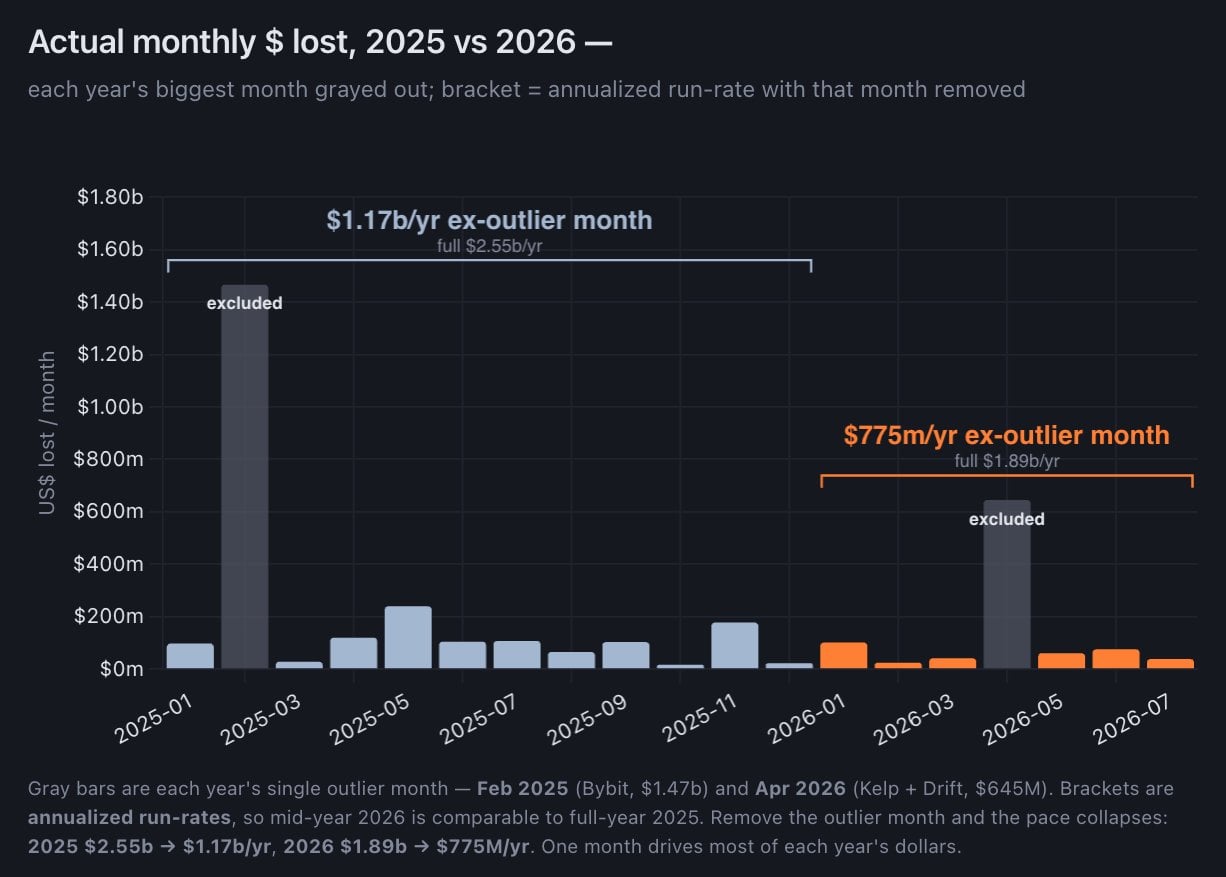
The core of this argument rests on the observation that the industry is moving away from the "wild west" era of massive, protocol-draining exploits. Instead, the current landscape is characterized by smaller, more frequent attacks targeting lower-tier protocols. When analysts exclude massive outliers—such as the $1.4 billion Bybit incident or the $292 million KelpDAO breach—the data suggests that DeFi is becoming more resilient, not less.
Chronology: The Evolution of Exploits (2021–2026)
To understand where the industry is heading, one must look at the trajectory of losses over the past half-decade. The evolution of DeFi security can be categorized into three distinct phases:
- The Era of Experimental Chaos (2021–2022): This period was defined by the infancy of smart contract development. Hackers targeted fundamental vulnerabilities in unverified code, leading to massive, multi-million dollar losses per incident. The median hack size during this period often exceeded $8 million.
- The Rise of Operational Vulnerability (2023–2025): As smart contracts became more robust, attackers pivoted. The focus shifted toward "operational security failures"—exploits involving compromised admin keys, weak multisig management, and social engineering. In 2025 alone, over $2.55 billion was lost to various exploits, averaging roughly $1.17 billion annually.
- The Maturation Phase (2026): We are currently witnessing a decline in the average dollar value of individual hacks. While the total number of incidents has risen, the median hack size has dropped to below $1 million. This shift indicates that major protocols have successfully implemented institutional-grade security measures, forcing attackers to target smaller, less protected platforms.
Supporting Data: Dissecting the Financial Impact
The disparity between total stolen funds and the safety of individual user capital is significant. In 2026, the total value lost to exploits stands at $1.89 billion, a notable decrease from the previous year’s figures.
Comparative Loss Analysis (2025 vs. 2026)
- 2025 Total Losses: $2.55 billion (~$1.17B per annum).
- 2026 Total Losses: $1.89 billion (~$775M per annum).
- Median Hack Size (2021): >$8 million.
- Median Hack Size (2026): <$1 million.
A critical point of contention involves "operational security failures," such as the compromise of admin keys. While many critics argue that the surge in hack incidents is proof of failing infrastructure, the data tells a more nuanced story. Nearly 75% of the $1 billion stolen in the first half of 2026 was linked to these operational failures. However, Qureshi notes that even these types of attacks are decreasing in dollar terms, suggesting that multisig management and key governance are becoming more sophisticated across the board.
The Total Value Locked (TVL) in DeFi vaults serves as a secondary metric for sentiment. Following the KelpDAO hack, which triggered a significant bank run on the Aave lending protocol, the TVL in DeFi vaults cratered from $113 billion to $61 billion. While it has since recovered to roughly $65 billion, the volatility in this figure highlights that institutional and retail confidence remains fragile, sensitive to even isolated security events.
Official Responses and Expert Outlook
The industry’s reaction to the security crisis has been bifurcated. Developers are doubling down on formal verification, bug bounties, and decentralized insurance products. Conversely, traditional financial entities are taking a longer-term view.
S&P Global Ratings has notably classified DeFi vaults as the functional equivalent of managed funds. This is a significant endorsement. By framing these vaults as "core infrastructure" for the future of tokenized real-world assets (RWAs), S&P is signaling that the current security teething problems are viewed as temporary hurdles rather than permanent roadblocks.
The concern remains, however, that DeFi must compete with the traditional finance (TradFi) sector. When DeFi protocols offer average yields of 2.7% to 3.8%, they are often perceived as offering a poor risk-adjusted return compared to U.S. Treasury bills. For institutional capital to flow back into DeFi at scale, the security premium—the "safety tax" that users pay for the risk of protocol failure—must be minimized through improved insurance and more transparent auditing processes.
Implications: The Path Toward Adoption
The implications of this security discourse are profound for the future of decentralized finance. We are witnessing the birth of a two-tiered ecosystem:
- Institutional-Grade DeFi: Major protocols (like Aave, Uniswap, and others) are hardening their defenses to the point where they are becoming institutional-grade, "too big to fail" entities. These platforms are likely to become the bedrock for tokenized assets.
- The "Long Tail" Risk: A vast, experimental layer of smaller protocols will continue to be the primary target for attackers. This is where the majority of "hack incidents" will occur, keeping the total count of security breaches high while the overall financial risk to the broader ecosystem remains controlled.
As AI-driven offensive security tools become more prevalent, the defense must also leverage AI-driven auditing. The race between automated exploit generation and automated smart contract verification will define the next chapter of DeFi.
Ultimately, the goal is to decouple the frequency of hacks from the financial impact of hacks. If the industry can continue to drive down the median loss per incident while providing insurance wrappers for user deposits, the security concerns of 2026 will likely be remembered as the final growing pains before DeFi’s integration into the global financial architecture. The shift toward tokenized real-world assets is already underway; the only remaining question is whether the infrastructure will be ready to bear the weight of that transition.
