

The decentralized finance (DeFi) sector is reeling following the announcement that Zapper, a prominent asset management platform that served as a gateway to the Web3 ecosystem for millions, will officially cease operations. After nearly seven years of building infrastructure intended to demystify complex on-chain activities, Zapper’s closure marks a somber turning point for the industry. The platform, which once stood at the vanguard of the "DeFi Summer" era, will shutter its doors on August 3, 2026, leaving behind a complex legacy of rapid adoption and the harsh realities of sustainable monetization.
The Rise and Fall: A Brief Chronology
To understand the significance of Zapper’s exit, one must look back at its trajectory. Launched during a period of unbridled optimism in the blockchain space, Zapper positioned itself as a "dashboard for everything," allowing users to track their portfolios, interact with liquidity pools, and navigate the burgeoning yield farming landscape from a single interface.
- The Early Years (2019-2020): Zapper emerged as a vital tool for early DeFi adopters who were struggling to manage assets across fragmented protocols. Its intuitive UI/UX played a significant role in lowering the barrier to entry for decentralized finance.
- The Peak (2021-2022): During the height of the crypto bull market, Zapper saw explosive growth. It became a household name among crypto natives, hitting its zenith with over 2 million monthly active users and facilitating a staggering $13 billion in cumulative transaction volume.
- The Struggle (2023-2025): As the market matured and the initial hype cycle subsided, the business landscape began to shift. Increased competition from specialized aggregators, wallet-integrated dashboards, and more efficient cross-chain bridges began to erode Zapper’s market share and revenue margins.
- The Announcement (July 2026): After years of attempting to pivot and adapt to a leaner economic environment, the leadership team reached the conclusion that the platform’s business model was no longer viable.
Quantifying the Scale: By the Numbers
The sheer scale of Zapper’s operation highlights how substantial its impact was on the DeFi ecosystem. At its peak, the platform served as a central nervous system for DeFi participants. The following metrics illustrate the magnitude of its reach:
- User Base: 2 million monthly active users (MAUs), a figure that cemented its status as a primary onboarding portal for DeFi.
- Transaction Volume: Over $13 billion processed at its peak, underscoring the platform’s role as a major facilitator of capital flow.
- Institutional Backing: The platform successfully raised $15 million in venture capital funding from industry titans including Framework Ventures, Coinbase Ventures, and ParaFi Capital.
Despite these impressive figures, the platform faced a "valuation-reality gap." The capital influx was intended to catalyze product expansion and user acquisition, but it could not insulate the company from the fundamental economic challenges that have begun to plague the infrastructure layer of the DeFi market.
Official Responses and Reflections
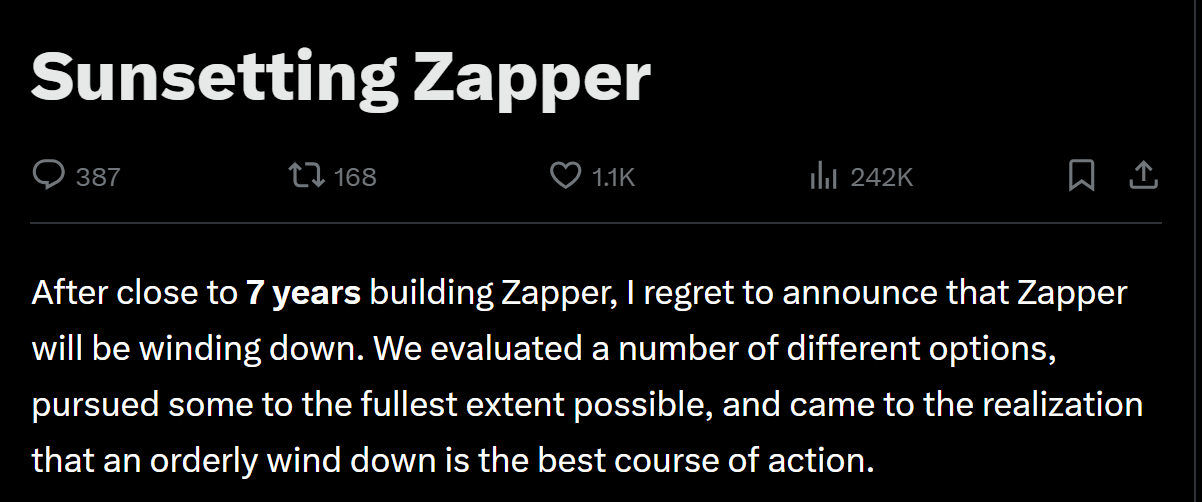
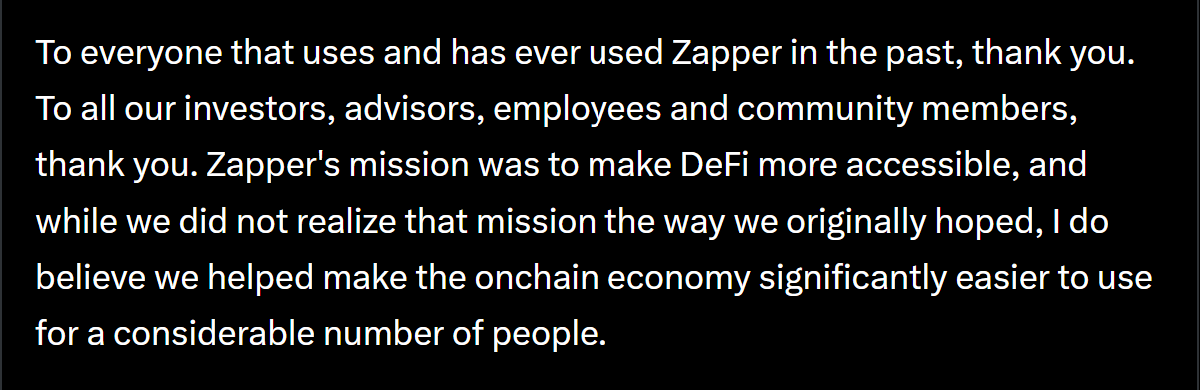
In a candid post shared on X (formerly Twitter), Seb Audet, the Co-Founder and CEO of Zapper, addressed the community with a sense of reflective disappointment. His statement highlighted the disconnect between the platform’s original vision and the eventual outcome.
"Zapper’s mission was to make DeFi more accessible," Audet noted. "While we did not realize that mission the way we originally hoped, the journey has been an invaluable lesson in the evolution of decentralized finance."
Audet’s acknowledgment serves as a microcosm for a wider sentiment within the industry: the realization that "growth at all costs" is a model that fails when the underlying revenue streams do not materialize. The platform has pledged to provide resources to assist users in migrating their assets and finding alternative tools, ensuring that while the interface is disappearing, the user’s capital remains secure and accessible.
The Economic Mirage: Why Growth Isn’t Enough
The closure of Zapper serves as a stark case study in the limitations of venture-backed infrastructure. Historically, many DeFi projects prioritized user acquisition and liquidity mining, assuming that transaction fees and premium features would naturally follow once a critical mass was achieved.
The Problem of Fee Compression
In the early days of DeFi, margins were wide. However, as the ecosystem became crowded with copycat protocols and aggressive competitors, fee structures faced massive compression. Users became increasingly price-sensitive, choosing platforms that offered the lowest slippage or the cheapest routing. Zapper, acting as an aggregator, found itself caught in a race to the bottom where the cost of maintaining high-quality infrastructure—such as node maintenance, data indexing, and smart contract security—began to outpace the revenue generated from transaction routing.
The VC Expectation Shift
Venture capitalists, once content to fund growth-focused KPIs, have shifted their focus toward long-term sustainability. The "free money" era, characterized by massive runway and high burn rates, has been replaced by a "profit-first" environment. When Zapper could not demonstrate a clear path to profitability that was independent of perpetual capital injections, the economic viability of the project collapsed.
Broader Implications for the DeFi Sector
Zapper’s exit is not just the end of a single company; it is a signal that the DeFi industry is entering a new, more mature, and perhaps more brutal phase of its development.
The Death of the "Dashboard" Business Model?
For years, the "all-in-one" dashboard was considered the holy grail of DeFi. However, the closure of Zapper suggests that the market may be moving toward more specialized tools or, conversely, toward native integration within wallets (like MetaMask, Phantom, or Rabby). When the dashboard functionality is a free feature built into the user’s primary wallet, independent platforms like Zapper find it nearly impossible to maintain a competitive moat.
The Sustainability Mandate
Moving forward, new infrastructure projects will be held to a higher standard of fiscal discipline. Success will no longer be measured solely by TVL (Total Value Locked) or MAUs. Instead, analysts and investors will be looking for:
- Sustainable Revenue Models: Projects must prove they can generate fees that cover operational costs without relying on inflationary tokenomics or constant VC subsidies.
- Defensible Moats: Simply providing access to existing protocols is no longer enough; projects must offer unique, proprietary value that cannot be easily replicated by open-source competitors or wallet providers.
- Operational Efficiency: Leaner teams and more focused product roadmaps will likely become the norm, as bloated overheads are increasingly punished by the market.
Conclusion: A Lesson for Future Builders
The closure of Zapper is a cautionary tale for the next generation of Web3 entrepreneurs. While the platform succeeded in its initial mission of bringing millions into the fold, it ultimately fell victim to the shifting tides of the industry. The era of building for "adoption at any cost" has passed, replaced by an era of "building for endurance."
As the DeFi ecosystem reflects on this loss, the focus will undoubtedly shift toward projects that can weather the volatility of market cycles through disciplined spending and clear, undeniable utility. Zapper may be fading, but the infrastructure and the lessons it provided will remain a foundational chapter in the history of decentralized finance. For now, the industry must bid farewell to a pioneer, acknowledging that in the world of Web3, innovation is rarely a straight line to success—it is a cycle of building, learning, and, when necessary, gracefully exiting to make room for the next evolution.
