

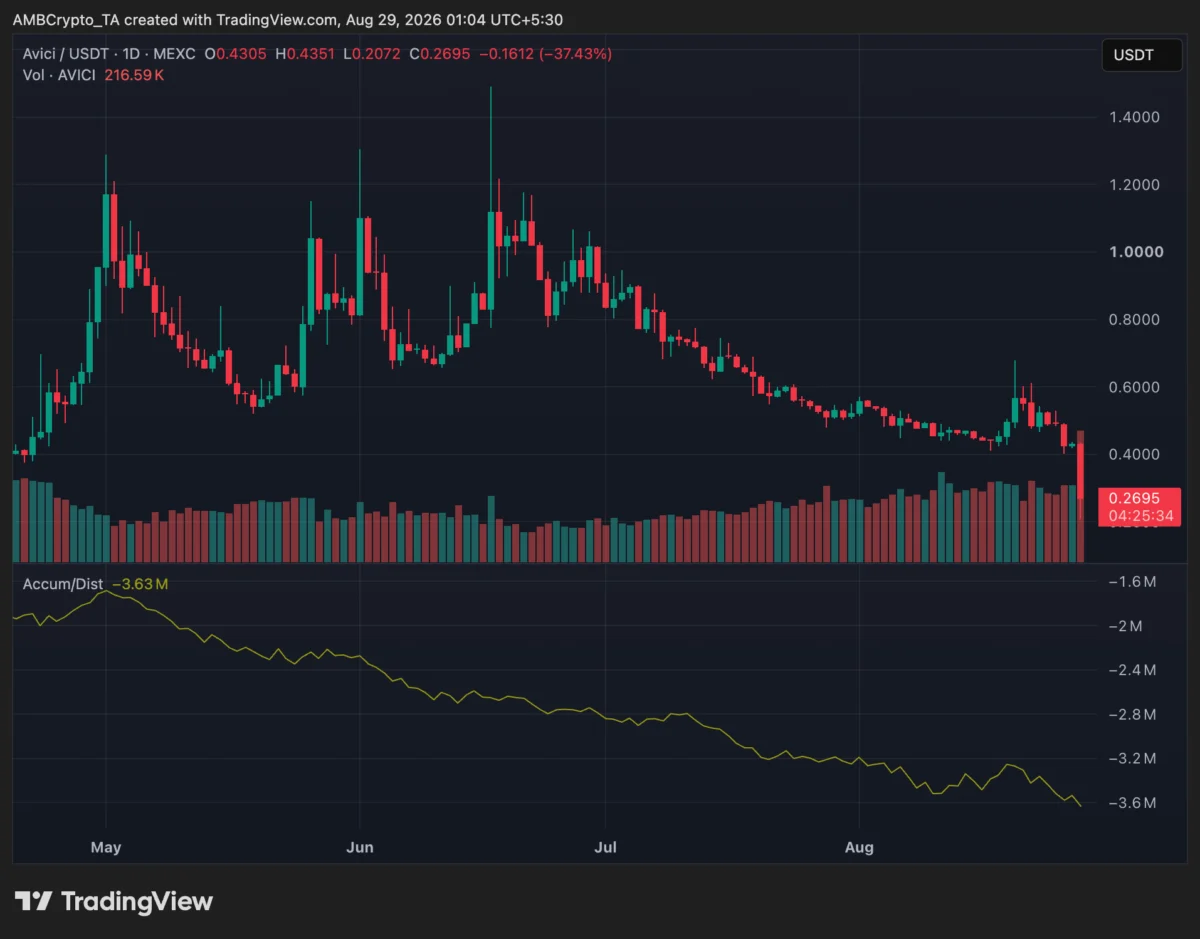
The decentralized finance (DeFi) sector was rocked on Friday as AVICI, a burgeoning player within the Solana ecosystem, faced a catastrophic technical failure that led to a sharp, aggressive sell-off of its native token. The disruption, which centered on the platform’s inability to process withdrawals from user card balances, has sent shockwaves through the community, erasing millions in market capitalization and casting a pall of uncertainty over the project’s future.
As of the latest reports, AVICI’s native token plummeted by as much as 50% during the height of the panic, before settling into a volatile recovery that left it roughly 37% below its opening price. While the company has officially characterized the event as a "withdrawal problem" rather than a security breach, on-chain data paints a more concerning picture of potential exploitation.
Main Facts: The Anatomy of a Market Collapse
The crisis began when users reported an inability to access funds held within the platform’s card-balance system. The immediate impact was an automated and panic-driven exodus from the AVICI token, which had already been struggling with a long-term bearish trend.
The core of the controversy lies in a specific Solana-based address that has been linked to the incident. On-chain forensics provided by the blockchain explorer Solscan revealed that this suspicious address held approximately $604,818.97 at the time the incident was identified. The composition of these funds included a significant concentration of stablecoins: roughly $570,410 in USDC and $34,188 in USDT, alongside a smaller amount of SOL.
What makes this development particularly damning is that the funds were not stagnant. Shortly after the identification of the address, the assets were systematically moved and disbursed elsewhere. As of the time of writing, the stablecoin balances on the address have been drained to zero, and the remaining 886.94 SOL has been transferred to a secondary wallet. This movement has fueled speculation that the "technical issue" described by the company may, in fact, be a sophisticated exploit or a security compromise that allowed an unauthorized actor to siphon user capital.
Chronology of the Incident
The unraveling of AVICI’s market stability can be broken down into a rapid sequence of events:
- Early Friday Morning: Users began reporting significant delays and failures when attempting to withdraw funds from their AVICI card balances.
- Mid-Morning Panic: As social media channels and Telegram groups became inundated with complaints, the AVICI token price began a precipitous slide. Trading volume spiked as retail holders rushed to liquidate their positions.
- The "Exploit" Identification: Blockchain analysts identified a specific wallet address on the Solana network that appeared to be aggregating funds from approximately 2,500 individual user accounts. The balance of this wallet—north of $600,000—corresponded closely with early estimates of the total amount "trapped" or "missing" from user balances.
- Company Acknowledgment: Avici released a brief statement via their official social media channels, confirming they were "aware of an issue" and were working with partners to resolve it.
- Capital Flight: Within hours of the wallet being flagged, the funds within it were moved, effectively bypassing any attempts at freezing the assets.
- Afternoon Market Stabilization: After hitting an intraday low of $0.2072—a staggering drop from its opening price of $0.4305—the token saw a minor recovery to $0.2695, though the sentiment remained overwhelmingly negative.
Supporting Data and On-Chain Analysis
The data provided by Solscan serves as the primary evidence in this ongoing saga. By tracing the flow of assets, investigators have noted that the funds were not just "stuck" due to a UI error, as some initial, overly optimistic observers might have hoped. Instead, the movement of funds suggests a high degree of intent.
The inclusion of 2,500 accounts in the address’s interaction history suggests a systemic breach rather than an isolated bug. In the world of decentralized finance, such a high number of affected users usually indicates that the vulnerability existed within a smart contract or a centralized custody mechanism used by the platform.
Furthermore, the price action of the AVICI token provides a textbook example of how thin liquidity in a small-cap market can exacerbate a crisis. Because AVICI is a relatively small project, the market depth is shallow. When a sudden sell-off is triggered by negative news, the lack of buy-side liquidity means that the price must fall significantly to find a buyer. This "slippage" turned a moderate sell-off into a market crash, with the token losing nearly half its value in a matter of hours.

Official Responses: A Strategy of Ambiguity?
Avici’s response to the crisis has been met with significant criticism from its user base. By avoiding the term "hack" and instead framing the event as a "withdrawal problem," the company has been accused of downplaying the severity of the situation.
In its official communication, the team stated, "We are aware of an issue affecting card-balance withdrawals and are working with our partners to resolve it." However, they notably omitted any estimate regarding the total amount of funds affected, the number of users impacted, or a timeline for potential reimbursement.
This lack of transparency has created a vacuum of information that is currently being filled by rumors and community-led investigations. In the absence of a comprehensive post-mortem analysis, investors are left to wonder if the company has the liquidity to cover the losses or if they are simply waiting for the situation to fade from the public eye.
Implications for the Future of AVICI
The implications of this incident are profound. First and foremost, the trust deficit created by this event may prove insurmountable. For a DeFi platform, trust is the primary currency. Once a user loses confidence in their ability to withdraw their funds, they rarely return.
1. Market Outlook
The technical chart for AVICI reveals a grim reality: the token had been in a multi-month decline long before Friday’s crash. The withdrawal incident acts as an accelerant to this existing downward trajectory. For the token to regain its footing, it must reclaim the $0.40 level—a significant hurdle given the current lack of investor enthusiasm. Should the price fall and sustain a position below $0.20, it could signal a complete breakdown of the project’s tokenomics.
2. Regulatory and Security Scrutiny
Given that the platform handled fiat-linked card balances, the incident may attract the attention of financial regulators. If the "withdrawal problem" is confirmed as a security failure, the platform could face legal challenges regarding its custodial responsibilities. Furthermore, this incident serves as a stark reminder of the risks associated with smaller, less-audited DeFi protocols.
3. Community Erosion
The involvement of 2,500 accounts indicates that this was not a "whale-only" problem; it hit the everyday retail user the hardest. The loss of funds for these individuals often leads to an aggressive campaign of "FUD" (Fear, Uncertainty, and Doubt) that can paralyze a project’s development and marketing efforts for years to come.
Conclusion: A Critical Juncture
As of this writing, trading remains active, and the situation is evolving by the minute. The lack of a clear, definitive statement from the AVICI leadership team is perhaps the most concerning element of the entire event. While the market saw a slight rebound from the $0.20 floor, it is clear that the project is at a critical juncture.
Whether this is a temporary setback that can be rectified with a swift technical fix and a transparent refund plan, or the beginning of a total platform collapse, remains to be seen. One thing is certain: the events of this Friday have fundamentally altered the trajectory of AVICI, and the burden of proof is now entirely on the developers to demonstrate that they can safeguard their users’ assets in a hostile and unforgiving digital landscape. Investors would do well to approach the asset with extreme caution until a full, audited account of the incident is provided.
