

In a significant development for the decentralized finance (DeFi) ecosystem, the entity behind the popular liquidity aggregator Odos has announced that it will permanently wind down its operations. This move marks the end of an era for a platform that had become a go-to tool for traders seeking optimal execution across fragmented liquidity pools. While the underlying blockchain infrastructure remains intact, the operational team has set a definitive timeline for the cessation of its front-end services, triggering a period of transition for its user base and a sharp market reaction for its native token.
The Shutdown Timeline: A Gradual Exit
The transition process for Odos is structured to minimize immediate disruption while ensuring a clean break from active operations. The company has communicated a clear, multi-stage timeline to its users:
- Immediate Restrictions: The team has already disabled several critical functions. This includes the ability to register new accounts, initialize new wallets, or place new limit orders. These measures were implemented immediately upon the announcement to prevent new capital from entering a platform that is effectively in its sunset phase.
- July 27, 2026 – The Read-Only Transition: Beginning on July 27, the Odos application will transition to a "read-only" state. During this period, users will retain the ability to view their transaction histories, historical balances, and account data. However, all interactive functions, including token swaps and position management, will be permanently disabled.
- July 30, 2026 – Final Cessation: The definitive shutdown is slated for July 30, 2026. After this date, all services operated by the company will go offline. The development team has confirmed that there will be no further software updates, maintenance, or technical support provided for the interface.
Understanding the Non-Custodial Nature of the Protocol
A critical point of emphasis in the team’s communication is the non-custodial nature of Odos. Because the protocol operates via smart contracts, user assets are held on-chain rather than within a centralized company vault. The shutdown of the interface does not equate to a loss of funds, provided users take proactive steps to manage their holdings.
The team has specifically addressed users who utilized the platform’s social or email-based login features. These users are being urged to migrate their assets to self-custodial wallets (such as MetaMask, Rabby, or hardware wallets) or to export their private keys well before the July 30 deadline. While the company will no longer provide support, they have committed to leaving access instructions available on their official support pages to assist users in navigating this recovery process.
The Resilience of the Token and the DAO
Perhaps the most nuanced aspect of this announcement is the distinction between the "operating company" and the "protocol ecosystem." The team has clarified that the ODOS token and the Odos DAO (Decentralized Autonomous Organization) will continue to exist independently of the company’s operations.
The ODOS token will remain active on-chain, as its mechanics are governed by immutable smart contracts that do not require the company’s ongoing participation. Furthermore, the Odos DAO—which serves as the governance body for the protocol—is legally and operationally separate from the entity that built the front-end application. Consequently, the DAO retains the autonomy to vote on future directions, potential upgrades, or community-led initiatives without the constraints of the original development firm.
Market Reaction: Volatility and Investor Sentiment
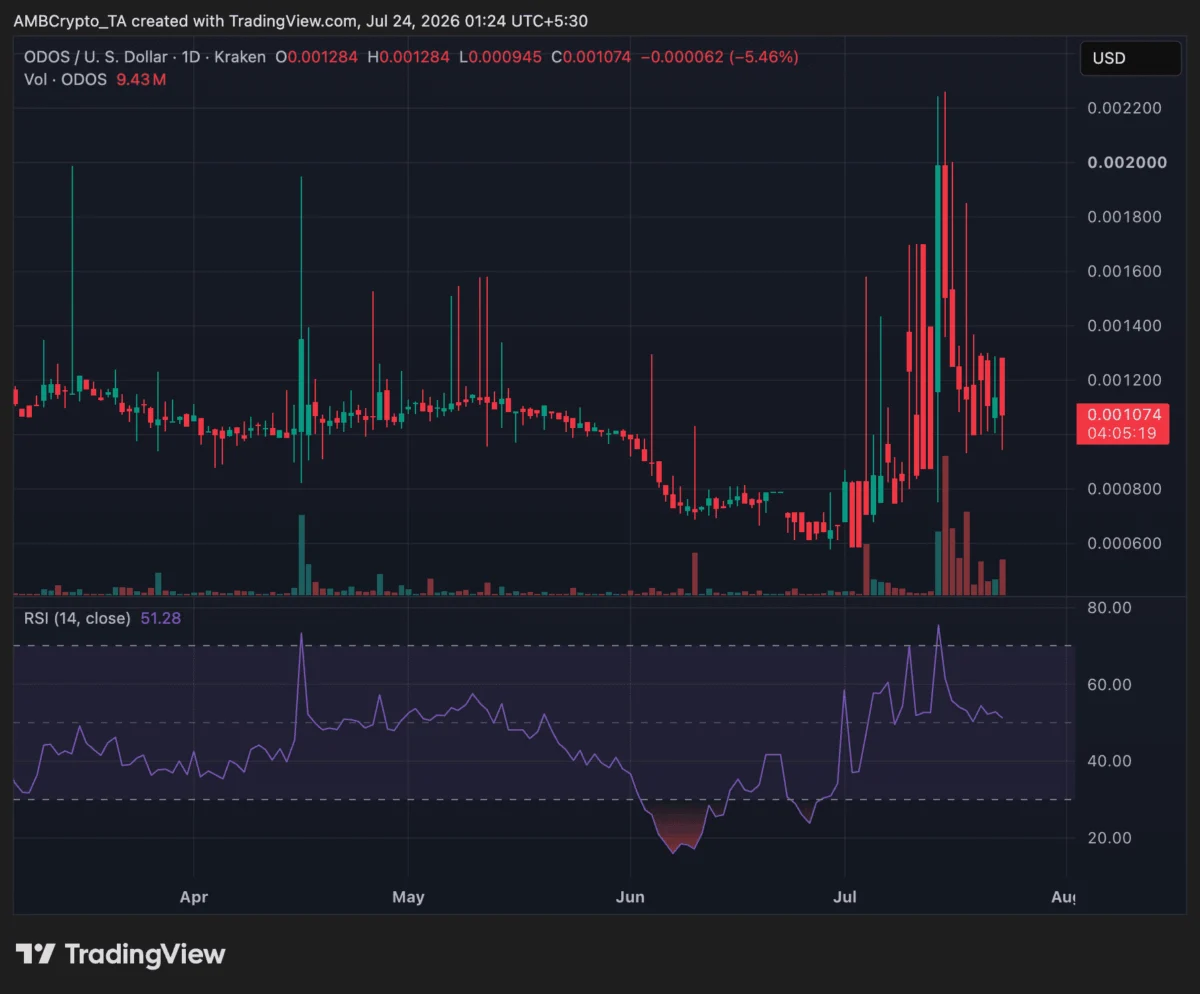
The news of the shutdown was met with an immediate, albeit tempered, decline in the value of the ODOS token. According to TradingView data, the token’s price dipped to approximately $0.00107 shortly after the announcement, reflecting a 5.5% decrease over a 24-hour period.
While the price decline is notable, market analysts point to the elevated trading volume as evidence of a significant rebalancing of positions. Interestingly, the Relative Strength Index (RSI) for the token has hovered near 51. In technical analysis, an RSI of 50 is generally considered neutral. This suggests that while there was an immediate sell-off, the market has not entered a state of panic-induced overselling. Investors appear to be weighing the loss of the primary interface against the potential for the DAO to manage the protocol’s future independently.
Security Warnings and Anti-Scam Precautions
In the wake of such announcements, the risk of phishing and social engineering attacks increases exponentially. The Odos team has issued a stern warning to its community regarding potential bad actors seeking to capitalize on the confusion.
The company explicitly stated: "There will be NO new Odos products, token migrations, token claims, or airdrops from us." The team is urging users to treat any unsolicited direct messages, "migration" websites, or social media accounts claiming to represent a "new" or "re-launched" version of Odos as fraudulent.
The security protocol for users is simple:
- Ignore Unsolicited DMs: The team will not reach out to individual users to assist with "migrations."
- Verify Channels: Only information published through official DAO channels or verified, long-standing social media accounts should be considered legitimate.
- Protect Private Keys: Never enter a seed phrase or sign a transaction on a third-party website that claims to facilitate a token swap or "migration" related to the shutdown.
Implications for the DeFi Aggregator Space
The exit of a prominent player like Odos highlights the inherent volatility and operational challenges within the DeFi sector. Building a sustainable aggregator requires constant innovation, high-frequency updates to keep pace with changing liquidity sources, and a robust business model to cover infrastructure costs.
The Challenge of Sustainability
Many DeFi protocols struggle to find a balance between providing a free, decentralized utility and generating sufficient revenue to sustain a full-time development team. The shutdown of Odos may be indicative of the broader "maturation" of the industry, where projects that fail to achieve long-term financial self-sufficiency are forced to wind down.
The Shift Toward DAO-Centric Governance
Conversely, the fact that the Odos DAO remains operational is a testament to the "decentralization" promise of Web3. By separating the corporate entity from the protocol, the team has ensured that the code remains available for community use. This structure allows for a future where a new team or community contributors could potentially build a new front-end interface, effectively "forking" the project or building on top of the existing smart contracts.
Investor Caution and Future Outlook
For investors, the Odos situation serves as a reminder of the "smart contract vs. interface" paradigm. In DeFi, the interface is merely a window into the blockchain. While the window may be closing, the "house" (the smart contract) still stands. However, the loss of an official, audited, and maintained interface significantly increases the barrier to entry for the average retail user, which naturally impacts the value and utility of the associated governance token.
Conclusion
The permanent wind-down of the company behind Odos is a significant moment in the current cycle of DeFi development. While the shutdown of the primary application represents a loss for those who preferred its specific UX, the continuity of the DAO and the token offers a path forward for the community.
As July 30 approaches, the focus for the user base must remain on asset security and the orderly transition of funds. By adhering to the official guidelines provided by the team and avoiding the inevitable wave of phishing attempts, the Odos community can navigate this transition with minimal disruption. Ultimately, the survival of the protocol as a decentralized entity will depend on the resolve of the DAO to steward the project into its next, albeit uncertain, chapter.
