

The decentralized finance (DeFi) sector is currently witnessing a paradigm shift. For years, the barrier between traditional institutional finance and the permissionless, automated world of DeFi has been defined by a single, immovable wall: custody. While institutional investors have long sought the yield and liquidity offered by protocols like Aave, regulatory mandates and internal compliance protocols have largely prevented them from self-custodying digital assets.
Aave, the industry’s leading decentralized lending protocol, is now proposing a landmark solution to bridge this divide. Through its new "Custodied Collateral Lending" initiative, Aave intends to unlock a vast, stagnant pool of capital by allowing institutions to leverage assets held with regulated custodians—specifically Anchorage Digital—to borrow stablecoins directly on the Aave V4 protocol.
Main Facts: The Mechanics of the Proposal
At the core of Aave’s latest proposal is a technical architecture designed to synthesize the security of regulated custodianship with the efficiency of on-chain lending.
Currently, institutions wishing to access liquidity against their crypto-holdings are often forced to choose between two unappealing options: either self-custody their assets—an operational impossibility for most regulated funds—or utilize wrapped assets like WBTC, which introduce significant counterparty risk, smart contract vulnerabilities, and regulatory uncertainty.
Aave’s proposal introduces a seamless workflow:
- Custodial Anchor: The institutional borrower maintains their actual assets (e.g., BTC or ETH) within the secure, regulated confines of Anchorage Digital.
- On-Chain Representation: Utilizing Chainlink’s "CustodySync" and the creation of "Custodied Collateral Tokens" (CoCTs), the value held at Anchorage is mirrored on-chain. These tokens act as verifiable, liquid receipts of the underlying collateral.
- Lending Execution: These CoCTs are then deposited into the Aave V4 protocol as collateral, allowing the institution to borrow stablecoins like USDC.
- Redemption Cycle: Once the loan and accrued interest are repaid, the CoCTs are burned, triggering a signal to Anchorage to unlock the original collateral for the institution.
This "hub-and-spoke" model ensures that the physical assets never leave the secure environment of the custodian, thereby satisfying the rigorous compliance requirements that govern hedge funds, family offices, and institutional asset managers.
Chronology of the Initiative
The journey toward this institutional breakthrough has been marked by iterative development and community governance.
- Initial Conceptualization: Recognizing that a significant portion of institutional capital remained "unreachable," Aave developers began exploring mechanisms to interface with qualified custodians without compromising the protocol’s decentralized nature.
- The Governance Launch: Aave officially introduced the Request for Comments (ARFC) titled "Custodied Collateral Lending: Aave V4 Isolated Hub-Spoke" on its governance forum. This signaled the transition from internal research to community debate.
- Technical Integration Planning: The proposal highlights the technical synergy with Chainlink’s infrastructure. By leveraging CustodySync, Aave aims to automate the communication between the custodial off-chain environment and the protocol’s smart contracts.
- Current Status: The proposal is currently undergoing rigorous review by the Aave community. Following the conclusion of sentiment checks and discussions, the plan is expected to proceed to a formal Snapshot vote. If successful, it will move into the final stages of implementation, potentially setting a new standard for how DeFi protocols integrate with the "real world" of traditional finance.
Supporting Data: Why Now?
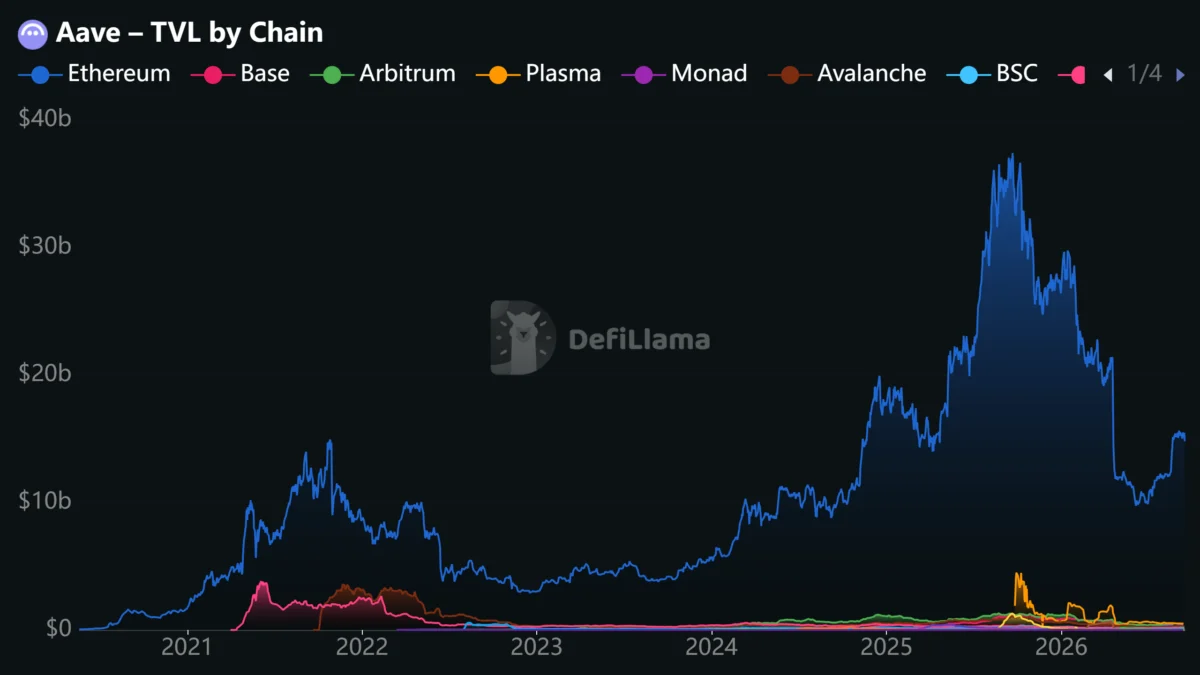
The timing of this proposal is far from coincidental. Aave has seen a remarkable resurgence in market confidence, with its Total Value Locked (TVL) climbing to $19 billion. This represents a staggering 52% recovery from its June lows of $12.5 billion.
However, despite this growth, market analysts point out that a massive amount of capital—estimated in the billions—remains sidelined. This "idle" capital represents institutions that are eager to participate in DeFi markets but are effectively barred by the lack of secure, compliant entry points. By capturing this segment, Aave is not merely adding another collateral type; it is tapping into a previously unreachable liquidity layer.
Furthermore, the shift toward Aave V4, the protocol’s next iteration, provides the perfect sandbox for this integration. V4 is designed to be more modular and efficient, making it the ideal environment to support the unique requirements of institutional-grade collateral.

Official Responses and Strategic Vision
Stani Kulechov, the founder of Aave, has been a vocal proponent of this initiative, describing the proposal as a "first-of-its-kind." In his public statements, Kulechov emphasized that the goal is to enable institutions to borrow against collateral held with a qualified custodian, accessing liquidity directly from the V4 markets without the friction of current bridge-based solutions.
"The integration onboards a class of collateral that is currently unreachable for Aave: assets held with a regulated custodian by institutional borrowers who cannot or will not self-custody," Kulechov noted in the governance forum.
The institutional response has been equally constructive. By partnering with a firm like Anchorage—which is recognized by regulators for its high security and compliance standards—Aave is signaling that it is prepared to play by the rules of the traditional financial establishment. This "compliance-first" approach is expected to lower the entry threshold for more conservative institutional players who have traditionally viewed DeFi with skepticism.
Implications for the DeFi Ecosystem
The ripple effects of this move, if successful, will be profound for the broader DeFi landscape.
1. Competitive Pressure on Other Protocols
If Aave successfully captures the institutional market, other lending heavyweights like Morpho and Kamino will face immense pressure to adapt. The current standard of using wrapped assets may quickly become obsolete for institutional investors who prioritize the security of regulated custodians. This could trigger an arms race among DeFi protocols to establish their own custody-integration partnerships.
2. The Standardization of "Institutional DeFi"
This initiative moves the industry away from the "Wild West" narrative toward a more mature, institutional-grade infrastructure. By formalizing the relationship between on-chain lending and off-chain custody, Aave is essentially creating a blueprint for the future of institutional DeFi. This could pave the way for broader regulatory acceptance, as the distinction between decentralized protocols and regulated financial services becomes increasingly blurred.
3. Mitigating Smart Contract and Compliance Risk
By eliminating the need for wrapped tokens (like WBTC), Aave is effectively removing a significant layer of systemic risk. Wrapped assets often rely on centralized entities to mint and burn tokens, introducing "bridge risk" and potential points of failure. By using Custodied Collateral Tokens (CoCTs), the protocol relies on the established, audited, and regulated security of the custodian, thereby providing a cleaner, more secure experience for the end-user.
4. Market Liquidity and Yield Stability
With an influx of institutional capital, the liquidity available on Aave will significantly increase. This has the potential to stabilize borrowing rates, as the supply side of the protocol expands to meet the demand of institutional borrowers. While this may slightly compress yields for retail lenders, it will create a more robust and liquid market, which is essential for the long-term sustainability of the protocol.
Conclusion
Aave’s "Custodied Collateral Lending" proposal is more than just a feature update; it is a strategic maneuver that bridges the gap between the permissionless innovation of DeFi and the strict regulatory requirements of global finance. By solving the "custody problem," Aave is positioning itself to be the primary gateway for institutional capital into the decentralized world.
As the proposal moves through the governance process, the eyes of the crypto industry will be fixed on the result. If implemented, it will mark a milestone in the maturation of DeFi, proving that the future of finance is not necessarily about choosing between the old world and the new, but about finding a way to integrate the two. The era of "unreachable" institutional capital may finally be coming to an end.
