

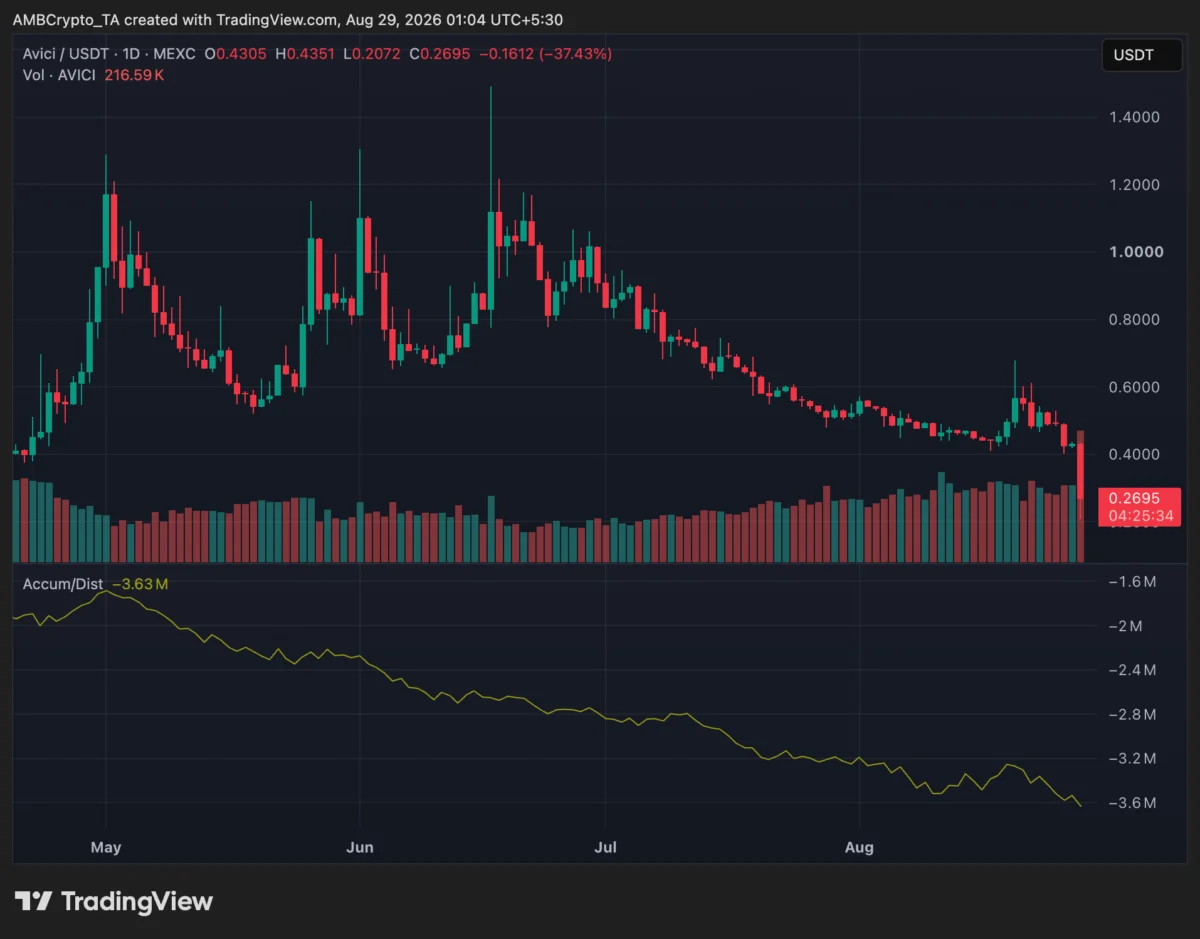
The cryptocurrency market witnessed a dramatic sell-off on Friday as AVICI, a digital asset operating within the Solana ecosystem, experienced a staggering 37% decline in value. The sharp downturn followed an alarming discovery: a significant technical failure affecting user withdrawals from card balances. As rumors of a potential exploit began to circulate across social media platforms, investors scrambled to exit their positions, leading to a volatile trading session that saw the token shed more than half of its market capitalization at the height of the panic.
While the project’s leadership has acknowledged the service disruptions, the lack of transparency regarding the nature of the issue—and the concurrent movement of over $600,000 from an address linked to the incident—has left the community in a state of high anxiety.
The Core Incident: A Breach of Trust
The trouble began when users reported an inability to process withdrawals from their AVICI card balances. As frustration mounted on community forums and X (formerly Twitter), it became clear that this was not merely a localized maintenance issue but a systemic failure.
Blockchain data analysts soon turned their attention to the Solana ledger, where they identified a specific wallet address that appeared to be the primary beneficiary of the anomaly. Before the funds were dispersed to secondary accounts, the address held a staggering $604,818.97. According to data provided by the blockchain explorer Solscan, the wallet contained a mix of stablecoins and native assets: approximately $570,410 in USDC, $34,188 in USDT, and roughly $221 in SOL. Crucially, the activity linked to this address suggests that as many as 2,500 individual accounts may have been affected by the incident.
Chronology of the Crisis
To understand the gravity of the situation, one must look at the timeline of the collapse:
- Early Morning (Pre-Market): AVICI opened the day at $0.4305, trading in a relatively stable, albeit bearish, trend that had persisted for several months.
- The Discovery Phase: Users began flooding community support channels with complaints regarding failed withdrawal attempts. The issue was not confined to a single geographic region or card type, suggesting a backend failure within the project’s infrastructure.
- The Panic Sell-Off: As news of the withdrawal block spread, the market reacted with immediate intensity. The token price entered a freefall, plummeting to a intraday low of $0.2072.
- The Exploitation: On-chain monitoring tools captured the suspicious movement of funds into the aforementioned wallet. By the time observers could track the assets, the wallet balance had been drained, with the USDC and USDT components sent to various destinations, leaving behind only a residual 886.94 SOL.
- Partial Recovery: By late afternoon, the token saw a minor technical rebound, stabilizing near the $0.2695 mark. Despite this recovery, the asset remained down more than 37% for the day, cementing its status as one of the worst-performing assets in the Solana ecosystem for the week.
Analysis of the Financial Impact
The figure of $600,000 has become the focal point of the current discourse. While the existence of this balance on a specific, suspicious address aligns with the total losses reported by users, legal and financial experts are cautious. It has not yet been definitively proven that the entire sum represents stolen client funds, nor has there been a forensic breakdown of exactly how many users were impacted.
However, for a project with a relatively small market capitalization, an outflow of this magnitude is catastrophic. Because AVICI operates in a niche liquidity pool, even moderate fluctuations in trading volume—triggered by panic selling—result in outsized price swings. The current volatility is a textbook example of a "thin market" reacting to negative sentiment.
Official Responses and Corporate Silence
In an official statement released via its social media channels, AVICI confirmed that it was "aware of an issue affecting card-balance withdrawals" and noted that it was "working with its partners to resolve it."

Notably, the company stopped short of labeling the incident a "hack." This semantic choice has drawn significant criticism from the crypto-security community. By avoiding the term, AVICI leaves open the possibility that the loss was the result of an internal system error, a bridge vulnerability, or a third-party partner failure. Furthermore, the company has remained tight-lipped regarding the total number of victims and the specific amount of capital that has been permanently lost. This lack of transparency has exacerbated the distrust among holders, many of whom have called for an independent audit of the platform’s code.
The Broader Context: A Pre-Existing Decline
While the withdrawal incident was the immediate catalyst for Friday’s 37% drop, it is important to contextualize the price action. AVICI has been trending downward for several months. Investors had already been expressing concerns about the project’s roadmap, community engagement, and market adoption.
The incident served as an accelerant, forcing long-term holders to capitulate. For those watching the charts, the question is no longer about the technical bug, but whether the project has the reputational capital to survive such a significant blow. The price has currently found a precarious support level near $0.20. Should it break below this floor, analysts warn of a "cascading liquidation," where the lack of buy-side liquidity could push the token toward near-zero valuation. Conversely, a sustained rally back toward the $0.40 resistance level would be required to signal a genuine recovery of investor confidence.
Implications for the Ecosystem
The AVICI situation serves as a stark reminder of the risks associated with decentralized finance (DeFi) platforms and their integrated card solutions.
- Security and Custody: The ease with which these funds were moved highlights a recurring weakness in projects that interface with traditional banking rails. If the "withdrawal" mechanism is easily bypassed, the entire security architecture of the platform is called into question.
- Regulatory Scrutiny: Such incidents inevitably attract the attention of financial regulators. The use of Solana-based tokens for card services involves complex jurisdictional issues, and if the platform is found to have inadequate safeguards for consumer assets, it could face severe legal repercussions.
- Community Trust: Trust is the most valuable commodity in the crypto space. Even if AVICI manages to resolve the technical issue and reimburse users, the damage to its brand may be irreparable. The "wait and see" approach taken by management is being viewed by many as a failure of leadership.
Conclusion: What Lies Ahead?
As of this writing, trading remains active, and the situation is fluid. The crypto community is awaiting a more comprehensive autopsy of the breach. Will AVICI provide a detailed post-mortem, or will they continue to rely on vague updates?
For investors, the situation is a cautionary tale. The lure of high-yield or convenient crypto-to-fiat card services must always be weighed against the underlying security risks. For now, all eyes are on the $0.20 support line. If AVICI fails to restore confidence through transparency and concrete restitution, the events of this past Friday may be remembered as the beginning of the end for the project. The road to recovery will be steep, requiring not just technical fixes, but a fundamental restructuring of how the platform handles user security and public communication.
In the high-stakes world of digital assets, the margin for error is razor-thin. For AVICI, that margin has been exhausted. Whether they can navigate the aftermath remains the central question for the coming weeks.
