

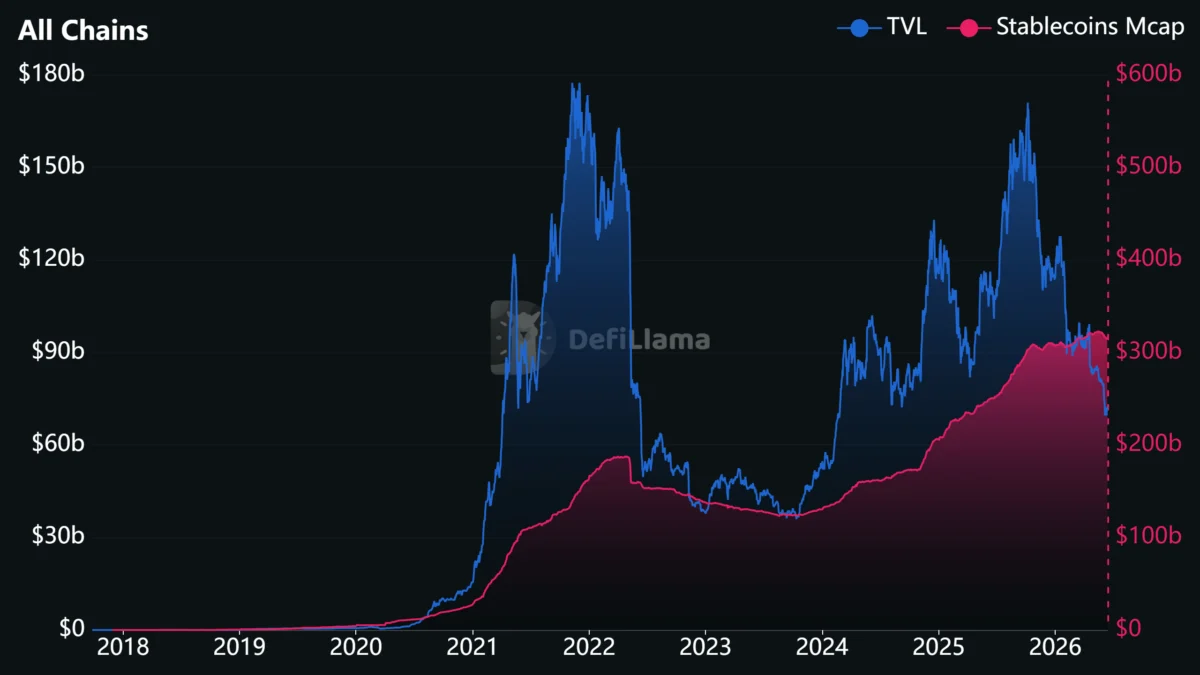
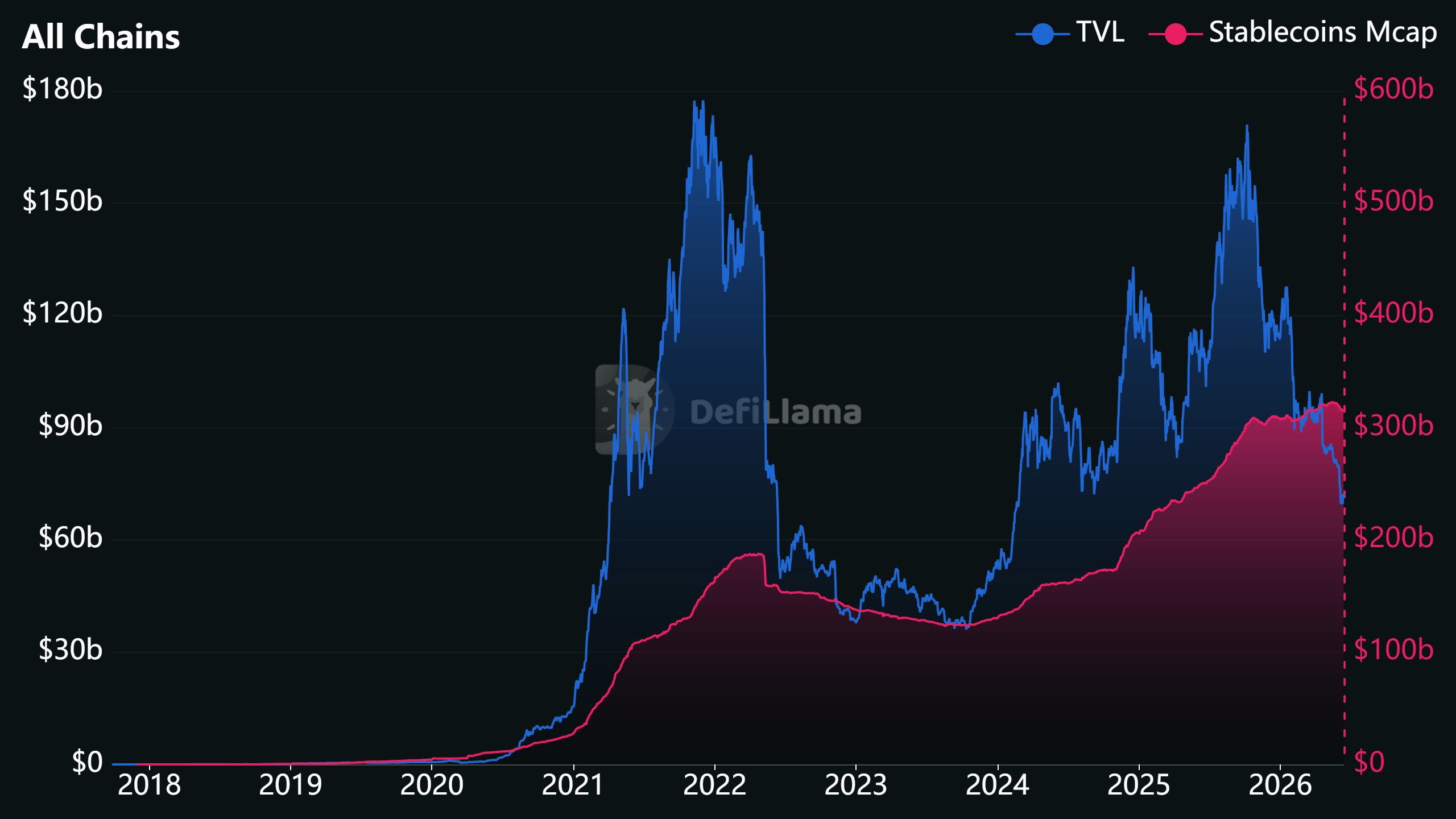
The decentralized finance (DeFi) landscape is currently grappling with a significant structural contraction. As of mid-2026, the sector’s Total Value Locked (TVL)—the primary barometer for ecosystem health—has plummeted from its late-2025 peak of $178 billion to approximately $72.5 billion. This precipitous decline is not isolated to a single niche or blockchain; it is a systemic withdrawal affecting lending markets, liquid staking protocols, and cross-chain bridge infrastructure.
For observers of the crypto-economy, this trend marks a pivotal shift in investor sentiment. While the raw numbers suggest a "mass exodus," a deeper analysis of stablecoin supply levels and staking participation rates reveals a more nuanced reality: capital is not fleeing the crypto ecosystem, but rather retreating into "safe havens" within it.
Main Facts: The Anatomy of a Contraction
The decline in TVL represents a massive reduction in liquidity deployed across dApps. This is not merely a reflection of falling token prices; it is an active removal of capital by liquidity providers (LPs) and institutional yield seekers.
- Systemic Scope: The weakness is pervasive. Lending protocols, which historically drove the bulk of DeFi activity, are seeing reduced utilization. Liquid staking platforms, which once promised "set-and-forget" yields, are facing redemption pressures.
- The Stablecoin Paradox: Despite the $105 billion drop in TVL, the global stablecoin supply remains remarkably resilient, hovering near $315 billion. This discrepancy is the smoking gun of the current market cycle: liquidity is plentiful, but it is sitting on the sidelines, waiting for better risk-adjusted opportunities.
- Protocol Vulnerability: The frequency of security breaches has cast a long shadow over the sector. In Q2 2026 alone, nearly 70 protocols were compromised, resulting in approximately $746 million in losses. While these incidents were largely smaller in scale than historical "mega-hacks," their cumulative impact has severely eroded user confidence.
Chronology of the Decline: From Peak to Pivot
The current environment stands in stark contrast to the euphoria of late 2025. To understand how we arrived here, we must look at the timeline of the shifting market appetite.
Q4 2025: The Zenith
By the end of 2025, DeFi was operating under the assumption of a "perpetual bull market." Yields were high, leverage was easily accessible, and new protocols were launching daily to capture the overflow of capital. TVL hit a record $178 billion as users chased aggressive APYs, often ignoring the underlying protocol risks.
Q1 2026: The Cooling Phase
As the new year dawned, the market began to consolidate. Institutional interest shifted toward more regulated, yield-bearing assets, and the "DeFi summer" fervor began to fade. Borrowing demand on major lending protocols began a steady, linear decline, signaling that the speculative appetite was waning.
Q2 2026: The Security Crisis
The second quarter proved to be the breaking point. A wave of exploits, ranging from smart contract bugs to oracle manipulation, triggered a flight to safety. Investors began to weigh the risks of earning 5% to 9% APY against the binary risk of a total loss due to an exploit. By mid-June 2026, the psychological shift was complete: capital preservation became the primary objective for the majority of DeFi participants.
Supporting Data: Why Yields No Longer Compete
The core issue facing the DeFi sector today is the erosion of the "Risk-Reward Premium." In a standard financial environment, investors take on smart contract risk, liquidity risk, and liquidation risk in exchange for a yield that significantly outperforms risk-free alternatives.
Current data from major lending protocols shows stablecoin lending rates fluctuating between 3.5% and 9%. While these rates might seem attractive compared to traditional savings accounts, they are insufficient to compensate for the volatile and high-risk nature of DeFi. When an investor can stake a native asset (like ETH or SOL) for a baseline yield without interacting with complex, exploitable smart contracts, the incentive to move that capital into a risky lending protocol vanishes.
The Staking Resilience
Data from Ethereum and Solana provides a compelling counter-narrative to the idea that crypto is in a death spiral.
- Ethereum: Approximately one-third of the total circulating supply remains staked.
- Solana: Staking participation remains robust at nearly 68%.
These figures indicate that while DeFi protocols are failing to capture liquidity, the underlying networks remain highly trusted. Investors are choosing the security of the protocol’s consensus layer over the secondary yields offered by the DeFi ecosystem.
Official Responses and Expert Consensus
The broader industry has begun to address these challenges. Several leading DeFi developers and foundation representatives have weighed in on the current contraction.
"We are seeing a maturation of the user base," notes one anonymous lead developer from a top-tier lending protocol. "Users are no longer blindly chasing yields. They are performing rigorous audits, examining collateralization ratios, and—most importantly—withdrawing funds when the risk premium doesn’t justify the technical exposure. It is a painful transition, but it is a necessary one for the long-term sustainability of the sector."
Market analysts at DeFiLlama have suggested that the current TVL drop is a "cleansing process." By removing "mercenary capital"—funds that moved between protocols solely to farm governance tokens—the remaining TVL represents more "sticky," long-term liquidity. While the total volume is lower, the quality of that liquidity may be higher.
Implications: The Path Forward
The contraction of DeFi is not a death knell; it is an evolution. The current landscape suggests several major implications for the future of the sector:
1. The Rise of "Risk-Adjusted" DeFi
Future growth will likely depend on the integration of more sophisticated risk-management tools. Protocols that offer transparent insurance-backed products or more robust, audit-verified smart contracts will likely win the battle for the remaining liquidity.
2. Protocol Consolidation
With less capital to go around, we are likely to see a "flight to quality." Smaller, experimental protocols may shutter, while established, battle-tested platforms (Blue-chip DeFi) will likely consolidate their market share. The fragmentation that characterized 2025 is expected to give way to a more concentrated ecosystem.
3. Institutional Integration
As retail liquidity remains cautious, institutional capital may provide the next wave of growth. However, this capital will require different guardrails—KYC/AML compliance, institutional-grade security, and clearer regulatory frameworks. The transition from "DeFi" to "CeDeFi" (Centralized/Decentralized Finance) may become the defining trend of the next two years.
4. The End of "Yield Farming" as a Growth Strategy
The era of hyper-inflationary token emissions to attract TVL is effectively over. Users have realized that high APYs funded by token inflation are unsustainable and ultimately dilutive. Future protocols will need to generate real revenue to attract users, marking a shift toward fundamental value over speculative hype.
Conclusion: A More Sustainable Foundation?
While the $100 billion decline in TVL is objectively a contraction, it is a corrective move that aligns DeFi with the realities of risk management. The surplus of stablecoin liquidity indicates that the ecosystem has the dry powder to recover, provided the industry can restore confidence in its security models and offer yields that truly reflect the risks taken.
The current period of quiet and consolidation may well be the most important phase in DeFi’s history. By shaking out the speculative excess, the sector is being forced to evolve from a "wild west" of high-risk yield chasing into a more disciplined, security-conscious, and sustainable financial layer for the internet. The capital has not left; it is simply waiting for the next generation of protocols that offer genuine utility, security, and sustainable, risk-adjusted returns.
