

In a move that has sent ripples through the decentralized finance (DeFi) sector, global banking giant Standard Chartered has initiated coverage on Uniswap, the world’s leading decentralized exchange. In a research note released to clients on Monday, June 15, 2026, the bank unveiled an exceptionally bullish outlook for the protocol’s native token, UNI. According to Geoff Kendrick, the bank’s Global Head of Digital Assets Research, UNI is positioned for a meteoric rise, with a projected price target of $100 by the end of 2030—a staggering 40x increase from current valuations.
This high-profile endorsement underscores a shifting narrative in institutional finance, where traditional banks are increasingly scrutinizing DeFi protocols not as peripheral experiments, but as core infrastructure for the next generation of global capital markets.
The Core Thesis: Tokenization as the Primary Catalyst
At the heart of Standard Chartered’s optimism is the burgeoning trend of real-world asset (RWA) tokenization. As traditional financial institutions seek to bridge the gap between legacy systems and blockchain technology, the demand for high-liquidity, secure, and decentralized infrastructure has spiked.
Kendrick argues that the DeFi ecosystem is on the cusp of a massive expansion, projecting that the value of tokenized assets locked within such protocols will grow by a factor of 37x between mid-2026 and the end of 2030. Within this forecasted landscape, where approximately $2.7 trillion is expected to be locked in DeFi protocols within four years, Uniswap stands as the primary beneficiary.
“Uniswap is uniquely positioned to scale to meet this opportunity,” Kendrick stated in the note. The bank cites three pillars for this dominance:
- Brand Recognition: Uniswap has cemented its status as the "blue-chip" standard of decentralized exchanges.
- Infrastructure Versatility: Its role as an "all-purpose infrastructure layer" allows it to handle everything from simple token swaps to complex institutional liquidity provision.
- Security and Resilience: Despite the inherent risks of DeFi, Uniswap’s battle-tested smart contracts provide a level of security that attracts risk-averse institutional capital.
A Comparative Look: Uniswap vs. Centralized Giants
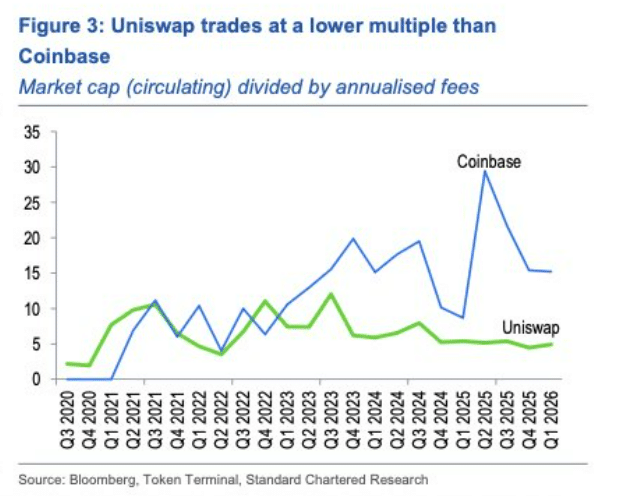
Perhaps the most provocative element of the report is the bank’s direct comparison between Uniswap and Coinbase. Standard Chartered posits that Uniswap is currently undervalued when measured by its market capitalization relative to annualized fees. By utilizing a "market cap to annualized fees" ratio, the bank suggests that Uniswap is trading at a more attractive multiple than its centralized counterpart, Coinbase.
This comparison serves as a signal to institutional investors that decentralized, automated protocols may soon outcompete centralized entities in terms of capital efficiency and operational scalability. Furthermore, Kendrick suggests that should Uniswap continue to aggressively pursue partnerships with traditional finance (TradFi) firms, UNI is poised to outperform both Bitcoin and Ethereum on a risk-adjusted basis over the next four years.
Chronology of the DeFi Pivot
The path to this moment has been paved by significant milestones in the protocol’s development:
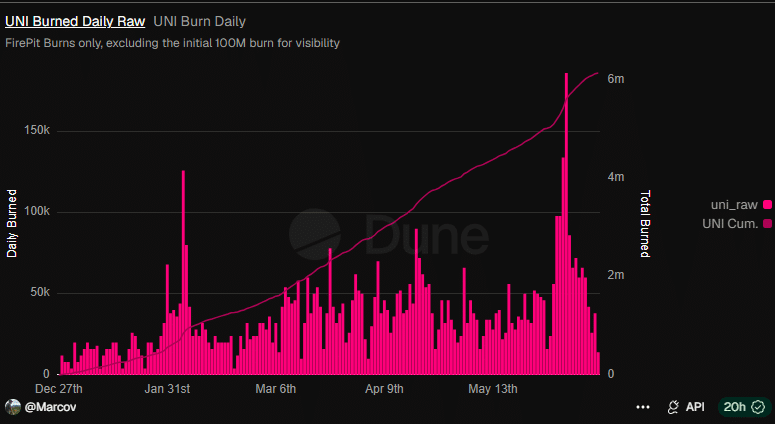
- Late 2025 – Early 2026: Uniswap officially activates its "fee switch" mechanism. This governance-approved update allowed the protocol to collect a portion of trading fees, which are then directed toward UNI token buybacks and burns, effectively creating a deflationary pressure on the token’s supply.
- Early 2026: Major institutional players, most notably BlackRock and Fidelity, signal their expansion onto the Uniswap protocol. These entities utilized the platform to scale their own tokenized money market funds, validating the infrastructure for institutional use.
- June 15, 2026: Standard Chartered issues its research report, marking a formal entry into the institutional analysis of Uniswap.
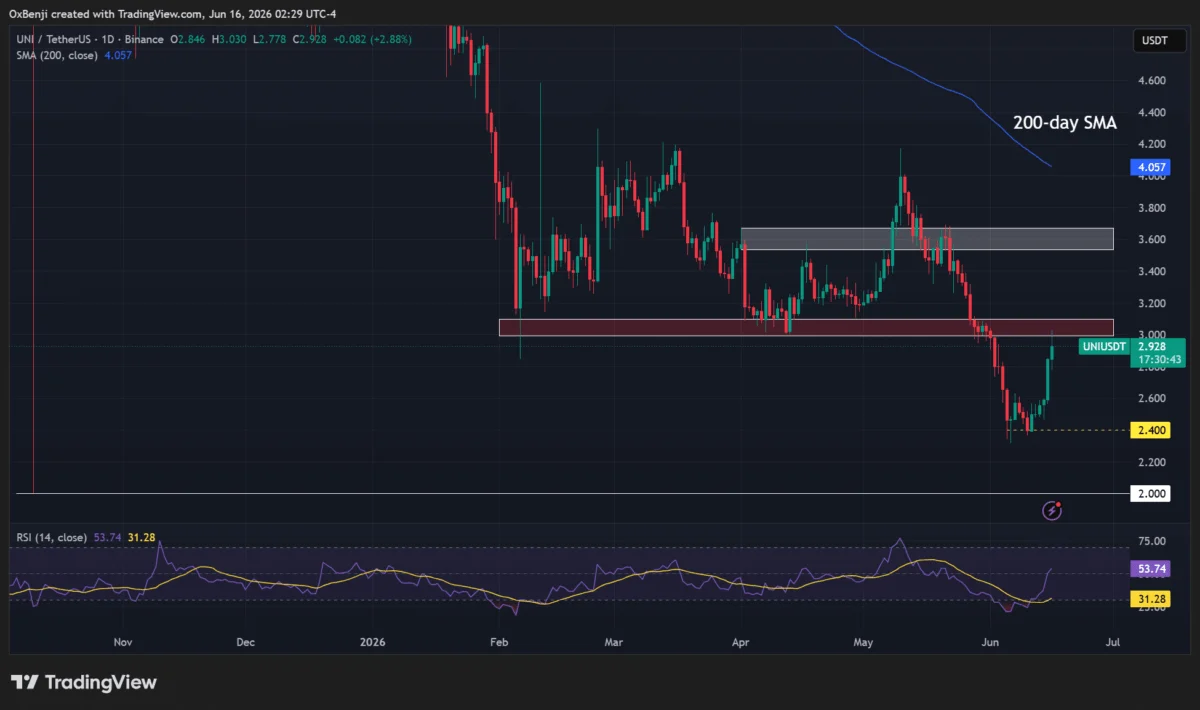
- June 16, 2026: The market reacts. UNI surges 18% in the wake of the news, erasing the losses incurred earlier in the month and establishing a new critical support level at $3.00.
Supporting Data: The Impact of the Fee Burn
The economic model of UNI has undergone a radical transformation. Since the activation of the fee switch, the protocol has demonstrated a consistent ability to generate revenue. The protocol currently generates an estimated $858 million in annual fees.
A significant portion of this revenue is dedicated to the buyback-and-burn program. Historical data from Dune Analytics reveals that approximately 106.15 million UNI tokens have been permanently removed from circulation since December 2025. This figure includes an initial, massive burn of 100 million UNI. Excluding that singular event, the protocol has been burning roughly 1 million UNI per month throughout 2026. This consistent reduction in supply, coupled with the projected growth in DeFi activity, forms the mathematical foundation of Standard Chartered’s $100 price target.
Official Responses and Market Skepticism
The reaction to the report was polarized, reflecting the broader divide between institutional analysts and the "crypto-native" investment community.
Hayden Adams, the founder and CEO of Uniswap, publicly welcomed the analysis, labeling the Standard Chartered document a "great piece of work." His endorsement added a layer of legitimacy to the bank’s research in the eyes of the retail crypto community.
However, the report also faced immediate pushback from industry experts. Omar Kanji, an investor at the prominent venture firm Dragonfly, took to social media to voice his disapproval, characterizing the bank’s methodology as "straight-up chart crime." Kanji specifically took issue with the bank’s comparison of UNI’s market cap to that of Coinbase. He argued that by including liquidity provider (LP) fees in the annualized fee calculation—fees that are earned by users, not the protocol treasury—the bank’s valuation model is fundamentally flawed. "Including LP fees in annualized fees and then saying it trades at a ‘lower multiple’ than $COIN is some serious slop analysis," Kanji remarked.
Critics also point out that the protocol’s success is not guaranteed. Regulatory headwinds, potential forks of the protocol, and the inherent volatility of the crypto market remain existential risks that a long-term projection cannot fully account for.
Implications for the Future of DeFi
The implications of Standard Chartered’s coverage are profound. Whether the $100 target is hit or not is perhaps secondary to the fact that a tier-one global bank is now creating "price targets" for a governance token of a decentralized exchange.
1. The Institutionalization of DeFi
This report signals that the "DeFi vs. TradFi" wall is crumbling. As institutional firms like BlackRock and Fidelity integrate with protocols like Uniswap, the distinction between decentralized and centralized finance will likely become blurred. Standard Chartered’s analysis serves as a roadmap for other banks to begin building similar coverage frameworks for DeFi assets.
2. A Shift in Token Utility
The "fee switch" and the subsequent burn mechanism have fundamentally changed the UNI token from a purely governance-based asset to one with a direct link to the protocol’s cash flow. This shift makes it easier for traditional analysts, who are accustomed to valuing equities based on discounted cash flow (DCF) models, to justify their valuations.
3. Market Sentiment and Technicals
The immediate 18% pump in UNI’s price demonstrates that market sentiment remains highly sensitive to institutional narratives. The $3.00 level has emerged as the psychological "line in the sand." If the bulls can maintain this as support, technical analysts see clear paths toward $3.60 and $4.00. Conversely, should the sentiment around the report cool, a failure to hold $3.00 could see the asset retreat toward the $2.60 or $2.40 range.
Conclusion
Standard Chartered’s ambitious forecast for Uniswap represents a watershed moment for the crypto industry. While critics are right to question the methodology behind the bank’s valuation, the underlying premise—that decentralized, automated infrastructure is becoming an essential component of the global financial system—is increasingly difficult to ignore.
As we look toward 2030, the success of Uniswap will depend on more than just price targets. It will require the protocol to navigate the complex waters of global regulation, maintain its technological edge against emerging competitors, and prove that its fee-burning economic model can sustain long-term value for token holders. For now, the market is listening, and the bold prediction has successfully reignited interest in one of the most important protocols in the history of decentralized finance.
