


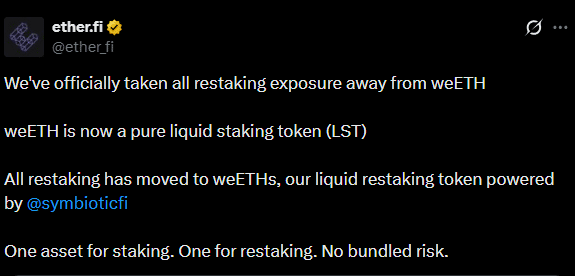
In a significant maneuver that signals a maturing—and perhaps cooling—decentralized finance (DeFi) ecosystem, Ether.fi, the titan of the liquid restaking sector, has announced a structural overhaul of its flagship token, weETH. As of August 7, 2026, the project has effectively stripped away all restaking exposure from weETH, transforming the asset into a "pure" liquid staking token (LST).
This decision marks a departure from the aggressive yield-optimization strategies that characterized the 2024-2025 DeFi bull run. By exiting the EigenLayer ecosystem for its primary token and migrating restaking activities to "weETHs" on the Symbiotic protocol, Ether.fi is attempting to isolate its core asset from the "bundled risks" inherent in complex, multi-layered staking architectures.
Main Facts: The De-risking of weETH
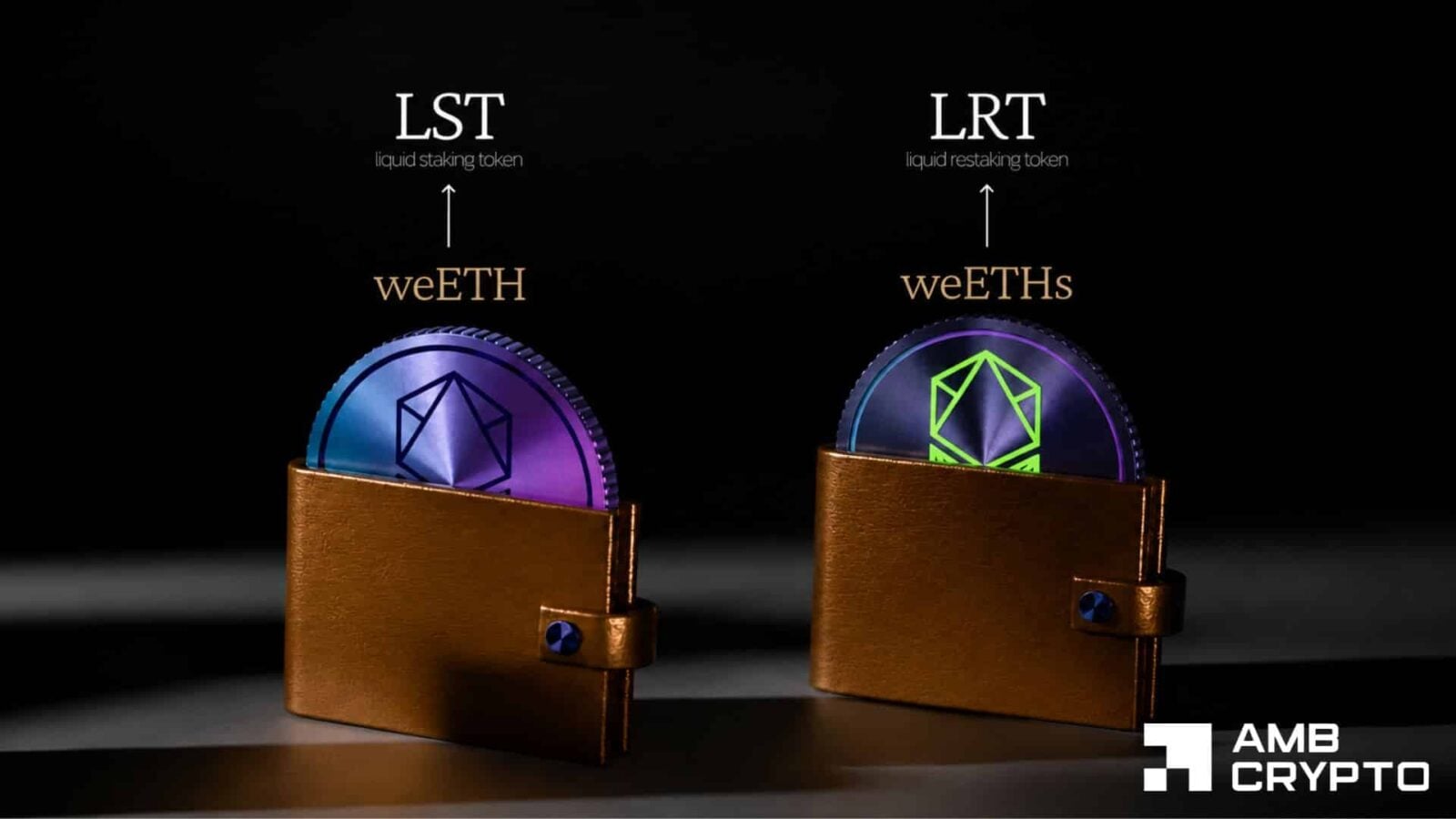
The core of Ether.fi’s announcement centers on the technical decoupling of weETH from the restaking yield-generation loop. Previously, weETH functioned as a Liquid Restaking Token (LRT), providing users with native Ethereum staking rewards plus additional yields derived from restaking on EigenLayer.
Under the new framework, weETH has been reverted to a pure LST. This means the token now strictly represents staked ETH and its associated rewards, removing the additional risks associated with the security of secondary protocols, slashing conditions, and the potential for smart contract failures within the restaking layer.
Key Highlights of the Transition:
- Asset Redefinition: weETH is now a pure-play LST, focusing on the stability of core ETH staking.
- Protocol Migration: The project has shifted its active restaking operations to Symbiotic, a move designed to diversify infrastructure dependencies.
- Risk Mitigation: The team explicitly cited the need to eliminate "bundled risk," acknowledging that the previous complexity created systemic vulnerabilities.
- Market Dominance: Despite this contraction, Ether.fi retains approximately 50% of the liquid restaking market, boasting a Total Value Locked (TVL) of roughly $11.4 billion.
Chronology: From Innovation to Contraction
The evolution of Ether.fi mirrors the broader trajectory of the Ethereum staking market, which has moved from rapid experimentation to a phase of defensive consolidation.
Phase 1: The Proliferation of Yield (2024–Early 2025)
During this period, the "restaking" narrative dominated the Ethereum ecosystem. Platforms like Ether.fi and EigenLayer pioneered the concept of "looping"—where staked ETH was restaked across multiple protocols to compound interest. These strategies were highly lucrative, often providing an additional 50 to 100 basis points (bps) of yield on top of native staking rewards.
Phase 2: The Security Reckoning (Late 2025)
As TVL surged, the risks associated with these complex strategies began to manifest. High-profile exploits, such as the $292 million breach at KelpDAO, exposed the fragility of deeply nested DeFi protocols. This led to a tightening of risk appetite across the board.
Phase 3: The Aave Clean-up (Mid-2026)
Lending giant Aave, a pillar of the DeFi ecosystem, initiated an aggressive risk framework update. This saw the deprecation of over $98 million in assets deemed too risky or possessing insufficient adoption. Crucially, the "Pendle PT" trades—which were heavily utilized by the Ether.fi and EigenLayer ecosystem to loop yields—were hit by these changes, forcing a broad reassessment of sustainable yield strategies.
Phase 4: The Strategic Pivot (August 2026)
Following the industry-wide de-risking, Ether.fi finalized its decision to sunset the restaking integration for weETH, opting for a cleaner, more resilient token model.
Supporting Data: A Market in Flux
The liquid restaking market has experienced a significant contraction. From a peak of $29 billion in Total Value Locked last October, the market has settled to approximately $22 billion. While the demand for native ETH staking continues to hit record highs—suggesting that users are still seeking yield—they are becoming increasingly selective about where they allocate their capital.
Comparative Metrics
| Metric | Q4 2025 | Q3 2026 |
|---|---|---|
| Total Liquid Restaking TVL | $29 Billion | $22 Billion |
| Ether.fi TVL | ~$15 Billion | ~$11.4 Billion |
| Market Sentiment | High Yield/High Risk | Risk-Off/Conservative |
The data indicates that while the "restaking" experiment was technically successful in terms of capital attraction, the market is currently undergoing a "flight to quality." Investors are prioritizing the safety of their principal over the marginal, often volatile, gains provided by complex restaking loops.
Official Responses and Industry Sentiment
The shift has been met with a mixture of pragmatic acceptance and melancholic reflection from the architects of the restaking movement.
Mike Silagadze, CEO of Ether.fi
In a candid statement regarding the transition, Silagadze noted, "End of an era. Sad. I still think restaking will come back in one form or another; I think it was just a bit too early." His comments reflect a growing industry consensus that while the underlying technology of restaking is sound, the current ecosystem lacked the maturity to handle the complexity without inviting unacceptable levels of systemic risk.
Expert Perspective: Tom Wan of Entropy Advisors
Tom Wan, a notable voice in DeFi research, emphasized the historical role Ether.fi played in the current market structure. "Ether.fi and Eigen kickstarted the first wave of ETH looping on Aave and the Pendle PT trade," Wan noted. His analysis highlights that the current "clean-up" is not just about Ether.fi, but about a necessary pruning of the entire DeFi stack that had become over-leveraged on the back of restaking yield.
Implications: The Future of Decentralized Finance
The decision by Ether.fi is more than a technical update; it is a signal of a broader structural shift in DeFi.
1. The Death of "Yield-at-All-Costs"
For the past two years, DeFi users have been conditioned to chase the highest Annual Percentage Yield (APY), often ignoring the compounding risk of underlying protocols. The current move by Ether.fi and Aave suggests that the market is finally prioritizing sustainability over speculation. Protocols that cannot prove their long-term security will likely struggle to maintain TVL.
2. The Rise of "Pure" Assets
By reverting weETH to a pure LST, Ether.fi is positioning its token as a "blue chip" in the staking landscape. In a market where users are wary of exploits, the simplicity of a pure LST becomes a competitive advantage. We can expect to see other protocols following suit, simplifying their token architectures to attract risk-averse institutional liquidity.
3. The Ripple Effect on DeFi
The Aave risk framework update and the subsequent retreat of platforms like Ether.fi will likely lead to a "de-leveraging" across the entire DeFi ecosystem. As risky assets are removed from lending pools, liquidity will be forced to find safer harbors, potentially leading to a period of lower, but more stable, yields across the board.
4. A Maturing Ecosystem
While some may view this contraction as a sign of failure, it is more accurately described as a maturing of the DeFi market. The "Wild West" era of experimental staking is giving way to a more disciplined, risk-conscious environment. The integration of restaking into platforms like Symbiotic shows that while the specific methods of 2024 are being deprecated, the innovation continues in a more controlled, isolated manner.
Conclusion
Ether.fi’s strategic pivot is a landmark moment in the history of liquid restaking. By choosing to prioritize stability over the complex, bundled risks of the previous cycle, the protocol is aligning itself with the current market reality: a demand for simplicity, security, and long-term sustainability. While the "era of extreme looping" may have ended, the lessons learned from this period will undoubtedly shape the next iteration of the Ethereum staking ecosystem. As the market continues to readjust, participants should expect further consolidation, with the most resilient and transparent protocols emerging as the new foundations for the decentralized economy.
