


In the hyper-competitive landscape of decentralized finance (DeFi), where liquidity is the ultimate currency, Uniswap has ignited a firestorm of debate. The industry giant recently unveiled "Trade Pools," a new token launchpad platform that promises to revolutionize how assets are brought to market on the Robinhood Chain. By introducing a significantly lower fee structure, Uniswap has positioned itself as a disruptor, yet the move has prompted accusations from critics who fear the platform might be prioritizing aggressive value extraction over user safety.
As Uniswap navigates this volatile segment of the market—historically dominated by platforms like PumpFun—the company is facing intense scrutiny. Is Trade Pools a genuine attempt to democratize access to high-quality trading tools, or is it merely an attempt to capture market share from established meme-coin launchpads?
The Genesis of Trade Pools: A Challenge to the Status Quo
The launch of Trade Pools marks a significant pivot for Uniswap. Initially, the decentralized exchange (DEX) rolled out "Uniswap Launches," an aggregator interface designed to house various third-party launchpads under one roof. This effort, debuted on the Robinhood Chain to capitalize on the network’s surging speculative activity, featured prominent players like Pons, Flap, and Bankr.
However, Uniswap quickly moved beyond mere aggregation. By launching its own native tool, Trade Pools, the exchange has essentially entered the arena as a direct competitor to the very platforms it was previously hosting. The primary differentiator? Cost. While rival launchpads often charge fees hovering around 1%, Uniswap has set its trading fee at a mere 0.25%—a fourfold reduction that has immediately sent shockwaves through the ecosystem.
Critics were quick to characterize this move as an aggressive land grab, suggesting that Uniswap is mirroring the "extractive" behaviors seen in other high-volume memecoin hubs. These critics argue that the platform could lead to the same pitfalls seen on platforms like PumpFun, where high turnover and aggressive fee structures often leave retail traders holding the bag.
Official Stance: Hayden Adams Defends the Vision
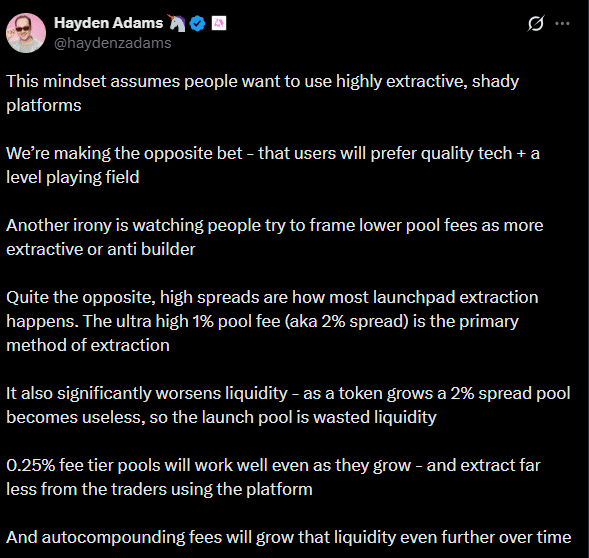
In response to the growing skepticism, Uniswap CEO Hayden Adams took to social media to push back against the narrative that the platform is designed for exploitation. Adams argued that the accusations fundamentally misunderstand the philosophy behind the new tool.
"This mindset assumes people want to use highly extractive, shady platforms," Adams stated. "We’re making the opposite bet—that users will prefer quality tech and a level playing field."
Adams emphasized that the 0.25% fee tier is not a race to the bottom, but a sustainable model intended to prioritize user retention. By reducing the cost of entry, Uniswap aims to provide a more hospitable environment for traders who have grown weary of the "casino-like" dynamics of other launchpads. "These 0.25% fee tier pools will work well even as they grow, and they extract far less from the traders using the platform," he added.
Chronology: A Rapid Expansion into the Robinhood Chain
The timeline of this development is inextricably linked to the emergence of the Robinhood Chain. Since its debut last month, the new Layer-2 (L2) network has become a focal point for memecoin mania.
- Last Month: The Robinhood Chain launches, sparking an immediate influx of capital and speculation. Uniswap quickly deploys its "Uniswap Launches" aggregator to capture the initial surge of interest.
- Two Days Ago: Uniswap officially debuts "Trade Pools," transitioning from an aggregator to an active market participant on the new L2.
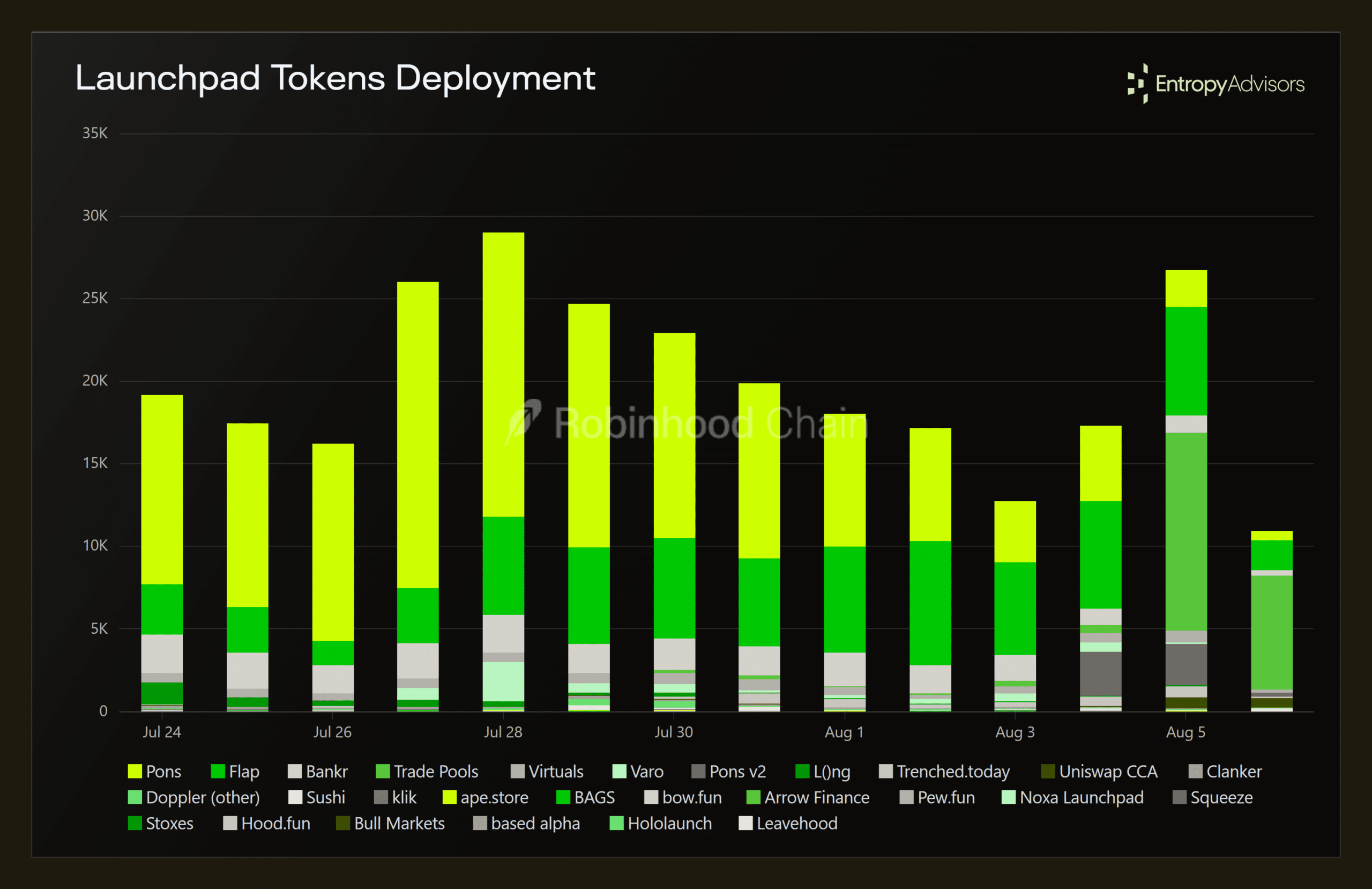
- The Immediate Aftermath: Within 48 hours of its launch, Trade Pools has already ascended to become the leading token launchpad on the Robinhood Chain.
- Market Reaction: The news triggered an immediate 5% price surge for the UNI token, which reached $4.19, reflecting investor confidence in the DEX’s ability to capture the L2 narrative.
Strategic Data: Why Trade Pools Matters to Uniswap V4
Beyond the surface-level competition with other launchpads, analysts see a deeper strategic motive behind the move. Tom Wan, head of data at Entropy Advisors, believes the launch is a calculated effort to force the adoption of Uniswap V4.
"I read Trade Pools as a strategic push to drive usage of Uniswap v4," Wan noted. "Most launchpads today graduate tokens into v3, while Trade Pools routes directly into v4."
The data supports this hypothesis. In the two days following the launch of Trade Pools, Uniswap V4 trading volumes witnessed a 2.4x surge, jumping from $100 million to over $237 million. By integrating the launchpad directly into the V4 infrastructure, Uniswap is effectively creating a walled garden that incentivizes developers and liquidity providers to stick with its latest technology, rather than migrating to competitors.
Market Implications: Robinhood Chain vs. The Heavyweights
The rise of Trade Pools has had a direct impact on the standing of the Robinhood Chain in the broader crypto ecosystem. The network is currently fighting for dominance against established giants like Solana and the BNB Chain.
Recent on-chain data highlights the shifting momentum:
- Robinhood Chain: Recorded nearly $600 million in launchpad volume last week, a massive figure for a network in its second month of existence.
- BNB Chain: Trailed behind with approximately $400 million in volume, showing that the Robinhood Chain is effectively cannibalizing market share.
- Solana: Still reigns supreme, boasting roughly $3 billion in volume, driven by established powerhouses like PumpFun and Bonkfun.
The success of the Robinhood Chain is critical for Uniswap’s broader goal of decentralizing the trading experience. As volume migrates from centralized exchanges to the L2, Uniswap’s ability to capture the "launch" phase of tokens—where the highest volatility and fees typically exist—is paramount to its long-term viability.
The Balancing Act: Quality vs. Extraction
The central tension of this story lies in the definition of "value extraction." For critics, any platform that facilitates the rapid launch of memecoins is inherently risky, as these tokens are often susceptible to "rug pulls" and extreme price manipulation.
Uniswap’s defense—that it offers "quality tech"—relies on the idea that by providing better smart contracts and a more transparent interface, it can mitigate the risks associated with memecoin trading. By offering a lower fee, Uniswap is essentially betting that it can attract a higher volume of legitimate, non-predatory projects.
However, the reality of the memecoin market is that it is driven by speculation. Whether the platform charges 0.25% or 1%, the inherent volatility of the underlying assets remains the same. Uniswap is effectively positioning itself as the "safer" casino in a town full of gambling dens.
Conclusion: A New Frontier for Uniswap
As the dust settles, the implications for the DeFi market are clear. Uniswap is no longer content to act merely as a routing layer for other projects; it is now actively shaping the lifecycle of tokens from the moment they are conceived.
The success of Trade Pools in its first 48 hours serves as a testament to the power of the Uniswap brand. By leveraging the growth of the Robinhood Chain and aligning its launchpad with its V4 architecture, Uniswap has set the stage for a period of aggressive growth. Whether this strategy will lead to the "level playing field" that CEO Hayden Adams envisions, or if it will inadvertently encourage the very speculative chaos it seeks to regulate, remains to be seen.
For now, traders and investors are watching the UNI token closely. As the market continues to evolve, Uniswap’s ability to maintain its market share against giants like Solana will depend entirely on its ability to prove that its "quality tech" is a tangible benefit to the end user, rather than just a marketing slogan. In the high-stakes game of DeFi, the platform that captures the launch market captures the future. For the moment, Uniswap is winning that race.
