


The landscape of decentralized finance (DeFi) is undergoing a quiet but seismic shift. While the retail fervor of the past cycle focused on memecoins and speculative trading, a more structural innovation has been brewing in the background: on-chain lending and yield-generating vaults. According to a recent analysis by Grayscale, these automated, smart-contract-driven investment vehicles represent the next logical step in the integration of crypto-native technology with traditional financial (TradFi) frameworks.
By automating asset management and removing the need for traditional intermediaries, on-chain vaults are positioning themselves as a direct, more efficient competitor to the Collateralized Loan Obligation (CLO) market—a massive, $1.5 trillion sector of the global economy.
The Rise of On-Chain Vaults: A Structural Overview
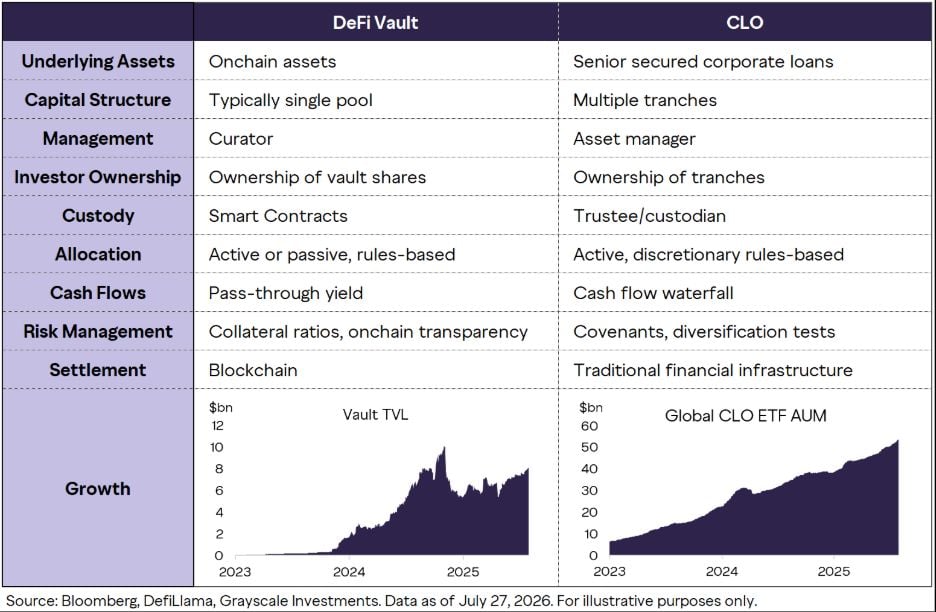
At their core, vaults are sophisticated smart contracts that pool capital from investors to execute specific yield-generation strategies. Unlike traditional investment funds, which rely on layers of human administrators, custodians, and middle-office staff, vaults operate autonomously. They are governed by code, overseen by "curators" like Steakhouse, Gauntlet, or Sentora, and audited in real-time on the blockchain.
The Comparison to CLOs
Grayscale’s Head of Research, Zach Pandl, has drawn a compelling parallel between these crypto-native vaults and Collateralized Loan Obligations (CLOs). In the traditional financial world, a CLO is a security backed by a pool of corporate loans. These loans are bundled together, and investors receive payments derived from the interest and principal of the underlying debt.
In the on-chain equivalent, the "pool" consists of digital assets or tokenized real-world assets (RWAs). Instead of an asset manager at a global bank, the strategy is managed by a decentralized protocol. This shift reduces management fees, increases transparency, and allows for near-instant settlement. For institutional investors, this represents a massive leap in efficiency.
Chronology: From Niche Experiment to Institutional Interest
The journey of on-chain vaults has been a gradual transition from experimental DeFi protocols to essential infrastructure.
- The Early DeFi Era (2020–2022): Vaults emerged as simple "yield aggregators." Protocols like Yearn Finance allowed users to automatically move funds into the highest-yielding lending pools. These were effective but largely limited to crypto-native assets.
- The Pivot to RWAs (2023): As the crypto market endured a protracted bear phase, the limitations of yield strategies based solely on volatile crypto assets became apparent. Projects like Ethena began exploring ways to diversify by incorporating traditional assets, such as AAA-rated CLO funds, into their yield-generation models.
- Institutional Integration (2024–2025): Major players began to recognize the utility of vaults. With the growth of tokenization, the distinction between "on-chain" and "off-chain" assets began to blur.
- The Current Landscape (2026): We have entered the era of institutional-grade curators. The market currently manages approximately $7.3 billion in assets, with 57 active curators and over 3,000 distinct vault strategies available to investors.
Supporting Data: The Concentration of Power and Potential
The current market for on-chain vaults is characterized by a high degree of concentration, a common trait in the early stages of a new financial product category.

Market Concentration
Data from recent reports indicates that the top three curators—Steakhouse, Sentora, and Gauntlet—command over 70% of the total assets under management (AUM). This concentration suggests that while the space is innovative, the market is currently gravitating toward trusted, professionalized entities that can provide the necessary security and strategic oversight required by larger capital allocators.
The $1.5 Trillion Opportunity
The ultimate prize for the vault market is the $1.5 trillion CLO market. CLOs are notoriously resilient; they are highly liquid and historically stable even during significant financial crises. By migrating even a small percentage of this market to the blockchain, vault protocols could see an exponential increase in AUM. S&P Global, in its latest outlook on digital assets, highlighted that as regulatory clarity improves, the "real-world asset" application of these vaults will likely become the dominant use case, effectively bridging the gap between TradFi and DeFi.
Official Responses and Regulatory Hurdles
The transition from a "wild west" crypto experiment to a legitimate financial product requires the blessing of regulators. This has been the most significant friction point for the growth of on-chain vaults.
The S&P Global Perspective
S&P Global has been vocal about the potential of these structures but has cautioned that institutional adoption remains stalled due to a lack of legal certainty. Specifically, they noted that many institutional investors are hesitant to engage because they cannot confirm the regulatory status of vault tokens. Are they securities? Are they commodities? The ambiguity currently acts as a "hard stop" for traditional firms with strict compliance mandates.
The SEC’s Evolving Stance
In July 2026, the U.S. Securities and Exchange Commission (SEC) provided a much-needed, if complex, update. The agency clarified that many vault designs would indeed fall under federal securities law. However, crucially, the SEC rejected a "blanket" classification. Instead, they signaled a move toward a case-by-case evaluation based on the specific architecture of the vault, its governance model, and how it distributes profit.
This shift—from total rejection to a nuanced, case-by-case review—is being viewed by industry analysts as a tacit acknowledgment that on-chain asset management is here to stay.
Implications: The Future of Capital Markets
What does this mean for the future of finance? The implications are threefold:
1. Democratization of Sophisticated Yield
Traditionally, the types of returns generated by CLOs were accessible only to institutional investors or high-net-worth individuals via private funds. On-chain vaults, by their very nature, are permissionless and accessible to anyone with a digital wallet. This democratizes access to sophisticated, credit-backed yields.
2. The Death of the "Middleman"
The traditional financial system is built on an expensive stack of intermediaries: custodians, brokers, fund administrators, and transfer agents. Every layer takes a fee. On-chain vaults replace this entire stack with a single, immutable smart contract. The cost-saving potential is not just incremental—it is transformative.
3. A New Standard for Transparency
In the traditional world, an investor in a CLO often has limited visibility into the specific loans being serviced. In an on-chain vault, every asset, every interest payment, and every transaction is recorded on a public ledger. This level of auditability could prevent the types of opaque risk-taking that led to the 2008 financial crisis.
Conclusion: Will the Vaults Go Mainstream?
The trajectory of on-chain vaults mirrors that of stablecoins and perpetual futures. Both began as niche, highly experimental tools used by crypto-natives, and both have since been adopted by global financial institutions.
While the regulatory environment remains the primary hurdle, the combination of institutional-grade curators (like Gauntlet and Steakhouse) and the clear efficiency gains offered by blockchain technology makes the mass adoption of vaults a matter of "when," not "if." As the SEC continues to clarify its oversight and as tokenized real-world assets continue to proliferate, the $7.3 billion vault market may well be the bedrock upon which the next generation of global capital markets is built.
For investors, the message is clear: watch the curators, monitor the regulatory filings, and prepare for a future where your investment portfolio is managed not by a banker in a suit, but by a transparent, efficient, and unstoppable piece of code.
