

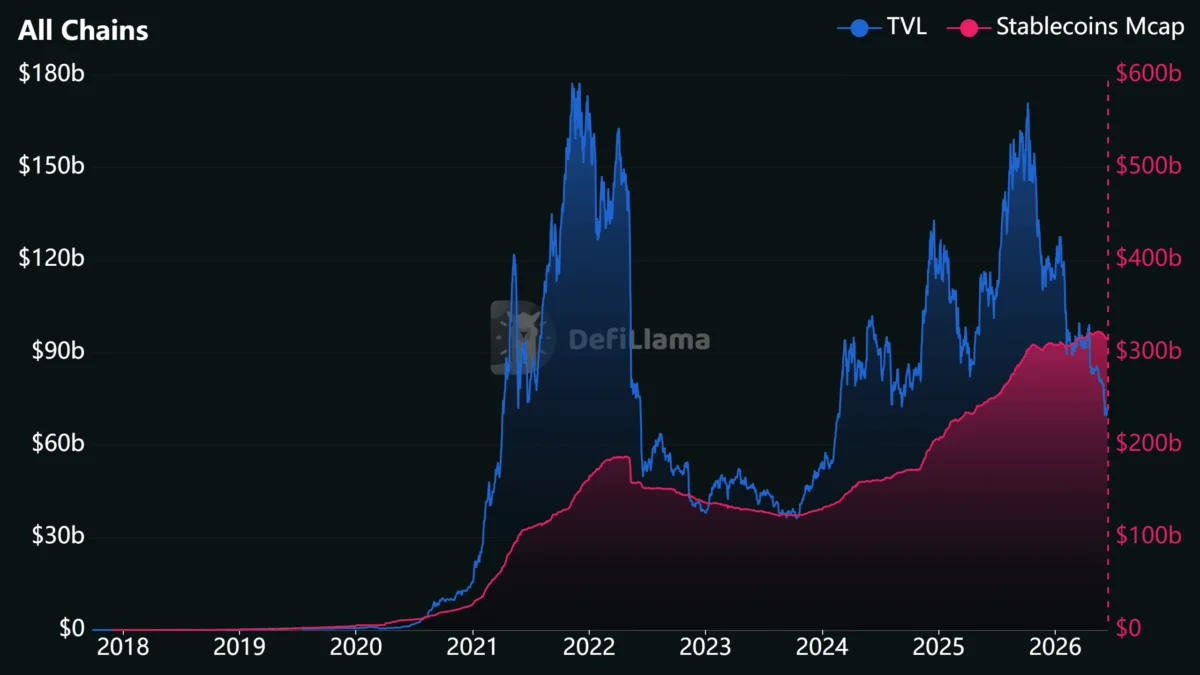
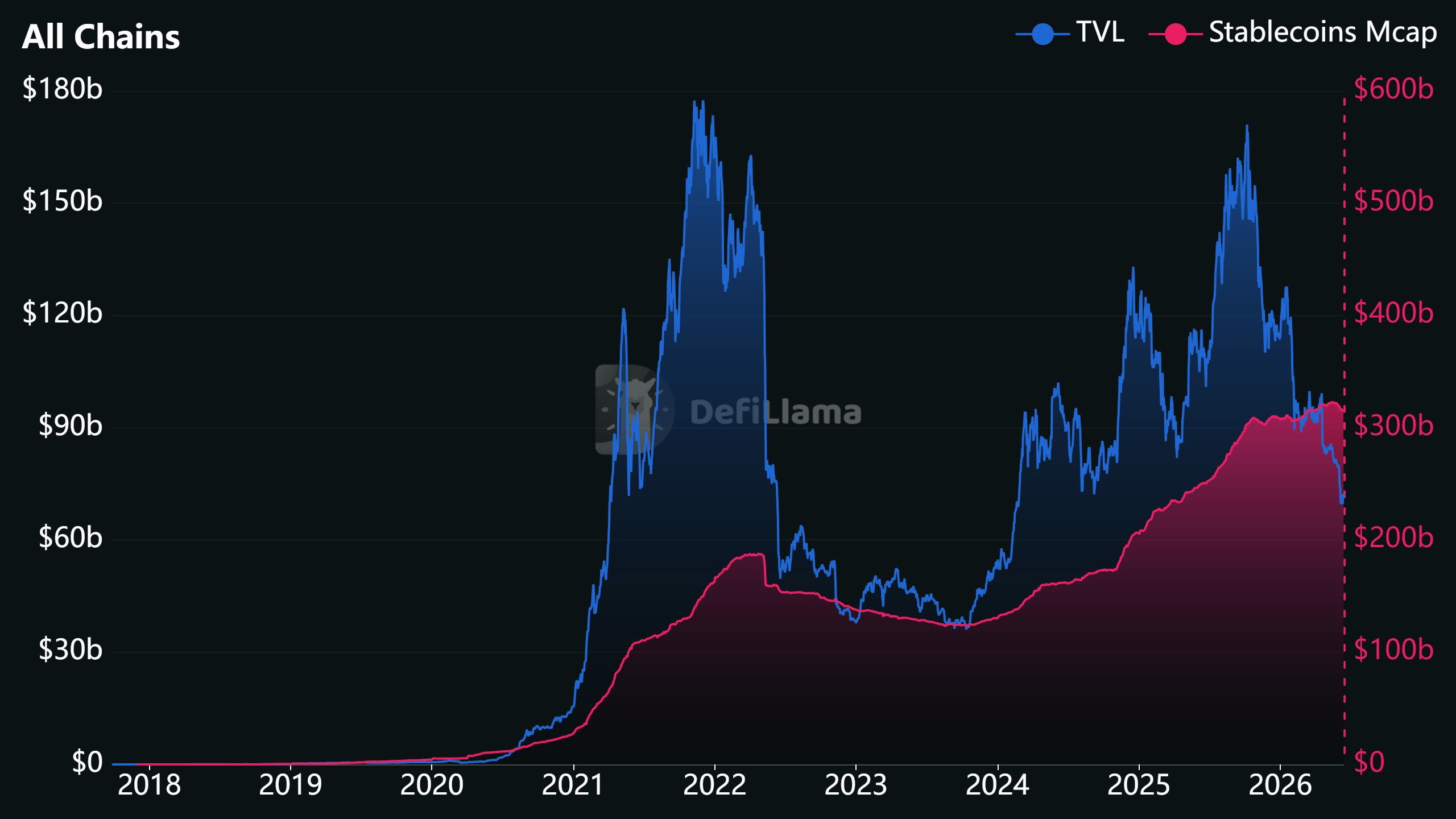
The decentralized finance (DeFi) landscape is undergoing a profound structural shift. According to data from DeFiLlama, the ecosystem’s Total Value Locked (TVL) has experienced a precipitous decline, plummeting from a late-2025 peak of approximately $178 billion to a current valuation hovering near $72.5 billion. This contraction is not confined to a single niche or protocol category; rather, it is a broad-based retreat that spans lending markets, liquid staking derivatives, and cross-chain bridge protocols.
For market observers, this trend represents more than just a fluctuation in asset prices. It signifies a fundamental reassessment of risk and reward within the crypto-economy. As capital exits active DeFi protocols, the industry finds itself at a crossroads: is this a temporary lull, or a permanent re-calibration of how decentralized capital is deployed?
Main Facts: The Anatomy of the Contraction
The current state of the DeFi market is defined by a striking paradox. While the TVL—a primary metric for measuring the health of the DeFi ecosystem—has effectively halved, the broader crypto-market liquidity remains surprisingly robust. Stablecoin supply, often viewed as the "dry powder" of the crypto world, remains stable at approximately $315 billion.
This decoupling suggests that the capital has not exited the cryptocurrency ecosystem entirely. Instead, it has been withdrawn from active, yield-bearing DeFi positions and migrated into more passive or secure holdings. Investors are not necessarily "cashing out" into fiat; they are "de-risking" their portfolios.
The decline is systemic, affecting the three pillars of DeFi:
- Lending Protocols: Reduced borrowing demand has led to lower utilization rates.
- Liquid Staking: A reduction in the velocity of capital as users opt for native staking over wrapped derivative strategies.
- Bridge Protocols: A significant cooling in cross-chain movement, as users show increased hesitation toward the security risks inherent in bridging assets.
Chronology: Tracking the Decline (Late 2025 – Q2 2026)
To understand the current malaise, one must look at the timeline of the last nine months.
- Q4 2025 (The Peak): The DeFi market reached an apex of $178 billion. This period was characterized by "yield farming mania," where high incentives and low-interest rate environments in traditional finance drove a massive influx of capital into experimental protocols.
- Q1 2026 (The Initial Softening): As macroeconomic pressures began to mount and the novelty of certain inflationary incentive models wore off, the first signs of stagnation appeared. TVL began a slow, steady descent as protocols struggled to maintain competitive APYs.
- April – May 2026 (The Security Crisis): The downward trend accelerated sharply following a series of high-profile security incidents. In the span of just two months, nearly 70 distinct protocols reported exploits, resulting in cumulative losses of approximately $746 million.
- June 2026 (The Consolidation Phase): Currently, the market is in a period of consolidation. Investors are exhibiting extreme caution, prioritizing the safety of underlying layer-one assets over the chase for double-digit yields.
Supporting Data: The Risk-Reward Mismatch
The primary driver of this capital flight is a compressed yield environment. On major lending platforms, stablecoin lending rates—which were once the bread and butter of the DeFi yield farmer—have compressed into a range between 3.5% and 9%.
When factoring in the inherent risks of DeFi—which include smart contract vulnerabilities, liquidity fragmentation, and potential liquidation events—a 5% return is often viewed as insufficient compensation by sophisticated liquidity providers.
The Security Factor
The $746 million in losses during the second quarter of 2026 cannot be overstated. While individual incidents were smaller in scale compared to the catastrophic "mega-hacks" of previous cycles, the sheer frequency of these breaches has eroded institutional and retail confidence. When users perceive that the risk of total loss is no longer an "edge case" but a consistent threat, the cost of capital effectively becomes prohibitive.
Stablecoin Liquidity
The fact that stablecoin supply holds firm at $315 billion is the most critical data point. It confirms that the liquidity is available; it simply lacks a destination that meets current investor risk-appetite thresholds. The market is waiting for either a higher-yield environment or a significant maturation in security infrastructure before re-deploying this $315 billion.
Official Responses and Market Sentiment
While no single "official" entity governs the entirety of DeFi, industry leaders and major protocol developers have begun to address the shift.
A consensus is forming among core developers that the "DeFi 1.0" model—defined by massive token emission rewards—is effectively dead. "The market has grown up," noted a lead developer of a top-tier lending protocol. "Users are no longer blindly chasing 20% APYs if those yields are subsidized by volatile governance tokens. They want real, sustainable, protocol-generated revenue."
Furthermore, audit firms and security-focused DAOs have ramped up their calls for more rigorous code-verification standards. There is a growing movement to transition from "move fast and break things" to a "security-first, audit-heavy" deployment lifecycle. This cultural shift, while positive for long-term health, contributes to the current slowdown as new product launches are delayed in favor of intensive security reviews.
Implications: The Divergence of Network Conviction
Perhaps the most fascinating aspect of the current downturn is the resilience of layer-one assets. Despite the contraction in protocol-level TVL, Ethereum (ETH) and Solana (SOL) continue to see massive engagement in native staking.
- Ethereum: Roughly one-third of the total ETH supply remains locked in staking contracts.
- Solana: Staking participation currently sits near 68%.
What This Means for the Future
This divergence indicates a shift in the investor’s mental model. DeFi is no longer seen as a monolithic "up-only" sector. Instead, we are witnessing a transition where users have high conviction in the networks themselves (Ethereum and Solana) but are deeply skeptical of the protocols built on top of them.
The implication is clear: The next generation of DeFi will likely be characterized by:
- Institutional-Grade Security: Protocols that can prove their security through formal verification and insurance-backed reserves will attract the bulk of the idle $315 billion.
- Real Yield: A move away from inflationary token incentives toward models that generate yield from actual trading fees, real-world asset (RWA) interest, and protocol-specific revenue.
- Selective Participation: Investors will become increasingly discerning, moving capital only into "blue-chip" protocols that have survived multiple cycles and proven their resiliency under stress.
Conclusion
The DeFi ecosystem is not collapsing; it is shedding its excesses. The reduction in TVL from $178 billion to $72.5 billion is a painful, yet necessary, purging of speculative capital that was never sustainable to begin with. While the current environment of low yields and high security concerns has caused a retreat, the underlying infrastructure remains robust.
The presence of $315 billion in stablecoin liquidity confirms that the industry is merely in a holding pattern. The capital is not gone; it is waiting. When the risk-reward ratio resets—either through higher yields in a changing macroeconomic landscape or the maturation of more secure, reliable DeFi primitives—this liquidity will find its way back into the ecosystem. Until then, the focus will remain on preservation, security, and the long-term sustainability of the foundational blockchain networks that support the decentralized dream.
