

In the rapidly evolving architecture of global cryptocurrency markets, stablecoins have emerged as the foundational bedrock of liquidity. As of mid-2026, the data emanating from major exchanges—most notably Binance—reveals a significant structural shift in how these digital assets are held and deployed. While Binance continues to anchor the ecosystem with massive reserves, the internal composition of those reserves is undergoing a transformation that carries profound implications for the broader market.
The Main Facts: A Divergence in Reserve Composition
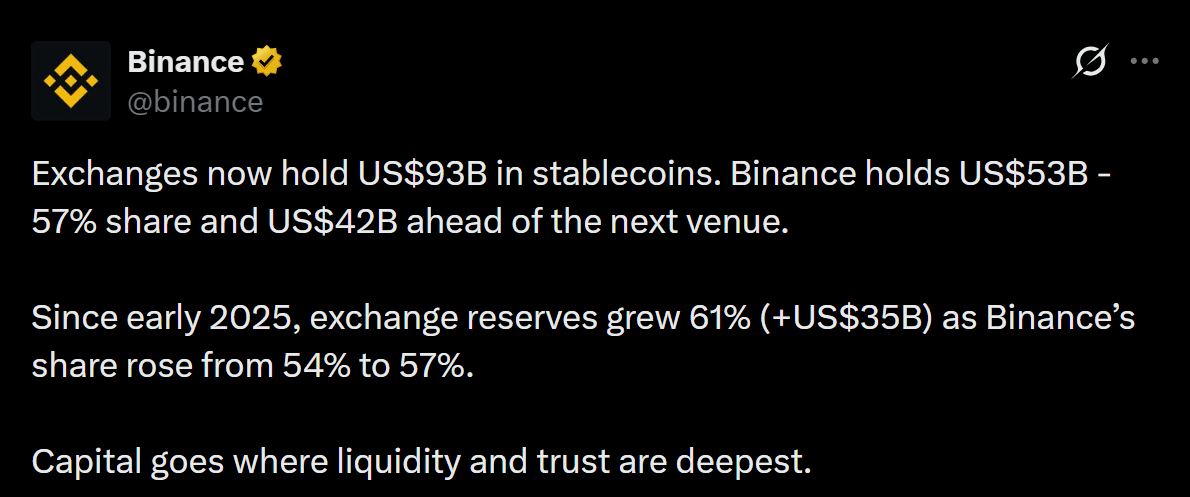
Binance remains the undisputed titan of exchange-held liquidity, maintaining approximately $53 billion in stablecoin reserves. This figure represents a staggering 57% of the total $93 billion held across major centralized exchanges. The growth trajectory for these reserves has been aggressive; since the dawn of 2025, Binance has bolstered its stablecoin holdings by $35 billion, a 61% surge that underscores the exchange’s entrenched position in the global trading infrastructure.
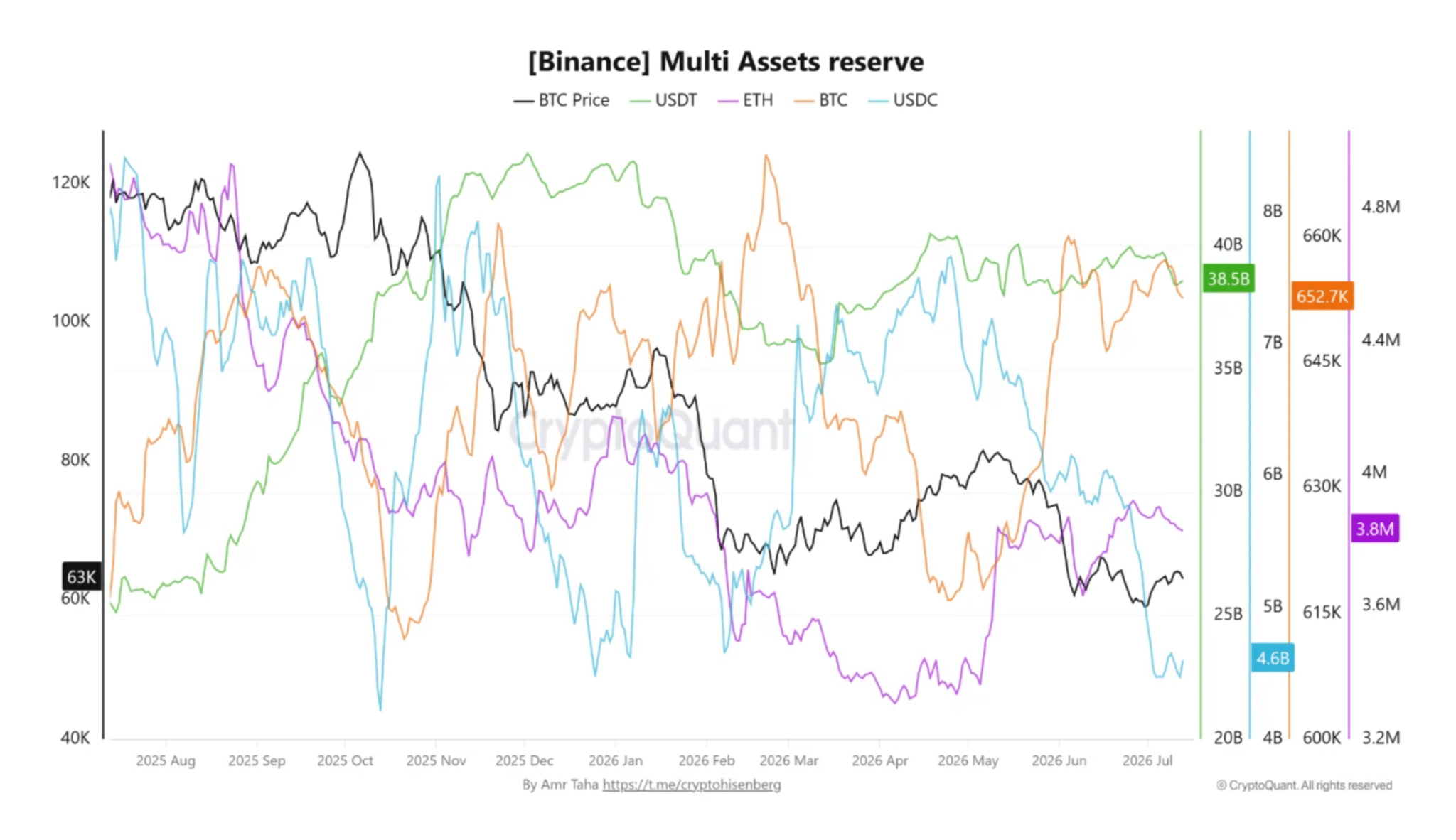
However, beneath this veneer of stability, a distinct divergence has emerged regarding the preference for specific assets. The two primary pillars of the stablecoin market, Tether (USDT) and USD Coin (USDC), have seen their fortunes on the Binance platform decouple. Tether, the industry’s most traded stablecoin, has maintained a dominant, steady reserve of $38.5 billion. Conversely, USDC—often favored for its regulatory transparency and U.S.-based oversight—has suffered a contraction. Reserves of USDC on Binance have plummeted by 40.3%, sliding from $7.7 billion to a current level of approximately $4.6 billion.
This leaves a chasm of nearly $33.9 billion between the two assets within Binance’s coffers. The market interpretation of this shift is clear: traders and institutional market makers are signaling a definitive preference for USDT as their primary vehicle for settlement and collateral, a move that effectively relegates USDC to a secondary role on the world’s largest exchange.

Chronology of the Shift
To understand the current state of play, one must look at the timeline of events that have defined the 2025-2026 period.
- Early 2025: The market witnessed a period of optimistic growth. Stablecoin reserves across major exchanges began an upward climb as institutional interest, spurred by the maturation of crypto-linked financial products, drove capital inflows. During this phase, USDC saw competitive gains as a preferred stablecoin for institutional "on-ramping."
- Late 2025: The momentum began to shift. Market participants began favoring the deep liquidity and expansive pair availability associated with USDT. The "flight to liquidity" saw traders consolidating their balances into Tether to ensure faster execution times and lower slippage across a broader array of altcoin trading pairs.
- Mid-2026 (The Current State): The first half of 2026 has been marked by a reversal of the early-2025 gains for USDC. As Binance solidified its market share, the ecosystem’s reliance on USDT grew, leading to the current ~40% depletion of USDC reserves. This period has also marked a trend toward the redistribution of stablecoins from "whale" wallets into more diverse, fragmented holdings across the ecosystem.
Supporting Data: Analyzing the Distribution of Wealth
Data provided by analytics firms such as CryptoQuant and Santiment offers a granular view of how capital is moving. The trend is not merely about which stablecoin is being held, but who is holding them.
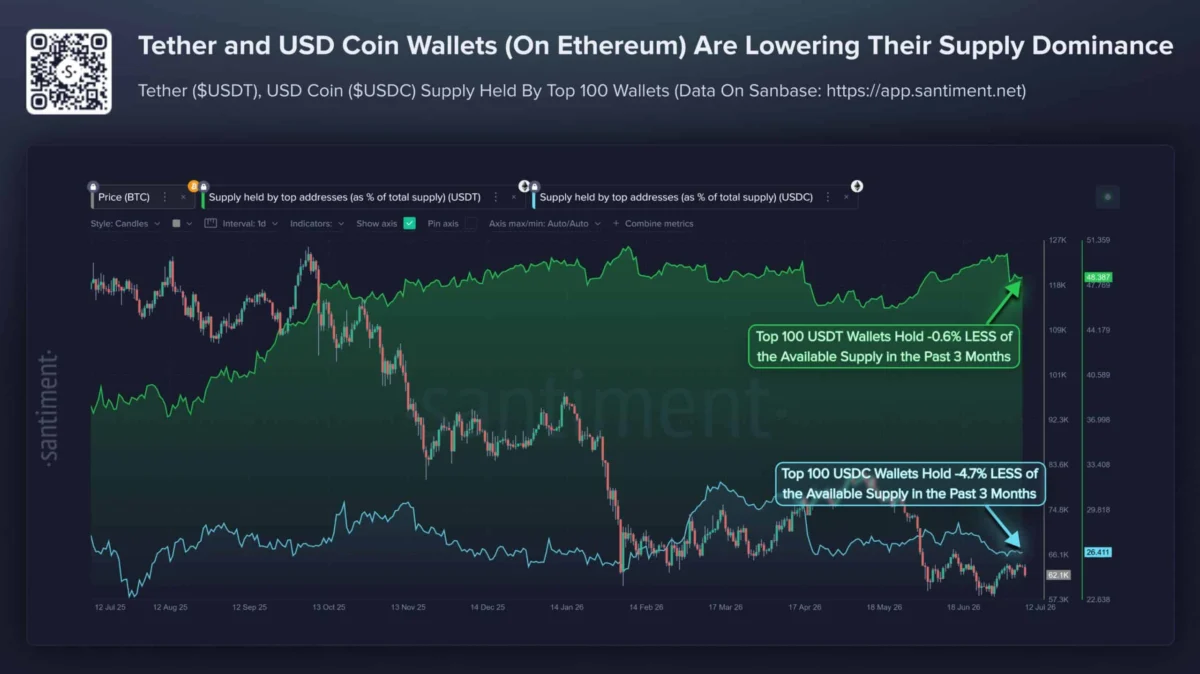
A critical observation from the last three months is the reduction in concentration among the largest wallet addresses. The top 100 USDT wallets have seen their total share of the circulating supply decrease by 0.6%. More dramatically, the largest USDC wallets have shed 4.7% of their share of the total supply.
This data suggests a move toward "democratization" of stablecoin liquidity. Rather than being siloed in the coffers of a few institutional whales or exchange-controlled hot wallets, capital is increasingly dispersing across a wider spectrum of participants, including decentralized finance (DeFi) protocols, retail investors, and smaller institutional desks. This distribution is, in theory, a bullish sign for market health. By reducing the reliance on a handful of large, concentrated holders, the market becomes less susceptible to liquidity shocks triggered by the actions of a single entity.
Institutional and Market Implications
The concentration of stablecoin reserves on Binance—and the subsequent dominance of USDT—creates a "network effect" that is difficult for competitors to dislodge. When liquidity is concentrated, the exchange becomes the most efficient venue for large-scale trading. As USDT becomes the primary settlement currency, it creates a self-reinforcing loop: traders hold USDT to trade on Binance, which attracts more volume, which in turn necessitates higher USDT liquidity.
However, there is a looming question regarding the broader market impact. With over $312 billion in total stablecoin supply, the "dry powder" is significant. Yet, as noted in recent market sentiment, risk asset accumulation has been sluggish. This indicates that while the liquidity exists, the risk appetite for aggressive deployment into volatile assets remains tempered.
The primary implication is that current market participants are in a "wait-and-see" mode. The abundance of stablecoins on exchanges acts as a coiled spring, but it requires a catalyst—perhaps a shift in interest rate policy, regulatory clarity, or a breakout in primary assets like Bitcoin—to move from idle reserves to active trading capital.
The Road Ahead: Liquidity vs. Participation
For the market to transition from its current state of "sidelines liquidity" to a sustained bull rally, the metrics of participation must evolve. Broadening the distribution of stablecoins is a necessary first step toward resilience, but it is not a sufficient condition for a price explosion.
Analysts are now turning their attention to secondary indicators:
- Active Address Growth: Are the wallets holding these stablecoins actually transacting?
- Velocity of Money: How quickly is capital circulating through DeFi protocols versus sitting in exchange-based earn products?
- ETF and Institutional Flows: How much of this stablecoin liquidity is being bridged into traditional financial instruments versus remaining within the native crypto ecosystem?
While the current liquidity foundation is the strongest the market has ever seen, the "next leg" of the market depends entirely on the willingness of investors to deploy their capital. The shift toward USDT on Binance has streamlined the operational side of trading, but the psychological hurdle of market volatility remains.
Conclusion: A More Resilient Foundation
The shift in Binance’s reserve mix is more than just a preference for one asset over another; it is a testament to the maturation of the cryptocurrency market. The migration of capital from concentrated whale wallets to a more distributed network of users indicates a maturing investor base that is increasingly comfortable with diverse participation.
While the dominance of USDT remains a point of focus for regulators and market observers alike, the sheer volume of stablecoin reserves ensures that the market is well-equipped for the next cycle. Whether this leads to a new rally depends not on the existence of the capital, but on the shift from passive holding to active market participation. For now, the "dry powder" remains in place, waiting for the signal to ignite the next chapter of the digital asset era.
