

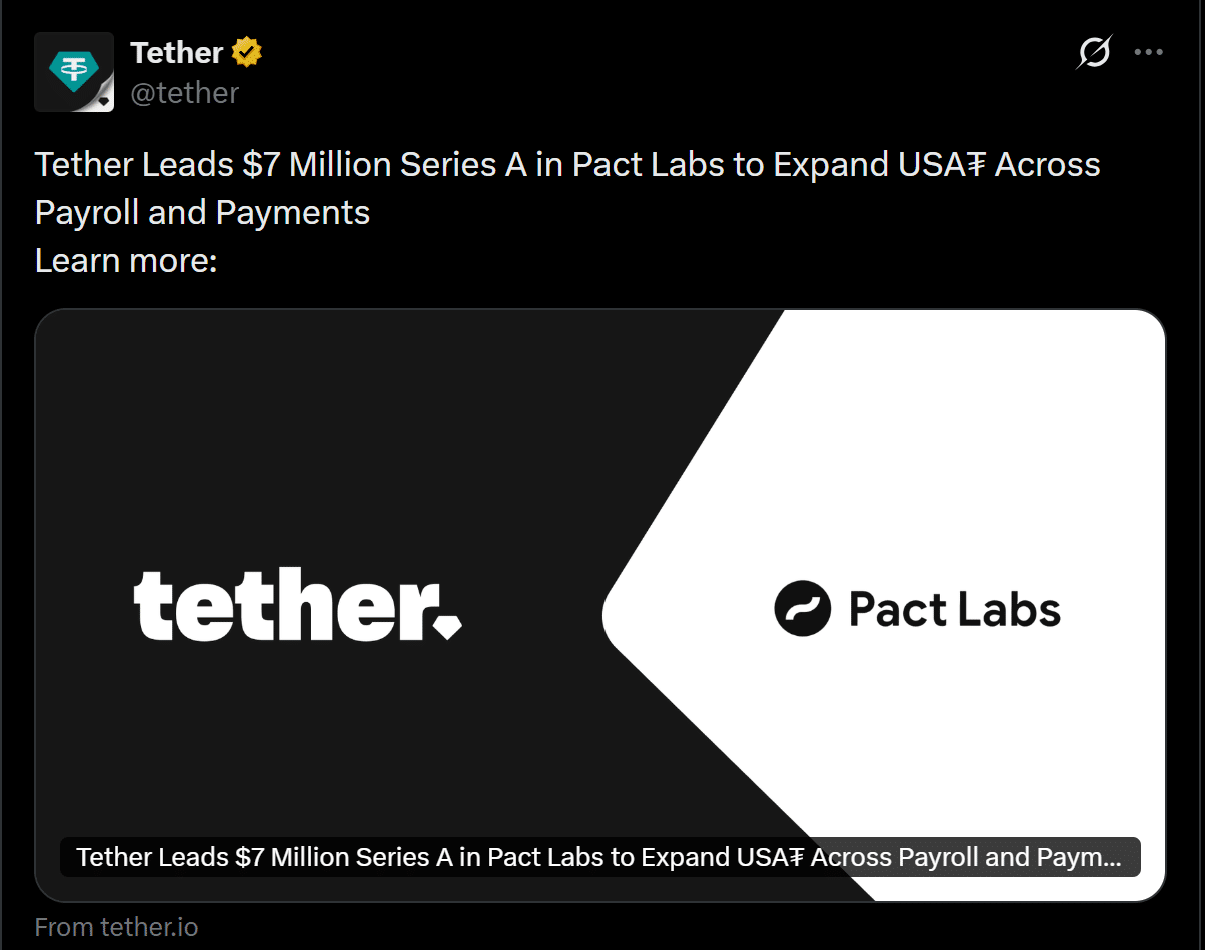
In a definitive shift that marks a new chapter for the world’s largest stablecoin issuer, Tether is aggressively transitioning its focus from the volatile theater of cryptocurrency trading markets toward the bedrock of everyday financial infrastructure. By leading a $7 million Series A funding round for Pact Labs, Tether is signaling a clear intent to dominate the multi-trillion-dollar payroll, earned wage access (EWA), and real-time payments sectors through its proprietary network, USA®.
This strategic pivot represents more than a mere expansion of services; it is a structural redesign of how stablecoins function within the global economy. By targeting the $11 trillion U.S. payroll system—a sector long hampered by legacy banking inefficiencies and sluggish settlement times—Tether is attempting to bridge the gap between decentralized finance (DeFi) and the utilitarian needs of the modern workforce.
Main Facts: The Intersection of Payroll and Blockchain
The core of Tether’s new strategy lies in solving the "settlement lag." Currently, the U.S. financial system relies on decades-old infrastructure that forces employees to wait days for wages to clear, a bottleneck that disproportionately affects liquidity for millions of workers. Tether’s integration with Pact Labs aims to replace these antiquated clearinghouses with instantaneous, blockchain-based settlement.
By leveraging USA®, Tether is not merely providing a digital currency but is actively building a payment rail designed for high-frequency, low-latency transaction flows. Unlike speculative trading, which relies on market sentiment, payroll-based stablecoin demand is driven by recurring human activity. This shift from "speculative volume" to "utility volume" provides Tether with a more stable, predictable revenue stream and positions its stablecoin as a fundamental component of the global labor economy.
Chronology of a Strategic Evolution
Tether’s path to this point has been a calculated progression, moving from a niche tool for crypto-traders to a pervasive financial asset.
- The Foundation Years: Tether established USDT as the liquidity lifeblood of the global crypto-exchange ecosystem, proving that dollar-denominated digital assets could maintain parity under immense market stress.
- The Infrastructure Expansion: Recognizing the limitations of relying on third-party networks, the company began investing in its own blockchain infrastructure, culminating in the development of Stable, a USDT-native Layer 1 network.
- The Compliance Pivot: Understanding that institutions would never adopt a "wild west" financial system, Tether initiated deep-tech partnerships with surveillance firms like Chainalysis to integrate real-time transaction screening and entity monitoring.
- The Payroll Incursion: In July 2026, the $7 million investment in Pact Labs served as the catalyst for the current phase, moving stablecoins directly into the payroll and wage-access verticals.
This chronology illustrates a clear trajectory: Tether is systematically removing the barriers—technological, regulatory, and practical—that prevent stablecoins from being viewed as "real money" by mainstream corporations and the public sector.
Supporting Data: The Case for On-Chain Payroll
The sheer scale of the opportunity is difficult to overstate. The U.S. payroll system processes more than $11 trillion annually, yet a significant portion of this capital remains locked in transit due to the Batch Processing cycles of the ACH (Automated Clearing House) system.
Stablecoin adoption, by contrast, offers "atomic settlement." When a company issues a payroll payment on a blockchain, the funds are available to the employee in seconds, regardless of weekends or bank holidays.
Tether CEO Paolo Ardoino recently articulated the rationale behind this expansion, noting that, "This confirms what our transaction data has shown for years: the demand for dollar-denominated settlement is a wages story." The data suggests that as global inflation persists and legacy banking becomes more expensive, the utility of a digital dollar—which is both programmable and near-instant—becomes increasingly attractive to both employers seeking to reduce overhead and employees seeking immediate access to their hard-earned money.
Official Responses and Institutional Validation
The success of this endeavor depends heavily on institutional trust, which is why the integration of Chainalysis has been a cornerstone of Tether’s expansion. As institutions contemplate moving large-scale transactional volume on-chain, they require the same level of oversight provided by traditional banking systems.
Chainalysis provides this through real-time transaction screening, rigorous entity monitoring, and sophisticated fund flow analysis. By embedding these tools into the Stable Layer 1 network, Tether has effectively created a "compliant-first" ecosystem. This institutional-grade security framework is designed to satisfy regulators and corporate risk departments, effectively neutralizing the common critique that stablecoins are primarily tools for illicit activity.
The support for additional ERC-20 and ERC-721 tokens on the Stable network further enhances this utility, allowing for a broader range of financial assets to move across the same rails that handle payroll. This creates a "network effect" where the more institutions that join, the more secure and reliable the infrastructure becomes for everyone involved.
Implications for the Future of Finance
The implications of Tether’s move into payroll are profound for both the crypto industry and the broader financial sector.
1. From Speculation to Utility
For years, the crypto industry has struggled with the perception that its assets have no "real-world" use case. By embedding stablecoins into the payroll cycle, Tether is grounding its utility in the most basic economic activity: earning a wage. This shift is likely to insulate the stablecoin market from the boom-and-bust cycles of Bitcoin and other volatile assets.
2. Disruption of Legacy Banking
If Tether’s infrastructure can successfully capture even a fraction of the $11 trillion U.S. payroll market, it will pose a direct challenge to the traditional banking sector’s dominance over payment rails. Banks rely on the time-value of money trapped in transit; real-time settlement on the blockchain eliminates this, forcing banks to rethink their own technological offerings or face obsolescence.
3. The Compliance Catalyst
Compliance is no longer a hurdle; it is the competitive advantage. By embracing stringent, automated compliance, Tether is effectively rebranding itself as a technology-first financial utility. This could pave the way for wider regulatory acceptance, potentially leading to stablecoins being integrated into government-backed projects or large-scale corporate enterprise resource planning (ERP) systems.
4. Enterprise Integration and "The Pilot Trap"
The primary hurdle remaining is the transition from pilot programs to full-scale adoption. For USA® to move beyond being a "niche payment alternative," enterprises must commit to significant volume. We are currently watching a transition phase: businesses are testing the technology, but widespread reliance on blockchain for payroll will require a level of trust that only time and perfect uptime can provide.
Conclusion: The New Financial Backbone
As Tether pushes further into the everyday financial lives of citizens, it is simultaneously rewriting its own identity. It is no longer just a "crypto company" but is evolving into a provider of global financial infrastructure.
The competitive advantage in the coming decade will not belong to the networks that launch the most tokens or host the most meme-coins; it will belong to the networks that successfully capture the recurring payment flows of the real economy. By positioning itself at the center of payroll, earned wage access, and real-time settlement, Tether is ensuring that it remains the default rail for the digital dollar.
Whether this experiment leads to a wholesale transformation of the payroll industry or remains a secondary option for tech-forward companies remains to be seen. However, one thing is certain: the race to build the next generation of financial infrastructure is well underway, and stablecoins are no longer standing on the sidelines—they are being built into the very foundation of the global workforce.
